Tag: Fluid mechanics

Electrostatic Precipitators

Electrostatic Precipitators

Electrostatic Precipitators

12/25/17

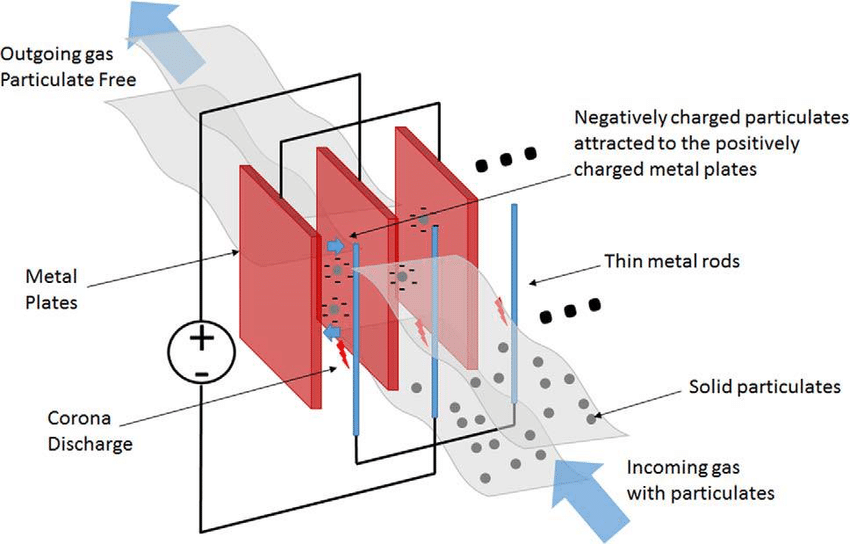
“How can we remove fine particles from a gas without contact?”


When a gas is being transported for use, it often has many fine particles (such as dust and smoke) attached, which can induce health issues. Traditional methods of removing these particles involve using physical barriers to filter out all particles. However, this has the effect of disrupting the flow of the gas. So how can we use our engineering mindset to solve this problem? Well, we know that from fundamental physics that there are two types of forces (contact and distance). And we also know that the latter can be caused by either gravitation, electrical, or nuclear interactions. And these fine particles in the gas are susceptible to become polarized and become at the whim of electromagnetic interaction. So what if we were to simply implement electromagnetic plates perpendicular to the flow of a gas, and suck up all of the fine particles while keeping the gas itself intact? Well, this is the fundamental idea behind Electrostatic Precipitators and are used in industries all around the world.

Cooling Towers

Cooling Towers

Cooling Towers

12/20/17

“How can we cool a large flow of water?”


Water is often used to cool buildings. However, during the process, it absorbs heat from its surroundings, thereby warming it up and making it less usable for future use. So how can we ensure that this water can be cooled down to usable levels? Well, let us use our engineering mindset to find out. We know that if water comes into contact with surrounding air, it will cool down a bit, and some may even evaporate. So what if we were to take our stream, move it through condensers, causing some to evaporate and the rest to cool down to a workable state? Well, this technology is known as cooling towers and is used in industrial processes all over the world.

Head Loss In Fluids

Head Loss In Fluids

Head Loss In Fluids

12/19/17

“How do fluids lose potential due to viscosity?”


Understanding of fluids has led to some of the most important breakthroughs in engineering. However, when analyzing these systems, it is very important to take into consideration that viscous forces will act upon the fluid in transit. So how can we take this into account? Well, what if we were to just take into account all of the losses from both frictional and inertial changes? This is known as the head loss in fluids and is one of the most important foundations of one’s study of fluid mechanics. Head loss can be visualized by the pressure drop in a manometer like the one shown in the picture.

Air Standard Assumptions

Air Standard Assumptions

Air Standard Assumptions

12/06/17

“What are the common assumptions for analyzing Power engines?”


Power engines are very complex machines. As such, we will have to simplify them a bit when performing analysis. So how can we use our engineering mindset to solve this problem? Well, let’s make some assumptions. First Since these systems are fluid based, and the air is the simplest fluid to analyze, let’s say that air is the primary working fluid. Second, let’s say that all processes are ideal and reversible. Third, have combustion is modelled by a heat addition process. Fourth finally, let the exhaust process is a heat rejection process. These are known as the Air Standard Assumptions and are some of the most fundamental aspects of thermodynamics

Anti-Bourdon Tubes

Anti-Bourdon Tubes

Anti-Bourdon Tubes

12/03/17

“How can we improve upon the Bourdon tube design?”


Bourdon tubes are excellent for measuring pressure in a pipe. However, due to their C shaped geometry and oval cross-section, they can be difficult to manufacture. So how can we use our engineering mindset to solve this problem?


Well, luckily for us, there is a solution out there called an Anti-Bourdon Tube. An Anti-Bourdon tube has an initial circular cross-section and straight body.  However, the hole is not centered in the center of the tube and is instead located more towards another side. When fluid is used to fill the device, the tube will expand and bend towards the thicker side. This bending motion can then be used to turn a gear to read the pressure. Anti-Bourdon Tubes are easier to fabricate than their regular counterparts, making them a good choice for pressure measurement projects.

Bourdon Tubes

Bourdon Tubes

Bourdon Tubes

12/02/17

“How can we measure a tube’s pressure without sensors?”


Most engineering systems built in the modern day use a great variety of sensors to achieve quick and easy measurement. However, how can we accomplish a pressure measurement in a tube using more old-fashioned methods? Well, let’s use our engineering mindset to learn more about a shrewd device known as a Bourdon tube.


Bourdon tubes work as follows. A hollow, oval-shaped tube will be wrapped in a “C” shape. As air moves into the tube, the profile will fill into a circular geometry, causing a contraction. When the end of the “C” moves downward, a link connected to a sector/pinion will move, turn a gear that turns a pressure dial which allows users to read the measurement of the total pressure.     


In a way, Bourdon tubes are fundamentally like an inflatable glove. When air goes through, the hand will inflate and turn the dial.


Pitot Tubes

Pitot Tubes

Pitot Tubes

11/29/17

“How can we measure the velocity of a fluid without using any moving parts?”


Measuring the velocity of a fluid is one of the most useful things we can do. With this, we can find out how much mass is flowing within a system, and adjust all calculations accordingly. But since fluids lack any form of defined shaped, measuring their average velocity can be very difficult. So how can we use our engineering mindset to solve this problem? Well, to begin, let’s look at how pressure moves within a system. A fluid’s total pressure is made of up both static pressure (the default, inert pressure) and velocity pressure (the pressure associated with the momentum of the fluid).


Since it is rather simple to obtain the total and static pressures and use their values to find the final velocity, let’s build a machine to do exactly that. Since fluids move steadily through a pipe, let’s start with that. And since we want to find the total velocity of a fluid, let’s also put the fluid through the hole. Then let’s also have holes perpendicular to the main tube to measure the static pressure. Then let’s subtract the difference to get the velocity pressure, and divide by the fluid’s density to obtain the fluid velocity. This machine is known as a pilot tube and is used widely in airplanes to measure the airspeed and HVAC systems to find the refrigerant flow rate.

Water Cooling

Water Cooling

Water Cooling

11/28/17

“How can we remove without using a gas?”
When most people think of a heat removal device, they probably visualize a fan based systems which released cooled air. However, using a gas can be hard to control, and may also require a lot of room. So how can we use our engineering mindset to solve this problem? Well, what if we were to replace the primary medium with a liquid, such as water? This would allow us to take advantage of water’s higher specific heat capacity, density, and thermal conductivity to optimize efficiency while ensuring that operations are non-toxic and inexpensive. This increased capacity made water cooling very popular in computer and automotive hardware enthusiasts since this process takes less space and can deliver more cooling. On the downside, using water might accelerate corrosion in metallic substances.

Wind Tunnels

Wind Tunnels

Wind Tunnels

11/16/17

“How can we analyze how objects fly without flying?”


Whether it be the drones used to deliver boxes, planes to fly across the world, or satellites launched into space, flight has revolutionized human society. As such, these systems need to be tested rigorously before operation. But doing in-flight analysis is not only difficult but expensive. So how could we use our engineering mindset to solve this problem? To begin, let’s think about what makes in-flight analysis so improbable. After searching, we should find that it’s controlling the and maintaining the vehicle while in flight moving with respect to the wind. But we also know from basic physics that one object moving against another object in a frame of reference in respect to a stationary object is the same as the latter moving while the former is static. So logically, if we can control the wind and keep the machine stationary, the analysis should be the same or similar. And if we can take from our HVAC systems knowledge then we know that we can control airflow using a VAV setup. So how about we construct a facility that can hold an object in a steady position while the air blows on it? Well, this is known as a wind tunnel, and is employed by NASA to simulate drag on their aircraft!