Tag: Mechanical Engineering

How materials in a composite bond

How materials in a composite bond

How materials in a composite bond

06/06/17

“How do materials in a composite bond with one another?”


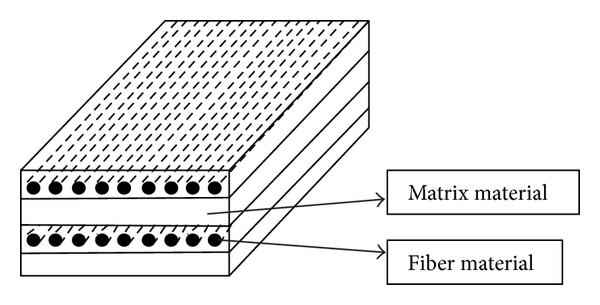
In all composites, there are two bonding materials. However, have you ever wondered how exactly do they bond with another without merging? Well, let’s use our engineering mindset to find out. If we look closely, then we will notice that one material (known as the “matrix” or “continuous” material will serve as a medium that surrounds the other material (known as the “discontinuous” or “fiber” material), therefore creating the composites that we know and love!
Bomb calorimeters

Bomb calorimeters

Bomb calorimeters

06/02/17

“How can we measure the calories present in food?”


In our modern health obsessed world, we would like to know the calories contained in all foods. However, how can this even be determined in the first place? Well, let’s think back to a bit of prior knowledge. We know that calories are another way of saying energy and that we can measure the energy content of fuels using calorimeters. So what if we were to make a special type of calorimeter to find the energy contained in foods? Well, let’s put our engineering mind to the test.


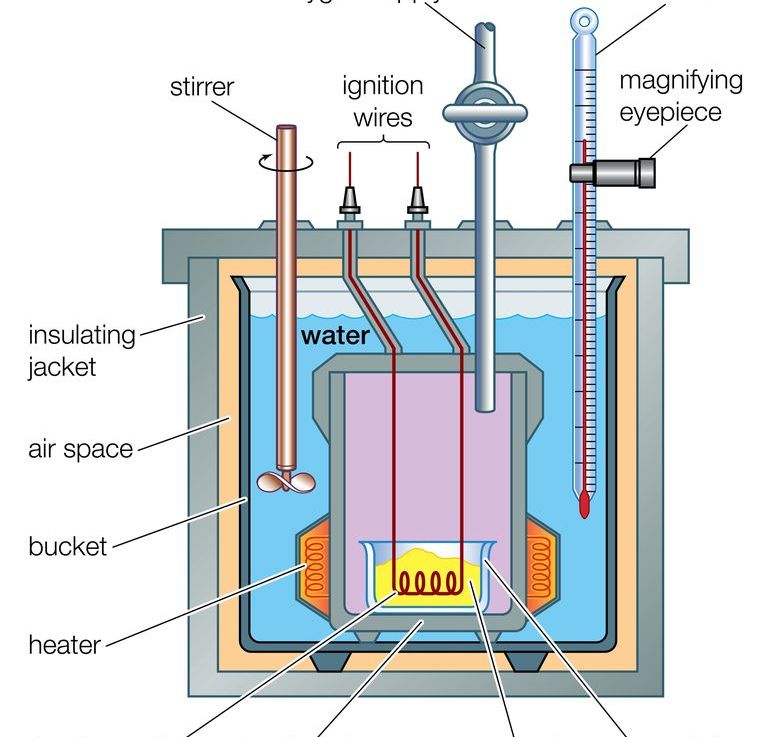
First, let’s get a big tub of water. Then, let’s take a sample of our food, place it in an insulating case with some oxygen, attach it to an ignition coil, and place everything in the water. When we activate the ignition unit, the ignition coil will cause our sample to explode and raise the temperature of the water. From the measured temperature change, we will be able to measure the calories contained in the sample! This device is known as a bomb calorimeter and is used in food labs all over the world.

Electro-hydraulic actuators

Electro-hydraulic actuators

Electro-hydraulic actuators

05/29/17

“Can we optimize hydraulic actuators using electricity?”


Hydraulic actuators are ever so useful in their ability to move heavy machinery and can found in areas ranging from construction equipment to manufacturing machinery. However, these machines often suffer from a burdensome design, being forced to integrate numerous disparate components into one coherent system.


So how can we simplify the operation of these actuators?


Well, what if we were to replace the hydraulic pumps and tubing with electrical power? Not only will this simplify the system complexity but also increase the internal safety and reliability. These machines are known as electro-hydraulic actuators and can be found in applications ranging from aerospace vehicles to automobiles.

Scratch tests

Scratch tests

Scratch tests

05/26/17

“How can we determine the fracture strength and resistance of a material using simple devices?”


Determining the fracture strength and resistance of a material is of the utmost practical use to the engineering profession. However, how exactly can figure them out experimentally in a cost-wise fashion? Well, let’s think about this using our engineering mindset. We already know the strength of many other materials. And we also know that if one material is able to scratch another, then it is the stronger of the two. So what if we were to take this method and use it to organize all of the different materials we know? Well, this is the fundamental idea behind the scratch test, and it is used for economically conscious projects around the world.

Vacuum pumps

Vacuum pumps

Vacuum pumps

05/25/17


“How can we induce a vacuum in a sealed container?”


In engineering projects, we often want to create artificial vacuums in sealed chambers. However, Doing so is an arduous technical task. So how can we use our engineering mindset to accomplish such a feat?


Well, let’s start with first principles. We know that when a gas expands, it loses density. And when it becomes less dense, it takes less energy to move around. Now let’s apply this fact into a working machine. Take a sealed volume of gas, let’s say 1m^3. Now expand it to 2m^3. Then, place a divider in the middle. Then flush out all of the gas on one side. Remove the divider, and let the process repeat until a desired density has been reached. This machine is known as a vacuum pump, and is used in a startling range of applications, from automobiles to semiconductor processing to air conditioner operation!

Hardness

Hardness

Hardness

05/24/17

“How can we quantify a material’s resistance to permanent shape change?”


When under a compressive force, materials tend to deform. However, some materials are more resistant to deformation than others. This resistance to compressive deformation can be quantified the concept of hardness. Hardness can be measured by varying a controlled force and recording the resulting deformations.  

Tires

Tires

Tires

05/23/17

“What makes tires so useful?”


        The vast majority motorized vehicles on this planet are able to transport passengers because of one simple invention, tires. However, what specific properties do they have that make them so useful? Well, let’s find out using our engineering mindset.

To begin, let’s analyze what makes a tire a tire. Tires are composed of a combination of synthetic rubber, natural rubber, fabric, and wire, fashioned with a thread and a body. Once manufactured, tires are threaded with grooves to provide traction, filled with air to provide buoyancy, and finally fitted onto vehicles.

        Tires are well regarded around the world for their strength, flexibility, and cost. However, some downsides associated with these tools are their tendency to hydroplane (when a tire runs over a damp surface and become uncontrollable) and their production and decomposition process can be destructive to the environment (particularly if they are burned)

How to calculate change in entropy

How to calculate change in entropy

How to calculate change in entropy

05/13/17

“How can we calculate the change in entropy for a thermodynamic process?”


It is well known that for all thermodynamic processes, there is a corresponding increase in entropy in the entire system. However, how can we quantitatively measure such a change? Well, after many years of research, physicists and engineers have been able to come up with an equation which states that the change in entropy for a reversible process is equal to the time integral of change of heat divided by the initial temperature, or (delta)s=integral(dq/T). From this, we can derive that for an isothermal expansion or contraction, the equation will be (delta)S=nRln(vf/v0), and (delta)d=-nRln(pf_p0), while in cooling or heating a system it will be (delta)s=ncln(tf/t0) and for a phase transition it will be (delta)s=(delta)h/T.

Condensers

Condensers

Condensers

05/09/17

“How can we make a machine that turns vapor into liquid?”
Liquids such as water are often turned into vapors in machines after thermodynamic processes. However, how can we do the opposite? Well, let’s use our mechanical engineering mindset to figure it out. We know that if we were to have one fluid come in contact with another fluid of a different temperature, then a heat transfer would take place. And if enough heat is transferred, then a phase change will take place. So what if we were to run vapor through a thin pipe surrounded by cooler air, and have this cool air constantly replenished by a fan? Well, eventually our vapor will cool down and condense into a liquid, completing our desired objective. This device is known as a condenser, and can be found in some of our infrastructure’s most important machines ranging from air conditioners to power plants to distillation units!