Month: August 2017

Transfer functions

Transfer functions

Transfer functions

08/10/17

“What causes controls systems to change input to output?”
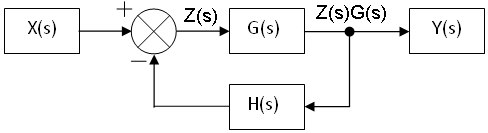
All controls systems have an input (usually some sinusoidal wave) and an output (the wave modified either through addition, multiplication, differentiation, or integration). However, what exactly causes this mathematical change? Well, the key behind this is something known as the transfer function. The transfer function H(s) is defined as the ratio of the output function Y(s) over the input function X(s) (H(s) = Y(s)/X(s)). If we rearrange this formula, then we can see that the input function multiplied by the transfer function is equal to the output function (H(s)*X(s) = Y(s)).

Poles and Zeros

Poles and Zeros

Poles and Zeros

08/10/17

“When does a transfer function go to zero or infinity?”


Transfer functions are usually made up of two polynomials, one in the numerator and one in the denominator. When the polynomial in the denominator (known as the pole) goes to zero, the transfer function will become infinitely large, while when the ones in the numerator go to zero, the function becomes a zero (hence the term zero for such functions). If a transfer function has more poles, then it becomes more unstable, while more zeros will make it more stable. Because of this, controls engineers try to maximize the pole-to-zero ratio.


Frequency domain

Frequency domain

Frequency domain

08/09/17

“How can we visualize the frequency of functions?”


Sinusoidal functions have a measurable frequency. However, it can be hard to distinguish them when multiple of them with different frequencies are added together. So wouldn’t it be logical if we could make some way to visualize all of the different frequencies together? Well, let’s think about this. First, let’s isolate each sinusoidal wave from one another. Then, let’s take its frequency and plot it on an axis. Then, let’s take the amplitude of each sinusoid, and place it on another axis. We can then connect these, and make a graph from it. This construction is known as the frequency domain and is frequently used in control theory and electronics to pick out all of the different sinusoids present

A visualization of reversible vs nonreversible processes

A visualization of reversible vs nonreversible processes

A visualization of reversible vs nonreversible processes

08/08/17

“What exactly is the difference between reversible and non-reversible systems?”


Reversible and non-reversible systems are two of the most fundamental and confusing concepts in thermodynamics. But this visualization should help clarify them. Let’s take a ping pong game. If we are playing without score, then after a round is over, everything goes back to normal with no change in the system, making it reversible. However, if we are keeping score, then after every round the number of points change forever, making this process non-reversible

Processes

Processes

Processes

08/07/17

“What do we call it when a system’s state changes?”


Thermodynamic systems have a variety of properties, ranging from temperature to pressure to volume, which all make up its state. However, these properties are subject to change if the system is not in equilibrium. So what do we call this change in properties? Well, after much investigation, thermodynamicist have come up with the term process to describe this change. Processes can be of many types, such as changes in volume or pressure.

Linear programming

Linear programming

Linear programming

08/06/17

“How can we maximize or minimize a set of linear equations?”


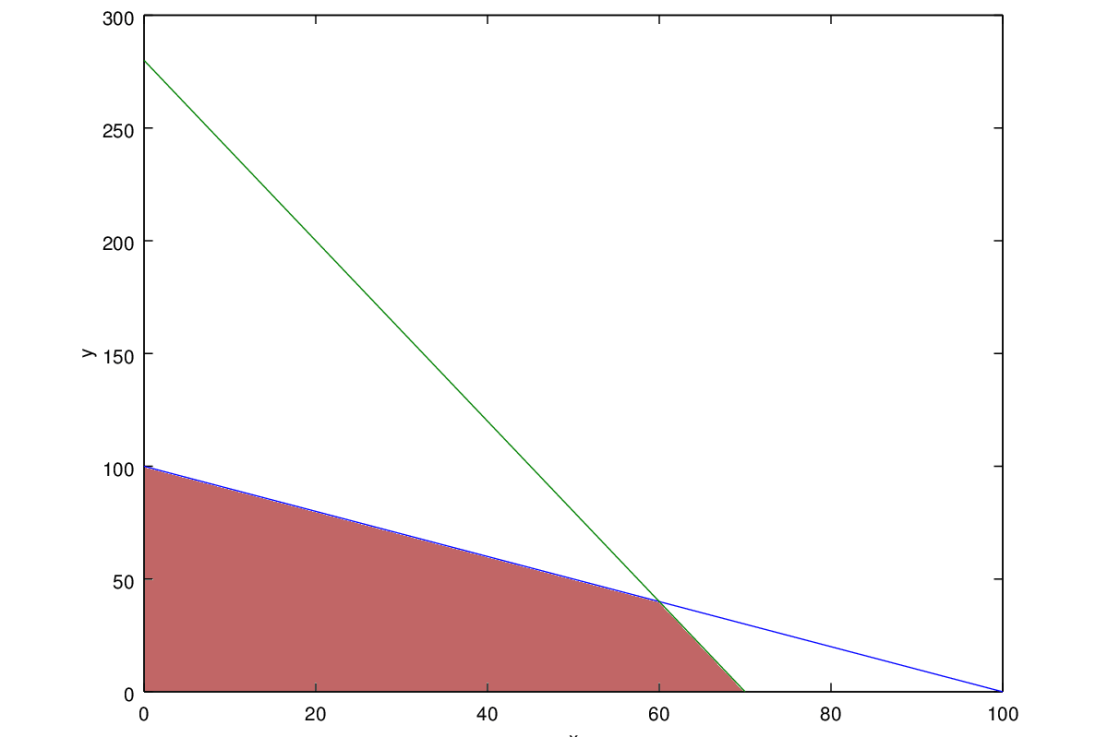
Often times, when working on problems, we have multiple variables related by multiple equations. For example, let’s start out with this situation. Let’s say we have two machine parts x and y that cost 2 dollars and 5 dollars to make respectively, symbolically p(x,y) = 2x + 5y. And let’s also say that we have to make a total of 100 machine parts respectively, or x + y = 100 (blue). And let’s also say that 202 times the number of part x and 5 times the number of part y must be equal to 1400, or 20x + 5y = 1400 (green). So how can we find the minimum price that meets all of our production needs? Well, let’s plot it on a graph (pictured), check all of the points of intersection (In this case (0,100), (60,40) and (100,0) ), and then see which of these points return the minimum desired quantity (In this case (0,100) –> $200). Linear programming can be applied to all forms of applications, ranging from engineering economic systems to control theory and even to general business!

Objective functions

Objective functions

Objective Functions

08/05/17

“What is a function that we want to maximize or minimize?”


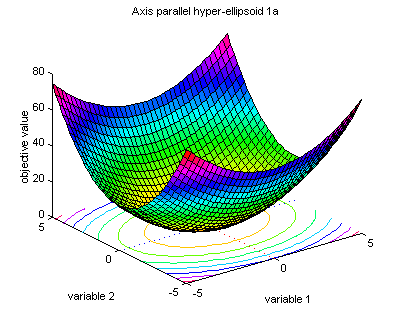
When working with systems of equations, we often have functions that we want to maximize. To illustrate, we might have a cost function f(x) = 18x + 15y which is dependent on two variables x and y. This function is known as the objective function and is used in mathematical operations everywhere.

Contour of model predictive control

Contour of model predictive control

Contour of model predictive control

08/04/17

“How can we predict how a system will react based on how it reacts right now?”
When working with control systems, we often have some desired output in our mind. However, frequently the actual performance of our systems diverges greatly from what we want. So how can we use our engineering mindset to correct this problem? Well, let’s think about it. We can tell a computer how we want a certain system to behave. And we can also create a log of its outputs. So what if every time we gave an output, we took its data, compare it to our desired, and try to minimize the difference with the next iteration? Well, this is the fundamental idea behind model predictive control and is used in industries spanning from building controls to renewable energy to intelligent transportation systems!