Month: May 2017

How to calculate change in entropy

How to calculate change in entropy

How to calculate change in entropy

05/13/17

“How can we calculate the change in entropy for a thermodynamic process?”


It is well known that for all thermodynamic processes, there is a corresponding increase in entropy in the entire system. However, how can we quantitatively measure such a change? Well, after many years of research, physicists and engineers have been able to come up with an equation which states that the change in entropy for a reversible process is equal to the time integral of change of heat divided by the initial temperature, or (delta)s=integral(dq/T). From this, we can derive that for an isothermal expansion or contraction, the equation will be (delta)S=nRln(vf/v0), and (delta)d=-nRln(pf_p0), while in cooling or heating a system it will be (delta)s=ncln(tf/t0) and for a phase transition it will be (delta)s=(delta)h/T.
Volcanic eruptions’ effect on climate change

Volcanic eruptions’ effect on climate change

Volcanic eruptions’ effect on climate change

05/12/17

“How do volcanic eruptions affect climate change?”


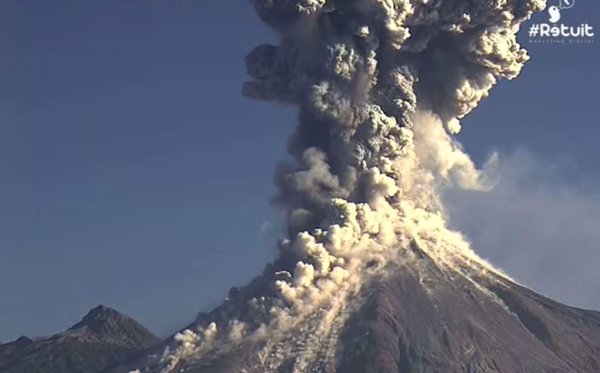
Volcanoes are famous for their mighty and breathtaking eruptions. However, many astute individuals are curious about how such phenomena can affect global temperatures. Well, let’s use our scientific mindset to find out. When volcanoes erupt, a multitude of particles is launched from the Earth’s interior and into the atmosphere. Some of these particles are composed of elements such as sulfur dioxide that block the sun’s rays and induce local cooling, while others are made of heat-trapping greenhouse gasses such as carbon dioxide. However, the effects of the latter are quite minuscule in comparison with the former, and if the particles are able to escape into the stratosphere, then a slight drop in temperatures over a large vicinity of the planet will be observed.

Phasors

Phasors

Phasors

05/11/17

“How can we represent AC current in vector form?”
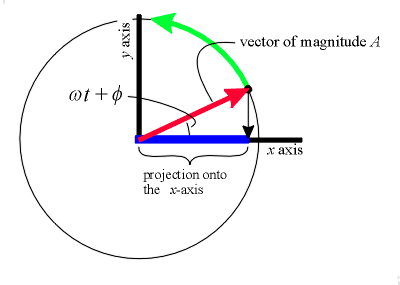
We have a problem. AC current calculations can be drastically simplified if they are put into vector form. However, at the same time they are constantly changing. So how can we make a dynamic form for phasors? Well, let’s think about it. We know that the magnitude of the combination of the real and imaginary magnitudes of the current will be constant throughout. And we also know that these values of these separately will be constantly oscillating. So what if we were to represent these values with a cosine function and a frequency in order to emulate these properties? Well, these representations are known as phasors and are used for every part of AC circuit analysis.

Batch-collector solar water heater

Batch-collector solar water heater

Batch-collector solar water heater

05/10/17

“How can we use the sun to heat our water?”


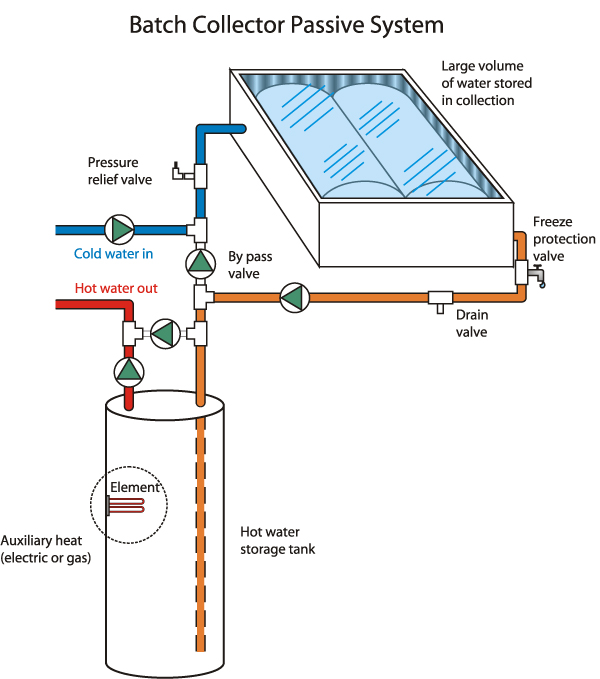
Obtaining hot water for a house requires a lot of energy, and it is very well known that the sun emits a large amount of energy, so wouldn’t be logical that we could translate this energy into heated water?  Well, as engineers, it’s not enough just to think about a system, we need to implement this system into reality. To start off, we will need a way to hold the water. This can be done with a cylindrical tube. Now, let’s put this tube in a case with a glass roof to allow sunlight to come in and heat the area, a miniature greenhouse so to speak. Next, we will need to fit this tube with inlet and outlet pipes in order to transport the water. For safety precautions, let’s also attach a tempering valve to ensure that the internal temperature does not exceed the operating temperature of the system. It looks like we have just made ourselves what engineers have termed a Batch-collector solar water heater. Batch-collector solar water heaters are a very affordable way to create heated water, but can be very inefficient due to the fact there is no mechanism to ensure long-term heat capacity.

Condensers

Condensers

Condensers

05/09/17

“How can we make a machine that turns vapor into liquid?”
Liquids such as water are often turned into vapors in machines after thermodynamic processes. However, how can we do the opposite? Well, let’s use our mechanical engineering mindset to figure it out. We know that if we were to have one fluid come in contact with another fluid of a different temperature, then a heat transfer would take place. And if enough heat is transferred, then a phase change will take place. So what if we were to run vapor through a thin pipe surrounded by cooler air, and have this cool air constantly replenished by a fan? Well, eventually our vapor will cool down and condense into a liquid, completing our desired objective. This device is known as a condenser, and can be found in some of our infrastructure’s most important machines ranging from air conditioners to power plants to distillation units!

Landfill Gas to Energy

Landfill Gas to Energy

Landfill Gas to Energy

05/08/17

“How can we convert landfill gas into energy?”


Landfill gas is often left to rot and waste the environment. However, would it be possible if we could actually do something with this corrosive material? Well, let’s use our engineering mindsets to think about this. We know that gasses are transported through piping systems to provide energy. So what is we were to replace these glasses with the methane gasses released by landfills? This system is known as landfill gas to energy and is often used for generating electricity, replacing non-renewable resources, cogeneration, and pipeline gas

Landfill gas

Landfill gas

Landfill gas

05/07/17

“How does our trash pollute the atmosphere?”


Humanity has a problem. When municipal solid waste (trash thrown out by the public) gets thrown out in landfills, it will slowly decompose. After nearly a year of being in a landfill, methane producing bacteria will begin to emerge and releases a gas known as landfill gas, which is composed of half methane and half CO2. Landfill gas is so potent that it can actually trap heat at a rate of 28-36 times that of CO2 over a 100 years period!

Landfills

Landfills

Landfills

05/06/17

“Where does trash go?”
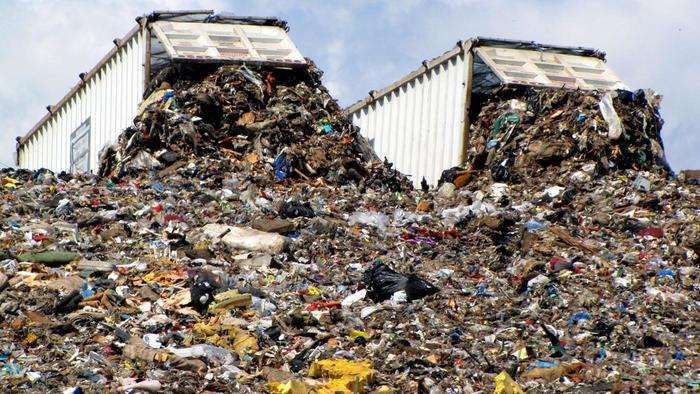
Every second of every hour of every day humanity disposes of large volumes of trash. However, have you ever wondered where this trash goes? Well, let’s use our engineering mindsets to figure out. One very lazy way is just to dump everything under a big pile of land and cover it up to not worry about it! These systems are known as landfills and are used all over the world, from the plains of North America to the forests of Europe.

Incineration waste to energy generator

Incineration waste to energy generator

Incineration waste to energy generator

05/05/17

“Is it possible to turn trash into energy?”


Humanity has two problems. Our levels of waste are piling up every year, destroying available land storage space. We also do not have enough energy to supply everyone on the planet. However, what if we could solve these two problems at once? Well, let’s think about it with our engineering mindset. We know that traditional energy generation methods such as coal and nuclear power involve the decomposition of a material to heat water into steam to drive a turbine. So what if we were to simply burn waste instead? This energy generation method is known as an incineration waste to energy generator and is used all over the world to generate electricity.