Month: January 2017

Why do wind turbines have only three blades?

Why do wind turbines have only three blades?

Why do wind turbines have only three blades?

01/14/17

“Why is it that wind turbines always seem to have three blades?”
Wind turbines can be seen everywhere nowadays, from the coasts of Brazil to the mountains of Scotland. Throughout these installations, they all seem to have one peculiar feature in common: only three blades are attached to the turbine. Why is it like this? Well, let’s use our engineering mindsets to figure this out. The more blades that a wind turbine has, the more torque, generating more electricity. However, each blade will come with its own particular weight and cost, so simply adding more would prove ineffective. If one were to create a performance vs cost analysis, they would find that the three blade design would come out as the most efficient! This little example is a great showcase for how engineering is not utterly based off the laws of physics but the nature of economics as well.

The Netherlands’ electric is now completely powered by renewable energy

The Netherlands’ electric is now completely powered by renewable energy

The Netherlands’ electric is now completely powered by renewable energy

01/13/17

“How is it that the Netherlands’ electric train system is now completely powered by renewable energy?”


A most riveting milestone in global renewable energy adoption has just been reached. The Dutch national railway company NS has just announced that the entirety of their electric train fleet is running on renewable energy!  This means that transportation systems that carry 600,000 passengers every day have and consumes 1.2 billion Kwh each year has just had their carbon footprint sabotaged! However, work is not done, as the company also plans to decrease energy used per passenger by 35% by 2020

Charge controllers

Charge controllers

Charge controllers

01/12/17

“How can we ensure that a battery does not get depleted or overcharged while we are using it?”


Much of our current technological operating infrastructure rests upon battery technologies. These simple devices allow us to store energy in a portable format for later use, such as in electric vehicles and micro-grid systems. However, because they are so vital for many systems, if they become depleted or overcharged, then all operation could be thrown into catastrophe. So how can we modify such systems to ensure that the state of charge for batteries are always at a stable level? Well, let’s use our engineering mindset to solve this issue. For this sort of problem, it looks like some sort of monitoring would be needed. So what if we made a device that could sense if a battery was becoming overcharged or over discharged it would shut down current? This is the operating principle behind a technology known as charge controllers, which have become an essential part for numerous renewable energy systems.

Series/parallel hybrid car drivetrain

Series/parallel hybrid car drivetrain

Series/parallel hybrid car drivetrain

01/11/17

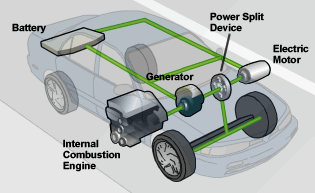
“Can we combine both the series and parallel hybrid car drivetrains?”


Both series and parallel hybrid car drivetrains offer their distinct advantages and disadvantages. The exclusionary principle of the series drivetrain allow for greater efficiency at lower speeds, while the combined efforts model of the parallel drivetrain allow for a smaller battery. However, would it be possible to combine both types in an attempt to have our cake and eat it too? Well, it turns out such a wild idea is indeed possible through the use of a series/parallel hybrid car drivetrain. These drivetrains are set up so that the electric motor and internal combustion engine can operate independently of the condition of the other. This allows for much greater efficiency than either component acting completely discrete or in union. However, these systems will come at a higher cost, making it prohibitive for many individuals to purchases such systems. Perhaps one day, the cost of the systems will plummet to the point that they will threaten to encapsulate the entire market.

Series hybrid car drivetrains

Series hybrid car drivetrains

Series hybrid car drivetrains

01/10/17

“How can we create a more hybrid car drivetrain more efficient for busy traffic?”


Parallel hybrid car drivetrains are wonderful contraptions, but they come with one downside. Much of the efficiency benefits gained from electric vehicle technology are lost during busy “stop and go” traffic, where the internal combustion engine will impinge upon the other components. So how could we get around this problem? Well, let’s use our engineering mindsets to solve this problem. We know that the inefficiencies only come along when the ICE is in use. So what if we were to create a system in which we could control the amount of power that the motor receives from the battery and ICE? Well, it turns out that this concept has already been put into practice as a series hybrid car drivetrain. The operating principle behind these mechanisms is that an onboard computer will measure the speed and acceleration of the vehicle, and use predetermined algorithms to control the power intake of the ICE vs the battery. Due to the larger power requirements, series hybrid car drivetrain systems require a larger battery and motor.


Parallel hybrid vehicle drivetrain

Parallel hybrid vehicle drivetrain

Parallel hybrid vehicle drivetrain

01/09/17

“How can both an electric motor and internal combustion engine be integrated into a hybrid vehicle?”


Hybrid cars are truly captivating machines, being able to combine the ingenuity of electric motors with the range of internal combustion engines. However, both of these components are designed to work independently of each other. So how can we use our engineering mindset to create a system that can integrate both types of power sources? Well, let’s think of it. If we think back to electronic circuits, we know that we can have multiple batteries supplying a common load by placing the batteries in parallel with one another. So why not do the same thing with our electric motor and ICE to simultaneously power the wheels? This setup is known as a parallel hybrid vehicle drivetrain and is used to power lower cost hybrid vehicles.

Hybrid cars

Hybrid cars

Hybrid cars

01/08/17

“How can we combine traditional internal combustion engine vehicles with electrical ones?”
Many consumers face a dilemma when purchasing a motorized vehicle. On one hand, they want to be energy efficient and environmentally friendly by purchasing an electric vehicle. On the other hand, they would like to have a large driving range with an internal combustion engine type vehicle. So how can we solve this problem? Well, why can’t have our cake and eat it two by combining them? This is the operating principle behind hybrid car technology, and it is becoming more prevalent in the automobile market every year.

Battery electric vehicles

Battery electric vehicles

Battery electric vehicles

01/07/16

“How can we minimize the impact that cars have on the environment?”


As of the time of writing, most cars use internal combustion engines (also knowns as ICEs) to power movement. This technology is highly pollutive and needs to be quelled soon to ensure the survival of humanity. But since cars and road infrastructure have become so intrinsic to the fabric of developed countries, it would consume too much energy to try to replace them all together. So how could we develop cars that are much less damaging to the environment? Well, let’s look at it like engineers would. Most cars use internal combustion engines to induce rotative movement to be transferred to the wheels via a drivetrain. However, this setup can be easily replaced with an electric motor powered by a rechargeable battery. When the car wants to move, the battery simply sends current to the motor to move the drivetrain to move the wheels. These Battery electric vehicles are becoming cheaper by the year, and may one day replace traditional vehicles all together!

Electric vehicle drivetrains

Electric vehicle drivetrains

Electric vehicle drivetrains

01/06/17

“What causes electric vehicles to move?”


Drivetrains are responsible for transferring the power from internal combustion engines to the wheels of a car. However, Electric vehicles often lack internal combustion engine technology in place of a motor powered by a battery. So how does the drivetrain for such automobiles differ? Well, let’s use our engineering mindset to solve this problem. We know that motors can be thought of as electrically charged wheels and that wheels connected with a shaft will move together. So how about we implement this type of system into an electric vehicle? If this sounds quite similar to a traditional powertrain, it’s because it actually is! However, electric vehicle powertrains do have a few differences, namely being much less energy intensive (consuming nearly 0% of available energy when compared to the 5-6% of ICE units) and having a more minuscule part count.