Month: October 2016

Chemical reactivity lists

Chemical reactivity lists

Chemical reactivity lists

10/22/16

“How can we determine the reactivity of an element?”

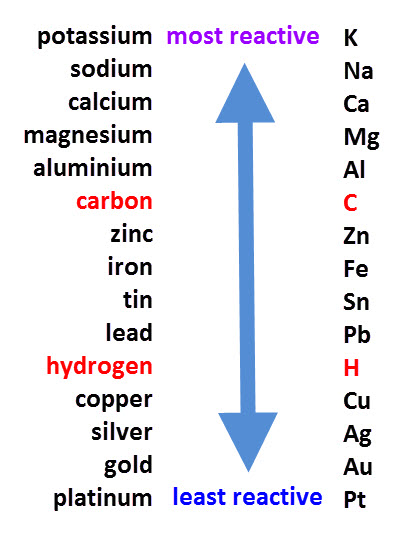
We all know elements can react with one another. However, how can we quantify the level of an element? Well, let’s think about it. We are aware of the fact that we can use a tool called Empiricism to organize external information. And we know that external information can include overseeing Chemical reactions. So what if we were to observe which elements reacted with which ion, and then wrote down the result? This is the root behind Chemical reactivity lists. What makes these lists so interested is that they can be organized linearly, Meaning that if you can make a vertical list of all of the elements, than they would be able to react with everything below their position, and be unable to react with everything above it, therefore allowing for future predictions.

Why do phone batteries last a short time?

Why do phone batteries last a short time?

Why do phone batteries last a short time?

10/21/16

“Well, why do they?”
Batteries are one of the most indispensable drivers of modern civilization. And smartphones are of the chief applications of this technology. However, how is it that something so pivotal to society’s function wear out it’s sole power source so rapidly? Well, let’s think about it like an Engineer would. We know that batteries are powered by releasing stored chemical energy through reactions. However, batteries have a low energy density, meaning that a large battery will hold a relatively small amount of energy compared to it’s size. And since phones need to be smaller for practical use, the battery has to be small as well, and since the only other way to increase battery capacity is to increase the efficiency (which would increase costs prohibitively), smartphone users are stuck with low battery lifetimes!

Chemical hybridization

Chemical hybridization

Chemical hybridization

10/20/16

“How can covalent bonds occur if the elements are in different orbitals?”
There seems to be a problem when it comes to covalent bonding. Bonding theory states that bonds occur because of an overlap of of atomic orbitals.Much of the time, the central element will have  different orbitals than the surrounding ones. So how can chemical bonding occur? Well, nature can be very clever. What happens is that the subshells will hybridize to become one big subshell. Each electron will try to fit into it’s own shell in the subshell. If there is overlap, then there will be a lone pair of electrons.To illustrate, an element with orbitals of s2 p2 will become sp3, as the second electron from s2 will have extra room. With hybridization, chemical bonding can occur.

Lewis structures

Lewis structures

Lewis structures

10/19/16

“How can we geometrically represent chemical bonds?”
Chemical bonds are one of the most fundamental aspects of Chemistry. But when a student of science is first introduced to them, they are simply shown them in a purely conceptual form. But how can we make a more accurate representation of what these structures actually look like? Well, let’s think about it. We know that some elements can covalently bond with one another by sharing orbital electrons. So what if we just drew structures that represented these orbital bonds? This is the fundamental principle behind a tool that called Lewis structures. There are several steps to forming a Lewis structure. The first is to identify the element in the bond with the least amount of electronegativity (With the exception of hydrogen). Then one has to place the rest of the elements around the aforementioned low-electronegativity element. Then, one must place the associated valence electrons around each of the element. Since all non-noble gas elements will have some of their electron orbitals free, there will be a need for some of the valence elements to form covalent pairs with others to obtain the necessary filled valence shell. Afterwards, if there are still more electrons that need to be filled, then double and triple bonds can be formed to increase the amount of valence electrons. If all valence electrons on the outer elements are filled up and the inner element still needs or has more valence electrons, then the surplus electrons will form lone pairs on the central element.

Method of sections

Method of sections

Method of sections

10/18/16

“Is there a simpler way to solve truss problems?”


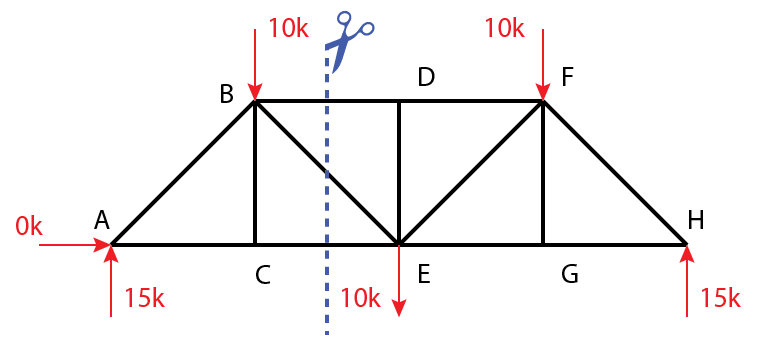
Trusses are one of the most fundamental elements in modern structural engineering. However, performing truss calculations is not only time consuming but can also be quite tiring, especially if we only desire to obtain the values for a few members. So is there a way in which we can simplify truss calculations if we are only focusing on a few parts? Well, let’s think about it. We know that when we work with external forces on trusses, we can solve for them without worrying about the internal forces, thereby allowing us to work with much less equations required. So what if we were to take the forces in the members we need and somehow turn them into external forces? This is the fundamental idea behind a technique known as the method of sections. To implement the methodm all we need to do is to find the members we desire, and then cut the truss through those members so that the internal forces will seem like net forces, and then solve for those members. This drastically reduces the time necessary to solve the problem, and prevents us from making too many absent minded mistakes

Phenolphthalein

Phenolphthalein

Phenolphthalein

10/17/16


“How do we can we find out if an acidic or basic reaction is occurring?”


When doing Chemistry, we will have to perform a lot of chemical reactions. However, sometimes these reactions can be invisible to our eye. Therefore, finding a way to know if a chemical reaction is going on would be quite a necessity to our interests. Since there are many types of chemical reactions, let’s start with one kind, acid-base reactions. So how can we know if acid-base reactions are going on? Well, let’s think about it for a moment. We know that when a base reacts with an acidic solution, hydronium ions[HO3] are released. And we know that weak acids not only can react with these hydronium ions but are also dissolved but not dissociated in solutions. This means that hydronium atoms can exist within a solution without altering the chemical properties much. Now all we have to figure what type of weak acid would be pertinent to our interest. Well, luckily for us, Chemists have discovered an element known as Phenolphthalein which actually changes it’s color depending on the pH of the surrounding substance! Specifically, Phenolphthalein will become clear in the case of a net acidic reaction, and pink in the case of a basic reaction. Phenolphthalein is used for chemichal purposes all over, whether it is for tritration or simple reactions.

Voltage

Voltage

Voltage

10/16/16

“What is voltage?”


Often times, when you read about electronics, you hear about some abstract measurement called voltage, but what exactly is this concept? Well, Voltage is defined as the difference in electrical potential between two points in space. Basically,  one can think of voltage like the electrical equivalent of pressure difference between two points in space, so the more voltage there is between two points, the more “push” there is associated with it. For example, just like a high pressure piping system is necessary to drive a turbine, a higher voltage system might be necessary to power more powerful electronic equipment. The unit for voltage is measured in volts, which is defined as one potential energy per meter, meaning that this would be the work done moving one unit charge. Voltage is occasionally called the “EMF” (especially in respect to batteries).

Abbreviated electron configuration

Abbreviated electron configuration

Abbreviated electron configuration

10/15/16

“What is a simpler way to present electron configuration?”


Electron configuration is one of the most fundamental aspects of chemistry. However, it is also one of the most tedious. Why would you want to write series and series of numbers and letters just to represent one element? Well, how about we look at some patterns in the periodic table to help us out. We know that orbitals are only completed when all of the subshells in that level have been filled, and this phenomena only occurs in non-ionized noble gases. An when we advance past a particular noble gas on the periodic table, the whole naming process will start over again (for example, after helium [He] the second orbital will start,and after neon [Ne] the third will start). Since we would know all of the subshells filled up to that point, how about we just list the subshells that come after the last noble gas? For example, titanium [Ti] will become [Ar] 4s2 3d2. This notation is much easier to read and understand than the old drawn out notation.


Well, luckily for us, chemists tend to be a fairly intelligent people, so they have instrumented a system known as abbreviated electron configuration to help us. Abbreviated electron configuration

Press brake

Press brake

Press brake

10/07/16

“How can we using machines to bend metal to a specified shape?”


Metal is one of the most omnipresent materials used by humanity. However, before it can be used, it must be bent. And not only that, but to suit the quantity of our civilization’s needs, we must do it on an industrial scale. So, how can we accomplish this? Well, what if we were to use a machine dedicated to bending metal? This is the operating principle behind a Press brake. Press brakes work as follows. The machine will have two main components,  a platform for the sheet of metal to rest upon, and a brake that is used to bend the metal. The brake is powered by a servomotor. When activated, the brake will be lowered and apply a pressure to bend the sheet of metal into the user’s specifications. The platform will then move the sheet of metal along, to repeat the process to create a piece of metal designed to the user’s specifications. Press brakes can make all sorts of metals such as cold-formed steel.