Tag: Mechanical Engineering

Normal stress

Normal stress

Normal stress

10/08/16

“What happens when stress acts upon an area parallel to the axis of an object?”
The concept of stress is one of the premier foundations of all of engineering science. So, what happens when a stress is applied to an area that is parallel to the axis of the object? Well, this type of action is very simple. Since all of the stress acts through the axis of an object, the only deformations will be parallel to the axis as well. This type of stress would cause tensile or compressive deformations (depending on the direction and strength of materials). Scientists and Engineers have termed this phenomena normal stress. You can find the magnitude of normal stress very simply, as the stress is just the force distributed over the area that it is acting upon (we can represent this symbolically with the equation (sigma)=F/A, with being (sigma) the stress, F being the force, and A being the geometric area)

Eccentric loads

Eccentric loads

Eccentric loads

10/07/16

“What happens when a non-axial load occurs on a column?”


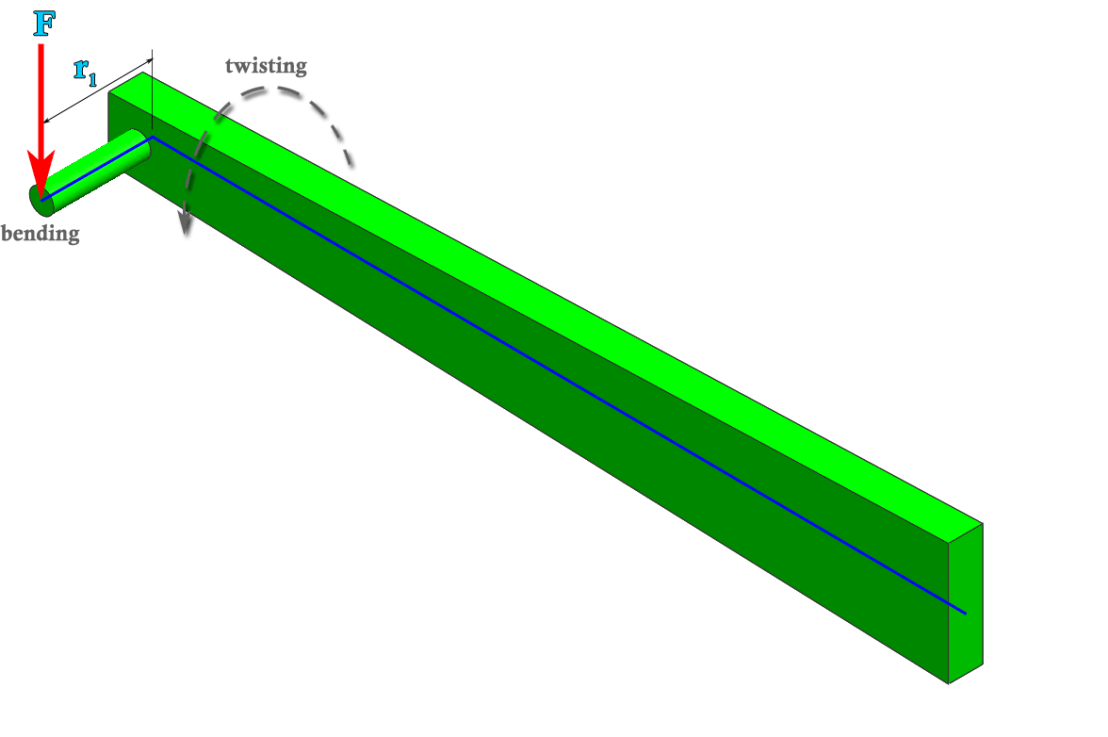
When working with  columns, we often have to analyze loads that impinge on the structure. However, what happens when a load acts in a direction not parallel to the axis? Well, what will happen is that the strength of the material will not be completely able to resist the force, thereby resulting in bending. Engineers have termed this type of load an eccentric load.

Cold formed steel

Cold formed steel

Cold formed steel

10/06/16

“Can we ever find a replacement for wood in construction”


Humanity is running into a problem. Wood, one of the most used materials in construction, is being depleted an exponential rate. Sooner or later, we must find a substitute for our needs. But what can possibly replace something as unanimous as wood? Well, luckily for us, engineers have already come up with another innovative solution, cold formed steel. But what exactly makes this material so special? Well, it all has to do with the fabrication process. Most steel is manufacturing using the hot formed procedure, in which the steel geometry is formed by being push baked at high temperatures. However, cold-formed steel gets it’s name due to the fact that is formed at room temperature. This greatly increases the yield strength of cold formed steel, makes it lighter in weight, smoothens its topology, and makes it more precise for detailing. But most importantly, cold formed steel is actually a recyclable material! And not only this, but it is also cheaper than lumber! Add on the fact that with steel you won’t have to worry about termites or rot, ad you’ve got yourself one amazing deal. In summation, cold formed steel is the way of the future, and it holds nearly limitless applications for future construction.

Shock absorbers

Shock absorbers

Shock absorbers

09/26/16

“How can we stop unexpected vibration from occurring?”


When working as an engineer, one has to look out for many unexpected vibrations occurring when designing a machine. With this in mind, how can make a system to integrate and solve this problem? Well, lets think about it for a moment. We know that vibrations have kinetic motion, which means that they have energy associated with them. And we also know that we can transfer this energy into other forms such as heat. So how about we create a device that transfers this vibrational energy into other forms of energy? This is the operating function behind a shock absorber. Shock absorbers work as follows. When a shock occurs to a machine, springs are attached to the part to absorb this energy and become compressed. Since this compression will store unbalanced potential energy, it must release itself. In order to prevent all of the energy from spilling out, the shock absorbers will now come into play. The shock absorbers will be constructed as a piston with oil in a tube, all inside of the spring. As the spring moves, it will cause a force on the piston, which will in turn cause oil to be forced through tiny holes in the piston that will precisely control the level of resistance to motion, therefore transferring much of the enegry in to heat. Automobiles make great use of shock absorbers, where they control the up and down motion of a wheels vehicles.

Telescoping expansion joint

Telescoping expansion joint

Telescoping expansion joint

09/22/16


“How can we implement an expansion joint for tubular geometries?”

Expansion joints are very useful devices. However, how can we create affordable versions to implement on tubular geometries such as in pipes? First of all, let’s look at the problem at hand. Thermal expansion causes a material to change it’s size depending upon the surrounding temperature, and as such there needs to be “breath gaps” to ensure that a structure will not collapse. However, using something like a plaster or a soft filling will not be strong enough to sustain the expected pressures on a pipe, and having loose material might cause a leakage into the fluid flow. Therefore, we will have to think of an adjustable solid part. Well, how about we take some design inspiration from one of humanity’s greatest achievements, the telescope. Part of what makes telescopes the machines they are is the fact that they have a telescoping build, which means that solid parts are made so that they can slide past each other. Now, how about we take this mechanism and apply it to our thermal expansion joints?


Well, what we could do is have two concentric expansion tubes, one with a larger tube and the other with a smaller one. The smaller diameter tube will connect to the two joints of the mechanism, and will expand and contract upon need. The larger diameter tube will act as a fixed support in order to center the smaller diameter tube, and as such have a smaller diameter. You can analogize the larger diameter tubes as being like the “braces” of the smaller diameter tube. O-rings are often used to seal these parts to ensure that all operations are smooth. This layout is known as a telescoping expansion joint. Telescoping expansion joints are very useful due to their simple yet effective design, and the fact that they can be curated for tubular geometries.

Gasket

Gasket

Gasket

09/19/16

“What is a simple way to ensure that fluids can be transferred without leakage while under compression?”


In modern machinery, fluids are often transferred when under compression. However, this action often leads to fluid leakage, so how can we design an apparatus that allows us to safely transfer this fluid . Well, let’s think about at using our engineering mindset. Well, often times it is the compressed space surrounding the mechanical transferring parts that causes the leakage. So wouldn’t it be logical if we just added a new part in between this space to prevent any unwanted interference? Well, this is the operating principle behind a very fundamental piece of technology called a gasket. The design of gaskets are usually made out of soft materials such as asbestos, aluminum and copper. The design and material makeup of gaskets is contingent upon the substance needing to be sealed, the operating temperature, and the geometry of the conjoined parts. Gaskets are often prone to be worn out after continual use, and must be replaced. Gaskets have many ubiquitous applications, most notably in car engines. In some applications, gaskets are being phased out in favor of sealants. 

Clamps

Clamps

Clamps

09/15/16

“How can we use a simple tool to prevent two objects from separating?”


When doing engineering work, holding two discrete objects together might be a necessity. There are many ways to accomplish this, but how can one do it using a simple mechanical device? Well, luckily for us, engineers have already devised a tool known as a clamp. To make a clamp, simply create a solid “c” shape part, then drill a hole through the bottom curve, and then put an adjustable screw through the hole. If you put an object through the air gap of the “C” shape, and then adjust the screw to touch the object, you can apply enough pressure to entrap it in place.

Equivalent forces

Equivalent forces

Equivalent forces

09/13/16

“How can we simplify force diagrams?”


When working in physics or engineering, we all have to work with forces. Sometimes, we will have a multitude of forces, all going in different direction. However, how could we simplify all of these different elements of a problem to get the big picture and streamline our solution process? Well, let’s think about it. First we should think of our objective, and that is to see what happens when all of these forces are combined. So how about we take the components of each of the separate forces and moments, add them together, and find the equivalent force for all of these values? For example, let’s suppose that we had a bar of length 6 meters, with one force of 20 acting on the far left from the top and another one of 20 newtons acting at the far right coming in from the bottom. When we do all of the calculations, the equivalent force in the x direction will be 0 Newtons (Since none of the forces have an x component), The net force in the y direction will be 0 Newtons (since both forces are going in opposite directions, they will subtract each other) and the net moment will be 135 N-m (Since they are both in the same moment direction, 3m*20N+3m*25N=135N-m). With the use of equivalent forces, we can analyze an unlimited amount of problems, ranging from structural engineering to electrodynamics

Pulleys and mechanical advantage

Pulleys and mechanical advantage

Pulleys and mechanical advantage

09/06/16

“Is it possible to lift an object with a force that’s less than it’s weight?”


If you ever had to design a system focused on lifting objects, you probably bemoan the fact that if you want to lift a heavy object, you have to use a force that is greater or equal to it’s weight.

Or do you have to?

What if there was some way if we could manipulate the laws of physics, so we could lift an object with a force that is less than it’s weight? Well, let’s think about how we could do this using mechanical advantage.

Let us start with a very simple machine called a pulley. More specifically, we will be starting with a single, fixed pulley. A fixed pulley is a dimply a disk hinged onto an axis in which it is free to revolve around but may not move transitionally. If we were to take a rope and move throw it over the circumference of a pulley, it would reverse the direction of the rope, so we could lift an object while using a downward force instead of an upward force. We still have to use the same force as the weight, but it allows us to change directions.

Now let’s go a step further. What if we were to take that same rope, and make it go under a new pulley, this time a moveable pulley, attach the end of the rope to a ceiling like structure above the pulley, and attach the weight to the moveable pulley. Now the rope will be supporting the pulley on both sides of the object, it can effectively double it’s force value! This means we can now use a force value that is less than the weight of our object to lift it up! You can even create more complex pulley systems to create a greater mechanical advantage. However, there is one major downside to using this setup. Since energy must be conserved, and you are using a smaller force, you must increase the distance you pull your object proportionally to the strength of the force you are using. For example, if you have use a force that is half of the weight, then you will have to pull the rope twice as far, three times as far for a force a third of the weight, and so on. In addition, when we perform these calculations, we assume a massless pulley with no moment of inertia or friction, so there are bound to be some inefficiencies that will require us to use even greater distances

All in all, pulley systems are a testaments of human ingenuity, and are a classical representation of simple yet effective engineering.