Tag: Mechanical Engineering

Shear strength

Shear strength

Shear strength

08/30/16

“How can we classify the ability of a material to resist forces that are parallel to the surface?”


Have you ever been mystified by how an object can be broken apart by taking two different sides and sliding one upwards and the other downwards? And have you ever thought about how we could quantify this phenomena? Well, believe it or not, this comes down to a very simple factor called shear strength. Shear strength is the maximum ability of an object to resist yielding against shear strains, or deformations in objects that are induced by internal sliding. Adhesives are often used to solidify the shear strength. The study of shear strength is critically important for structural engineering, as doing so could prevent catastrophic failures. For example, we  can apply the shear strength of materials to study how a boat being tethered to a dock could cause a rupture on the dock.

Yield

Yield

Yield

08/29/16

“How can we measure when a deformation will be permanent on a material?”


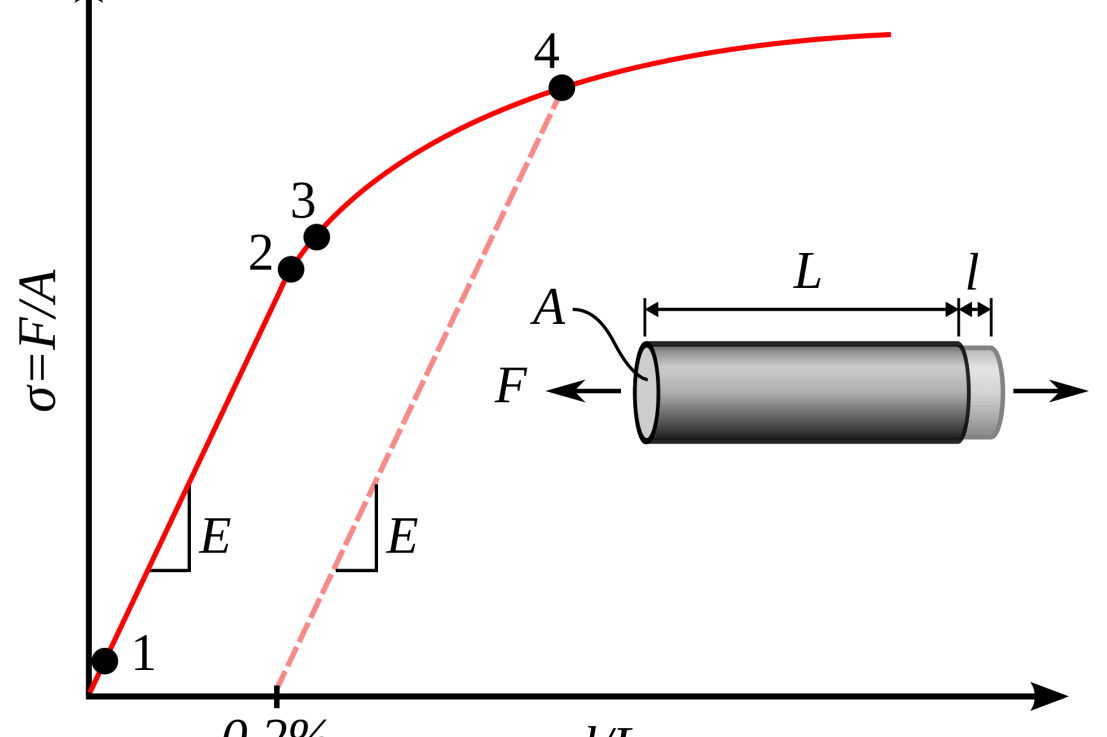
When you were young, you probably noticed that if you apply enough stress onto an object, there will be a point in which in the material will be permanently deformed. However, did you ever consider that we might be able to classify this point in some form? Well, after many years of research, structural engineers have termed this “point of no return” as the yield. In technical terms, the yield point or yield strength is a material property that measures the point at which the level of stress applied becomes so high that the material will no longer deform elastically (meaning returning to it’s original shape) and instead deform plastically (meaning that there is some permanent deformation). The yield strength of an object is very important for estimating the applied strength it can take, since it could be used for pre-emptive failure analysis.

Trusses

Trusses

Trusses

08/28/16

“What is the fundamental framework behind many modern structures?”


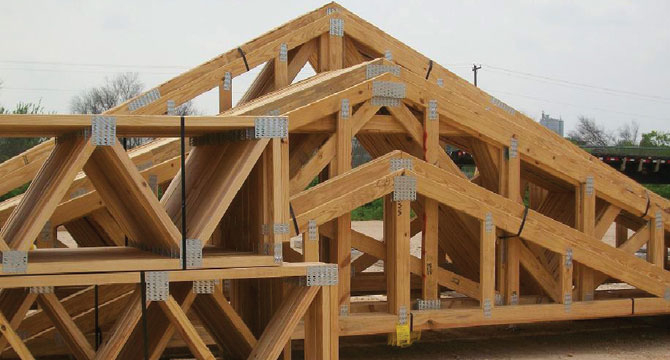
Have you ever wondered what exactly makes moderns structures such as bridges and houses supportable? Well, believe it or not, all of these complex structures have their foundations in a straightforward yet ingenious engineering piece, the beam. And not just beams by themselves, but beams arranged in a very particular way. When making edifices, one must take into account that beams have very little lateral strength. In other words, beams do not have much strength to support perpendicular forces. However, beams are very sturdy when it comes to compressive and tensile forces. So in order to build complex structures, beams must be construed in a way that all of the forces are applied at the joints so that all of the forces are either compressive or tensile forces. We can accomplish this by having the beams must be connected only by their joints. This way, all of the loads will  be distributed on the ends of the beam, so we can have highly stable structures without having to worry about collapse. This type of framework is called a truss, and is used in all forms of engineering.

Hydropower

Hydropower

Hydropower

08/26/16

“Can water be used to create useful energy?”

Water is one of the most omnipresent substances found on this planet.An entire three-quarters of the planet is covered by it. Water often moves not in small streams but with large flows, piling through it’s path with titanic levels of energy. So one might think, is it possible to capture some of this energy to transfer it into useful forms?

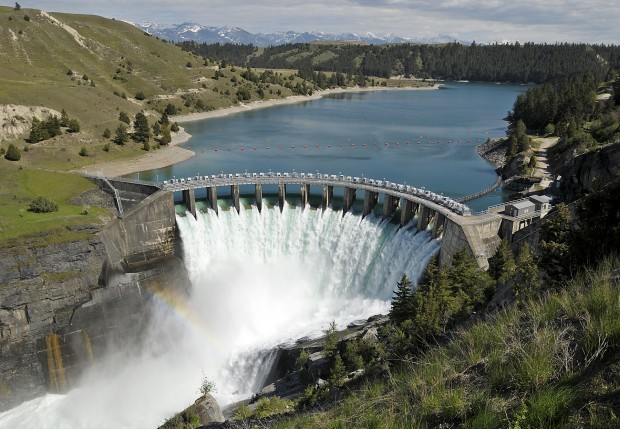
Well, let’s think about how we could do so. First of all, we know that turbines can extract energy from moving fluids to power a generator to create electricity. Second of all,  We know that water flow can be controlled through the uses of dams. So what if we placed a damn near a flowing path of water, and directed all of that energy so it would move a turbine that would power human infrastructure? Well, this is the operating principle behind hydropower.

Hydropower is the use of the kinetic energy of water to power electricity. The power generated by a hydropower plant can be calculated with the following equation P=Mu*rho*Q*g*h, with Mu being the efficiency of the turbines, rho being the density of the water passing through, (Kilograms per cubic meter), Q being the flow (Cubic meters per second), g being the acceleration by gravity, and h being the height difference between the inlet and outlet in meters. Hydropower is clean, renewable, and affordable form of energy. Hydropower produces almost one fifth of the world’s electricity, the primary contributors being China, Canada, Brazil, The United States, and Russia. Notable hydroelectric projects include the three gorges damn in China and the Grand Coulee Dam on the Columbia River in northern Washington in the U.S. However, one has to be cautious when developing such systems, and the infrastructure may disrupt local wildlife and natural resources.

In summation, hydropower is a fascinating subject, and engineers around the world are dedicating themselves to the study and application of this form of power.

Motor armatures

Motor armatures

Motor armatures

08/21/16

“What component causes an electric motor to spin?”


We know that Electric motors have two main mechanical parts, a stationary stator that encapsulates a rotating rotor. Now, how is this rotation induced? Well, in addition to having the aforementioned two mechanical components, electric motors has two electrical components. The first electrical component is called the field, which is simply the magnetic field component inside the airgap. This field will turn the armature, which is the primary power producing component in the motor. The armature carries current that is oriented perpendicular to the magnetic field, which in turn will induce a force which will cause a torque to take place. The armature usually consist of several conductive windings for this effect to happen. The field and the armature can be on either on the rotor or the stator but one must only occupy one other.