Tag: Fluid mechanics

Liquid pressure variation with height

Liquid pressure variation with height

Liquid pressure variation with height

09/12/17

“How does the pressure of a liquid vary with height?”


Liquids are famous for their permeable structure, such that you can insert an object at any point inside it. However, depending on which part of the height you insert it, it will experience a different pressure. So how can we quantify this pressure variation with height? Well, if we investigate empirically, we will find out that this variation can be symbolically represented as P = rho*g*h, with P being the pressure, rho being the density, g being the gravitational acceleration, and h being the height.
Shell and tube heat exchanger

Shell and tube heat exchanger

Shell and tube heat exchanger

07/31/17

“What is the most popular type of heat exchanger?”


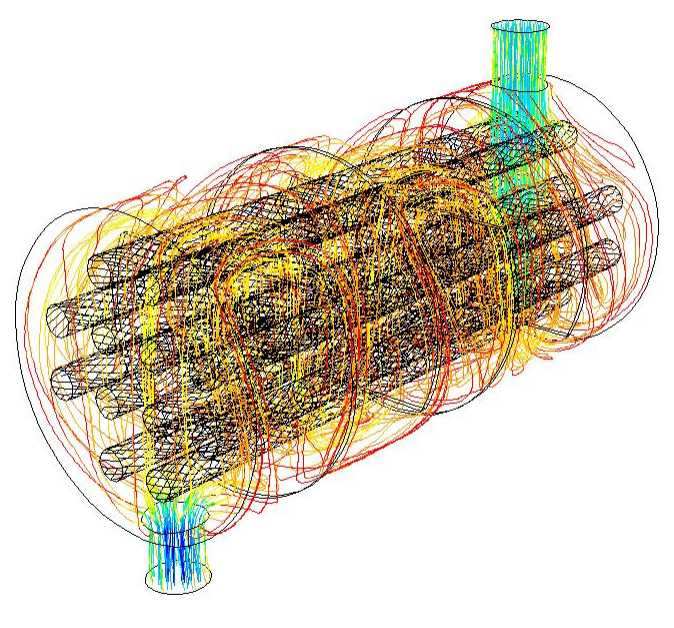
Let’s think of a design for a simple heat exchanger. First, let’s take a bundle of tubes and put it into a shell. Then, let’s run one fluid through the tubes and another around the tubes, both at different temperatures. Over time, the heat from the hotter one to the colder one. This setup is known as a shell and tube heat exchanger. Shell and tube heat exchangers come in two varieties, single phase (which have the fluids in only one phase) and multiphase (which uses both gases and liquids simultaneously). Because of their simple construction, shell and tube heat exchanger have become the most popular in the world.


Pumped hydrogen storage

Pumped hydrogen storage

Pumped hydrogen storage

06/24/17

“How can we use a gravitational potential to store energy?”


If you have ever taken an introductory physics class, then you know that anything with a mass at some distance from the Earth has an energy potential associated with it given by the equation P.E = mgh, with m being the mass g being gravity and h being the height. So logically speaking, if we were to vastly increase the mass then we would also vastly increase the potential energy. So if we have a large enough mass, we can store enough energy for an electric grid!


This is the exact idea behind a technology known as pumped hydrogen storage. Pumped hydrogen storage takes two water reservoirs at a height gradient, and discharges energy to the grid by moving the water through a turbine and stores more energy by using a grid powered pump increase the level of water on the top layer

Vacuum pumps

Vacuum pumps

Vacuum pumps

05/25/17


“How can we induce a vacuum in a sealed container?”


In engineering projects, we often want to create artificial vacuums in sealed chambers. However, Doing so is an arduous technical task. So how can we use our engineering mindset to accomplish such a feat?


Well, let’s start with first principles. We know that when a gas expands, it loses density. And when it becomes less dense, it takes less energy to move around. Now let’s apply this fact into a working machine. Take a sealed volume of gas, let’s say 1m^3. Now expand it to 2m^3. Then, place a divider in the middle. Then flush out all of the gas on one side. Remove the divider, and let the process repeat until a desired density has been reached. This machine is known as a vacuum pump, and is used in a startling range of applications, from automobiles to semiconductor processing to air conditioner operation!

Condensers

Condensers

Condensers

05/09/17

“How can we make a machine that turns vapor into liquid?”
Liquids such as water are often turned into vapors in machines after thermodynamic processes. However, how can we do the opposite? Well, let’s use our mechanical engineering mindset to figure it out. We know that if we were to have one fluid come in contact with another fluid of a different temperature, then a heat transfer would take place. And if enough heat is transferred, then a phase change will take place. So what if we were to run vapor through a thin pipe surrounded by cooler air, and have this cool air constantly replenished by a fan? Well, eventually our vapor will cool down and condense into a liquid, completing our desired objective. This device is known as a condenser, and can be found in some of our infrastructure’s most important machines ranging from air conditioners to power plants to distillation units!

Landfill gas

Landfill gas

Landfill gas

05/07/17

“How does our trash pollute the atmosphere?”


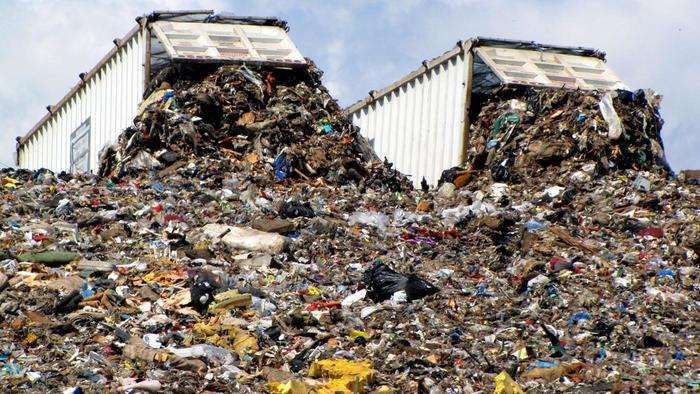
Humanity has a problem. When municipal solid waste (trash thrown out by the public) gets thrown out in landfills, it will slowly decompose. After nearly a year of being in a landfill, methane producing bacteria will begin to emerge and releases a gas known as landfill gas, which is composed of half methane and half CO2. Landfill gas is so potent that it can actually trap heat at a rate of 28-36 times that of CO2 over a 100 years period!

Complex fluids

Complex fluids

Complex fluids

05/02/17

“What happens when there is a fluid with more than one phase present?”
Most engineering or physics applications of fluid mechanics deal with only one phase of matter. However, what happens when there is there is a multiphase solution present, such as in shaving cream? Well, after much investigation, engineers and physicists have determined that such materials can not be treated as typical fluids and instead must be classified as complex fluids. Complex fluids exhibit often unusual stress-strain relations, are highly nonlinear, and relatively unknown. Perhaps readers of this blog will pursue research into this subject and illuminate us on this subject.

Boilers

Boilers

Boilers

04/25/17

“How can we use machines to heat up fluids?”
We use warm fluids in our lives every day, whether it be in the showers we take, the HVAC systems that make our homes cozy or in our electrical generators. However, how exactly can we heat up such fluids? Well, let’s use our engineering mindset to find out. We know that if left to the surroundings, the heat from a fluid will radiate out. So if we were to place this fluid into a container, then logically the heat would be trapped inside. Furthermore, let’s control the temperature of this fluid by placing the container near a combustible source as to constantly supply energy. After constructing this, we will have ourselves what engineers have termed a boiler. Such machines are vital to the operation of our infrastructure, whether it be in the engines of trains or for culinary purposes.

Heat exchangers

Heat exchangers

Heat exchangers

04/18/17


“How can we transfer heat from one fluid to another without them being in contact?”
Fluids are often used as materials to heat other materials. However, sometimes fluids themselves need to be heated. So wouldn’t it be logical if we could use one fluid to heat another? However, there is one problem with this. If we have two fluids come into physical contact with one another, they will usually merge and mix with one another. So how could we prevent such a phenomena from happening? Well, let’s use our engineering mindset to figure this problem out. We know that pipes are a very efficient way to transport fluid phenomena. And we also know that heat can be transferred from inside the pipe to the outside. So what if we were to create a machine that would take on one fluid, extract the heat from it using piping and other mechanisms, and pass it onto a separate fluid? Well, this is the fundamental idea behind a device known as a heat exchanger, and it can be found in a vast multitude of devices, ranging from refrigerators to power plants to diesel engines.