Category: Physics

Practice of Capacitors

Practice of Capacitors

Practice of Capacitors

06/25/16

“How can we apply capacitors to accomplish practical tasks?”

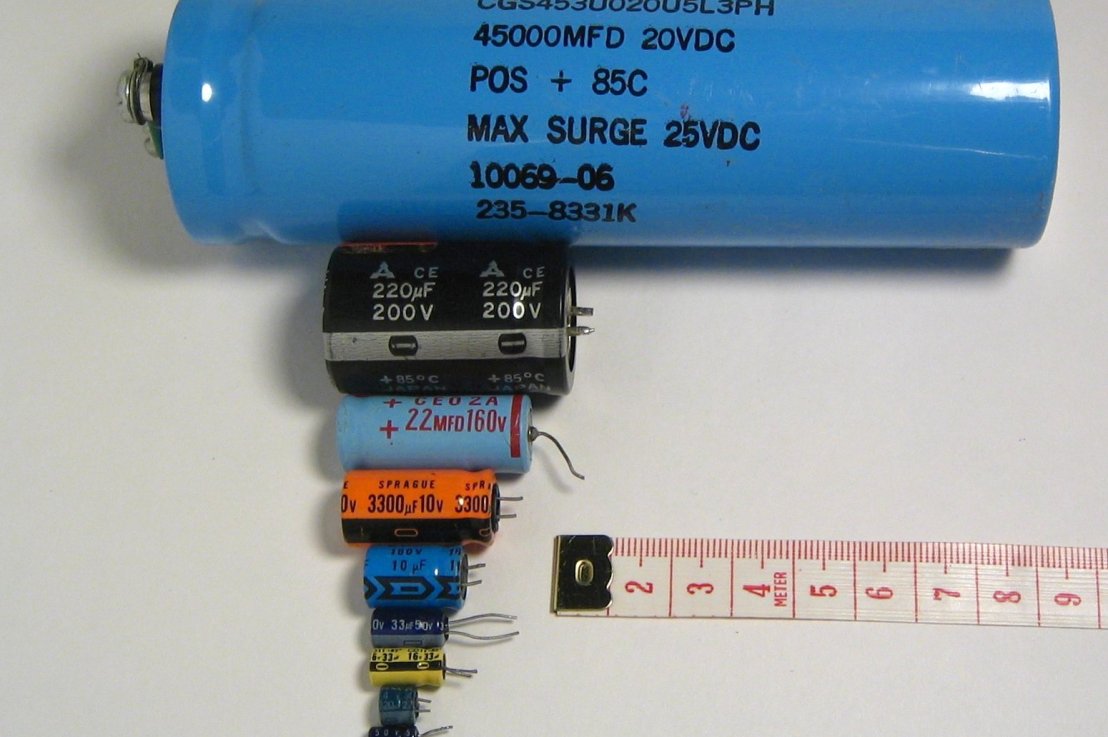
Capacitors have many uses in application. The most common utilization for capacitors is to store energy. Energy can be stored within the electric field of a capacitor, and this energy can continue being stored even if the battery has been disconnected! Capacitors also have a very quick discharge time (often only in the milliseconds) so they can serve as a quick battery. Capacitors can also be used a sensors, accomplishing tasks such as measuring the fuel levels in an airplane. However, one of the most powerful uses of a capacitor is to be a low pass filter. Since the resistance of capacitors in an AC circuit increases inversely proportionally to the frequency of an object, a low frequency current will be hampered by the filter, which means that a minimum threshold of frequency must pass through.
Theory of Capacitors

Theory of Capacitors

Theory of Capacitors

06/24/16

“Is it possible to store electricity in an electric field?”

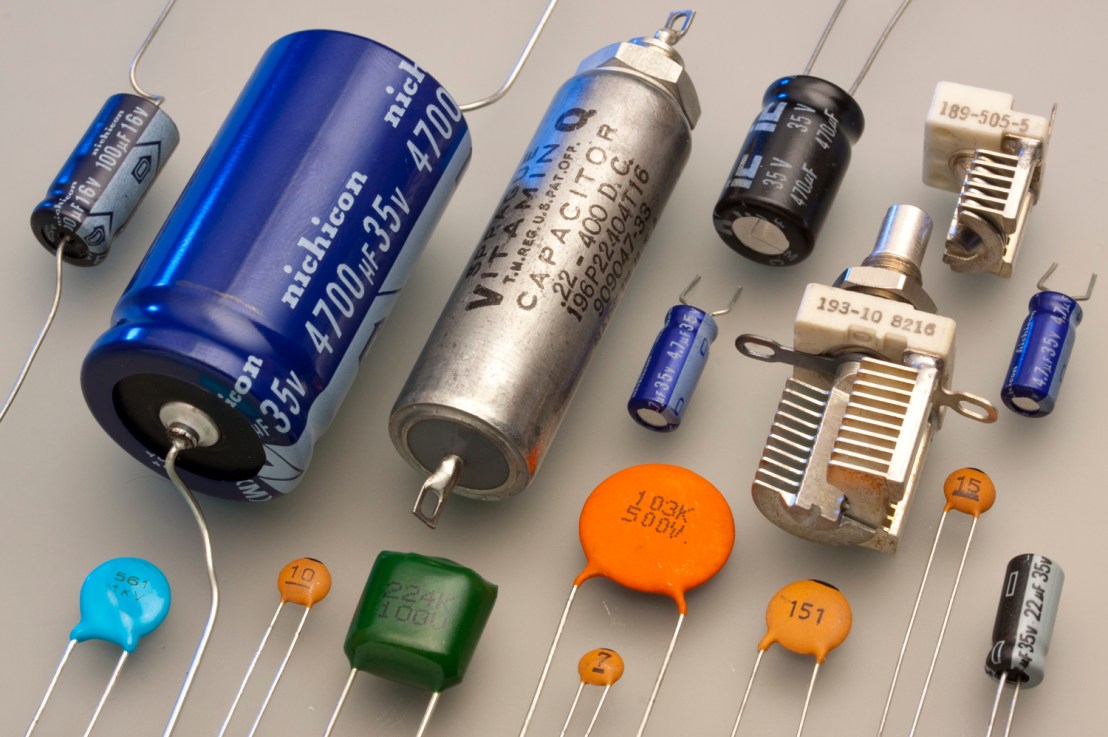
Let us consider the following. Two conductive plates are placed on the positive and negative terminals of a circuit with a battery, both in parallel with one another and separated by an insulating material. When the battery turns on, electrons will rush from the “positive” terminal plate, causing a net positive charge on the aforementioned plate. This net charge will then induce electrons to flow from the negative side of the battery to the other plate The balance of these two charges will create an electric field, which in turn will store voltage. This device is called a Capacitor

 We can symbolically analyze capacitors using the equation C=qv, with C being the capacitance, q being the charge, and V being the voltage. Now let’s think about this equation from a real world perspective. We know that Capacitance is caused by a charged particles emiting voltages, so the higher the ratio of maximum charged particles to voltage, the more that this capacitor can store. An equivalent  way to put this equations is C=e*A/D, where e is the electric permittivity constant, A is the area, and d is the distance between the plates. Again, let’s put this in a real world perspective. This seems to be a ratio of the area of the plates to the distance between them, so the more area, the more charge we can store, and the greater distance the smaller the electric potential will be between the charges In addition, we can analyze the energy of the capacitors using the equation E=½ * C* V2, so the more capacitance and voltage, the more energy can be stored in in the object. In summation, capacitors are an intriuing way to store energy

Kinetic energy

Kinetic energy

Kinetic energy

06/22/16

“What quantity can we give to a moving object?”

As discussed earlier, energy exists in all kinds of forms, but we want to to be specific, how exactly do we define the energy of a moving object? We call this quantity Kinetic energy. Kinetic energy is a measurement of energy of a

A young physicist might have two questions on their mind. First of all, how what quantity can we give to a moving object, and how can we apply the idea of energy to a moving system? Well, more seasoned veterans of science have already debated and answered the question, with the end result being kinetic energy. Kinetic energy is the quantity of energy associated with a moving object. The unit for Kinetic energy (here on will be abbreviated as K.E) is the Joule, and the formula is K.E = 1/2 * m *v2, with m being the mass of the object and v being the velocity. From this relationship, we can notice an interesting relationship, when the velocity of an object increases, the kinetic energy will increase to the square of the difference! For example, if an object goes twice as fast than another object of the same mass, then it will have four times as much kinetic energy.

Furthermore, the Kinetic energy of an object is directed related to the work that was done on to the object. We can put this numerically as F*d=1/2 * m*v2, Where F is force and d is distance. This means that by knowing the work done to an object, we can find the change in kinetic energy, and if we know the mass, the we can use this to find the change in velocity! On top of this, due to the conservation of energy, K.E can be transferred into all sorts of other forms of energy, such as potential energy.

AC electricity

AC electricity

AC electricity     06/14/16

“What is AC electricity?”

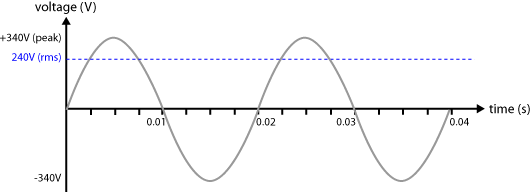
When one first starts to learn about the basic concepts of electricity and circuitry, they are first introduced to the conceptually easier and more primitive DC electricity.However, the most commonly used form of electricity for power transmissions in the modern age is known as AC electricity.

A generator for AC electricity works as follows. A shaft that contains magnetic materials is encass in series of windings. When the generator turns, the electromagnetic interactions between all of the materials will induce a voltage that alternates with time (hence the name Alternating current).

However, what makes AC power vital for long distance transportation is the transformer. Before AC, there was a problem, households require a lower voltage for safety  purposes, but transferring low voltage over a long distance is inefficient due to the IR power loss, or the fact that the higher the current, the more energy will be dissipated over a long distance. But with the introduction of a transformer, this dilemma can be solved. Since AC currents are constantly changing, they produce magnetic fields around their paths. If one is to place a ring of loops near this magnetic field connected to a different circuit, then another current can be induced. What is particularly fascinating about transformers is that both circuits can have different voltages! The way that this works is that the value for magnetic flux will be different depending on the number of loops, so if the “receiving” side has more loops, the transformer will be a step up transformer and the other side will have a higher voltage, while the reverse is true for one with less wires (“step down” transformers). Therefore, the voltage for power transmission can be extremely high and can “step down” once it becomes close to a user’s home.

Pressure volume diagrams

Pressure volume diagrams

Pressure volume diagrams              06/13/16

“How can we empirically model the change in pressure and volume of a gas?”

In order to model the change in pressure and volume of a gas, Scientists and Engineers have created a framework known as Pressure volume diagrams. P-V diagrams are very simple, the Pressure and volume of an object will be represented by a cartesian coordinate system with the Pressure on the vertical axis and the Volume on the horizontal. When work is added to the system, the change in volume and pressure is recorded along an arc length. The volume under this curve represents the change in work in the system. The return process does not have to be symmetric, so often a P-V diagram could possibly have a different return curve.
Let us illustrate with the following example. Imagine gas with a piston in a machine.The state of the gas gas starts at point 1 on the graph. Heat is then added, which the increase the pressure. The normalization process then starts, which decreases the pressure and increases the volume, causing the state to go to poin 2. Heat is then extracted, which causes the state to go to point 4, and the reverse normalization process starts, which causes everything to go back to the begining at point 1.

Avogadro’s law

Avogadro’s law

Avogadro’s law              06/09/16

“Do gases of the same volume, temperature, and pressure have the same amount of molecules?”

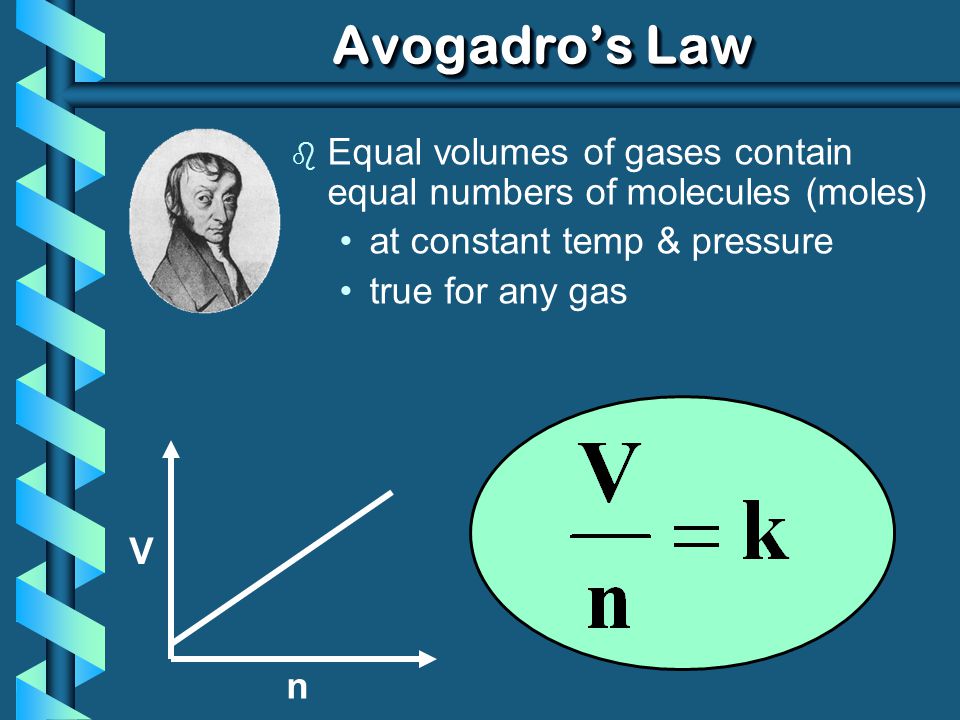
Through thorough experimental observation, it has been shown that Gasses of the same volume, temperature, and pressure have the same amount of molecules. This can be neatly summarized as Avogadro’s law, which symbolically states that Vn=k, with Vbeing the volume of the gas nbeing the number of molecules and kbeing some constant.

Charle’s law

Charle’s law

Charle’s law                  06/08/16

“ What is the relationship between a gas’ volume and temperature?”

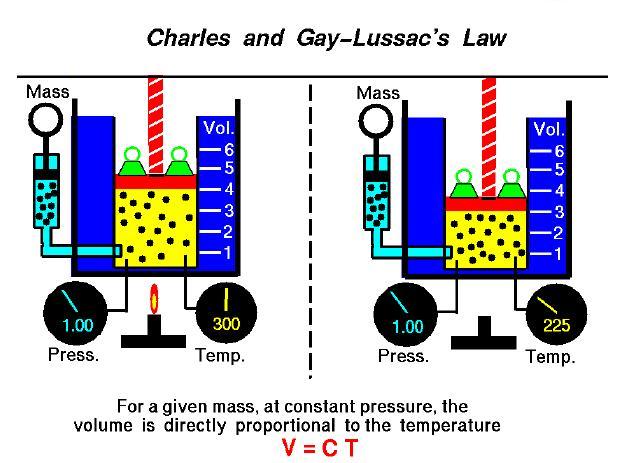
For a gas, the relationship between it’s volume and temperature is very simple. As a gas’s temperature increase, it’s volume will increase proportionally. This is because the molecules of a gas are relatively unbounded to one another, and when their temperature increases, their average speed will increase, and the volume encapsulating the gas will increase as a result. This can be symbolically summarized in Charle’s law, in which VT=k, with Vbeing the volume, T being the temperature, and k being a constant.

Boyle’s law

Boyle’s law

   Boyle’s law          06/07/16

“What is the relationship between Pressure and Volume in a gas?”

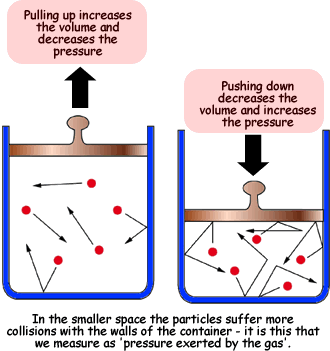
The relationship between Pressure and volume can be neatly summarized in a simple concept known as Boyle’s law. Boyle’s law states that for a gas the pressure multiplied by the gas is simply equal to some constant k. To put this numerically, P*V=k. We can expand upon this by the fact that if the pressure and volume change, their product will be equal to the same multiple, so P1*V1=P2*V2.

Ideal gas

Ideal gas

Ideal gas                06/06/16

“What model can we use to describe a gas?”

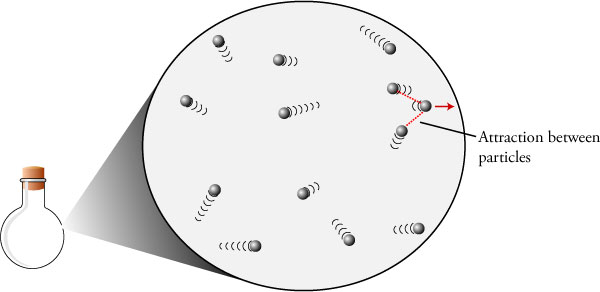
Let us visualize all of the particles in a gas in their pure intricateness. Think of all of those individuals particles bumping around in semi-random number. There are numerous factors that affect this gas, such as temperature T (how quickly each of these particles are moving around) pressure P(the density of each of the gas particles bouncing against the tank), Volume V (the amount of geometric space the gas takes up), The amount of gas . All of these facets are fundamentally related to each other with something known as the ideal gas law P*V=n*R*T, with R being a constant. This equation is insurmountably amazing because it means we can find out so many properties of a gas by just knowing a few factors!