Category: Physics

Eddy Currents

Eddy Currents

Eddy Currents

07/13/16

“What happens when a conductor moves through a magnetic field?”
Let’s consider a situation. Say we have a conducting material, such as copper or iron. And let’s also say that we are going to pass this material through a magnetic field. Since conductors contain electrons, and when electrons move at a speed relative to a magnetic field, a force will be generated. And since conductors allow electrons to move within the internal structure of the material, these electrons will swirl around in a way so that they generate a magnetic field that opposes the original magnetic field. Because such movement of electrons are circular in nature, scientists and engineers have termed this phenomena eddy currents.

Atomic clocks

Atomic clocks

Atomic clocks

07/10/16

“Is it possible to have clocks accurate to a billionth of a second?”

We use clocks to keep time everyday. Whether it be for scheduling flights or processing the internet, civilization depends on clock technology to keep everything in balance. Clocks work by measuring the oscillations of a pattern, such as measuring how long a pendulum takes to swing back and forth or the earth to move around the sun. However, such machines are not always perfect. Since clocks (of all types) are physical objects, they are subject to the physical laws of the universe. Consequentially, these contraptions are prone to perturbation, which in effect makes them liable to becoming out of sync with other clocks. These inconsistencies add up over time (pun defiantly intended), and if they go on for too long, then drastic consequences can happen. For example, high speed finance trading could go asunder, which would have devastating effects on the global economy.

So how can we make a clock so accurate that we would never have to worry about civilization collapsing?

Well, luckily for people anxious about such an event, scientists and engineers have constructed marvelous devices known as atomic clocks. Atomic clocks work by measuring the internal oscillation of a cesium atom. Cesium atoms vibrate over 9 billion times in one second, and atomic clocks base their own measurements off such vibrations. Atomic clocks that are so accurate that commercial units are accurate to one second in 3 million years! Because of this genius design, scientists and engineers now base the unit of the second is based upon how  atomic clocks can measure the osculation of a cesium atom.

Joule heating

Joule heating

Joule heating

07/09/16

What effects does dissipated current have on a wire?

Let’s think about something. When particles move through a conductor, we know that they do not move in a straight line, but instead in a semi-random and chaotic pattern of colliding off the walls of the material. During the collision process, some of the kinetic energy of the electrons is converted into thermal energy inside the conductor. After a while, this process (Which scientists and engineers have termed joule heating) will have a macroscopic effect on the temperature of the material. We can quantify Joule heating by using the formula H = k* I^2 *R * T, where H is the heat, K is a constant I is the current, and R is the resistance of the material. One very pragmatic application of joule heating is in a technology that we all know of, the incandescent light bulb. The increased temperature of the filament in the light bulb causes it to glow, which gives off light to the surrounding area.

Partial pressure

Partial pressure

Partial pressure

07/07/16

“How can we quantify the different pressures contributed by different gases in a container?”

Let’s think about something. We know that a mixture is a combination of different gases held within a given volume. We also know that different gases are made up of different molecules. And we also know that different molecules come in different sizes and forms, giving them different quantitative properties. And one of these different quantitative properties happens to be pressure. So therefore, gases of different chemical makeup will have different pressures. So how can we mathematically determine the pressure that each gas contributes to the mixture? Well, this is actually one of the easiest things to solve for in chemistry. All one has to is find the total percentage contribution to the mixture that one of the gases contribute, then multiply that concentration by the total pressure, and one can get the amount of pressure that the individual gas contributes. Scientists and Engineers have termed this the partial pressure of the gas.

Calorimetry equation

Calorimetry equation

Calorimetry equation

07/06/16

“How can we measure the change in energy of an object when it changes temperature?”

Let’s consider something. We know that temperature is a measure of the average internal kinetic energy of an object. So logically, if there is a change in temperature, there is a change in the energy of an object. But how is it possible to measure this change? Well, luckily for us, Scientists and Engineers have come up with a special relationship relationship known as the calorimetry equation. This equation can be represented numerically as q=m*c*t, with q being the change in energy, m being the mass of the object, c being the specific heat capacity (a constant based on the material), and t being the change in temperature.

Electric conductivity

Electric conductivity

Electric conductivity

06/30/16

“What are the properties of materials that conducts electric current and how can we measure it?”

When pondering electrical insulators, many may wonder if there are any anti-thesis to such materials? Specifically, what are some properties of objects that conduct electricity? And how do they do so? First off all, we must think about how electric current works in the first place. Electric current is caused when a voltage potential difference interacts with the free-moving electrons within a lattice. These particles, being weakly bonded to their structure, are carried away in the direction of the potential difference. So logically, all current conducting materials (which will henceforth be referred to as conductors) must have an internal lattice with electromagnetic bonds that are not too powerful, and a path for electron travel.

With this knowledge, we can then delve further in to what geometric factors may affect the conductivity. If the cross-sectional area of the object is larger, then that means that the electrons have a greater area to travel through (remember, electrons do not move in a straight line, they bounce around the internal structure, so when the area gets wider, they have more room to move, which means less traffic and therefore less collision and therefore less resistance). Secondly, if the Length is longer, then there will be more internal resistance, which would lead to a slowdown.

After much research, scientists and engineers have come up with an analytic model of conductivity, with the equation G=(alpha)*A/L, with G being the capacitance, (alpha) being a constant, A being the cross sectional area, and L being the length. What’s even more interesting is that this relationship is directly inverse to the equation for  resistance! This is an amazing technical feat, because this means that human ingenuity was able to find a fundamental relationship between the resistance and conductivity of a material.

Electric insulators

Electric insulators

Electric insulators

06/29/16

“How do we classify materials that do not let charge flow freely?”

For most of our study of electromagnetism, we have been studying materials that allow electrons to flow freely. But out of curiosity, are there materials that do not allow such a free movement of electrons? If these materials do in fact exist, then trying to induce an electric current to flow through them would be futile, as the electrons would not even budge. Believe it or not, these objects do in fact exist, and scientists and engineers  classify these materials as insulators. Insulators have many pragmatic purposes, such as dielectrics and high voltage systems.

Electric polarization

Electric polarization

Electric polarization

06/28/16

“Do insulators respond to electric fields?”

What happens when an insulator, which by nature holds it’s charges in stasis, is placed within an electric field, specifically one with a very large strength? Well, as an object within the universe. the insulating material is made up of subatomic particles. Some of these subatomic particles have a charge.The charges will react to this electric field, and consequently, particles of one charge will be attracted to one side of the object, and particles of another charge will be attracted to another. As a result, the object will have an induced polarization, or some parts of the object’s geometry will have a net charge as a result of the electric force.

Dielectrics

Dielectrics

Dielectrics

06/27/16

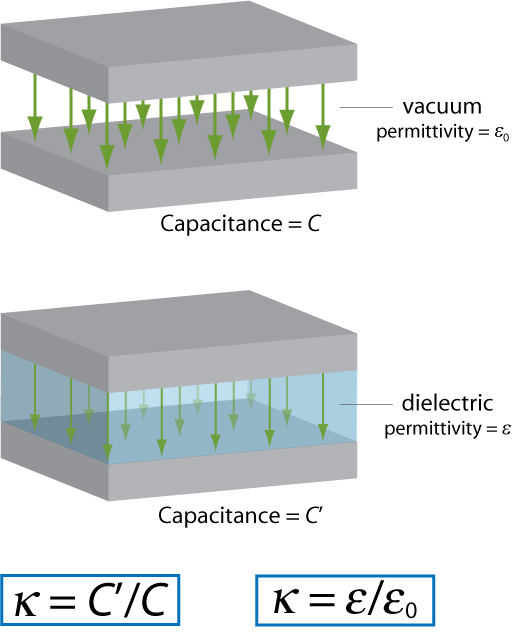
“Is there a way to increase the capacitance of a capacitor without actually modifying the capacitor itself?

Scientists and Engineers are very practically minded people,so when working with electronics, they would like to make the components as efficient as possible. So when applying this mentality ro capacitors, one way to accomplish this is by increasing the capacitance of the capacitors themselves. So let’s think about how a capacitor works in the first place. If you remember, what makes such components function is that two conducting plates are placed parallel in between a non-conducting material. Let’s call this material a dielectric. When placed in between the two charged plates, this dielectric will react to the net charge on each plate and become polarized. As a consequence, some of the negative charge of the dielectric will be oriented towards the positive plated and vice versa for the negative plate. This causes some of the charge to cancel out, which reduces the effective voltage, which increases the space for extra charge which allows the capacitor to store more charge! We can symbolically relate the old and new capacitance with the equation C=kc, where the capital C represents the new capacitance, k representing the dielectric constant (basically the quantity of the material to store energy in an electric field) and c representing the old capacitance. As one can see, dielectrics are very practical devices that can have many potential uses