Category: Physics

Circumstellar habitable zone

Circumstellar habitable zone

Circumstellar habitable zone

Isaac Gendler


“What is the area around a sun in which a planet can sustain life?”

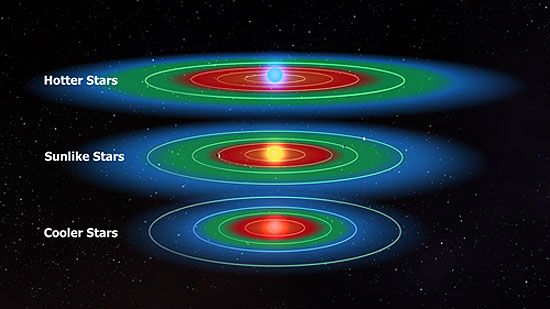
Ever since humanity first looked to the stars, we have dreamed about inhabiting other worlds. But to our dismay, ever since the beginning of surface readings of the other planets inhabiting our solar system, we have found that the sufficient conditions for complex life are truly rare indeed. However, with the recent and exponential discovery of exoplanets, this dream might become a possibility again. And one of the first steps we must take is to find at what range around a star can a planet support life. To solve this question, we must think about what is the primary source of complex life. After much debate, scientists have decided that liquid water is such as source. So for a planet to be habitable, it must be far enough from the sun to not have it’s water boil up, but not far enough to have it’s reservoirs freeze up either. The range is represented as a torus around the sun, and the size is contingent on how much energy a sun gives off, so if a sun gives off only a small amount of energy, it’s radius will be smaller, and if it gives off a lot, it’s radius will be higher. Astronomers and astrophysicists have termed this phenomena the circumstellar habitable zone. Given the right amount of atmospheric pressure and range from the sun, liquid water is possible for life on another plant.

Proxima B

Proxima B

Proxima B

09/10/16

“Is one of our nearest rocky planet habitable?”


A discovery has been made that is possibly so great that it can change the course of humanity forever. Or not. A new planet has been discovered in Proxima centauri (the nearest solar system to ours) only 4.2 light years away from us called Proxima B. We already know a few things about Proxima B, specifically has a mass that is just over a third greater than the Earth’s, it is only slightly more than seven million kilometers away from the star that it orbits, and is tidally locked (meaning one face of the planet will always be facing the star). But more importantly, this planet falls within the habitable zone of it’s star, which means that this planet has temperatures in the range  that is “just right” to host liquid water.

However, there are many factors of this planet that might just burst our bubble. First of all, we have no idea what the atmosphere of proxima B is composed of. In fact, for all we know, it could be completely toxic! Also, since the host star of Proxima B is a red dwarf, the habitable zone for the distance for the habitable zone of this planet is merely 5% of our own. This means that Proxima B is extremely close to it’s orbiting sun. So close in fact that the time for a single year to go by is merely 11 Earth days, and since red dwarfs can be very volatile, there is a strong possibility of unpredictable flairs from the planet.

Proxima B is a perfect example of why as a scientific thinker one must express excitement yet restraint when hearing possibly paradigm shifting news, since we must not bee to short-sighted to observe that such news could be false, yet not too cynical to take joy in the wonder and mystery of the universe.

Pulleys and mechanical advantage

Pulleys and mechanical advantage

Pulleys and mechanical advantage

09/06/16

“Is it possible to lift an object with a force that’s less than it’s weight?”


If you ever had to design a system focused on lifting objects, you probably bemoan the fact that if you want to lift a heavy object, you have to use a force that is greater or equal to it’s weight.

Or do you have to?

What if there was some way if we could manipulate the laws of physics, so we could lift an object with a force that is less than it’s weight? Well, let’s think about how we could do this using mechanical advantage.

Let us start with a very simple machine called a pulley. More specifically, we will be starting with a single, fixed pulley. A fixed pulley is a dimply a disk hinged onto an axis in which it is free to revolve around but may not move transitionally. If we were to take a rope and move throw it over the circumference of a pulley, it would reverse the direction of the rope, so we could lift an object while using a downward force instead of an upward force. We still have to use the same force as the weight, but it allows us to change directions.

Now let’s go a step further. What if we were to take that same rope, and make it go under a new pulley, this time a moveable pulley, attach the end of the rope to a ceiling like structure above the pulley, and attach the weight to the moveable pulley. Now the rope will be supporting the pulley on both sides of the object, it can effectively double it’s force value! This means we can now use a force value that is less than the weight of our object to lift it up! You can even create more complex pulley systems to create a greater mechanical advantage. However, there is one major downside to using this setup. Since energy must be conserved, and you are using a smaller force, you must increase the distance you pull your object proportionally to the strength of the force you are using. For example, if you have use a force that is half of the weight, then you will have to pull the rope twice as far, three times as far for a force a third of the weight, and so on. In addition, when we perform these calculations, we assume a massless pulley with no moment of inertia or friction, so there are bound to be some inefficiencies that will require us to use even greater distances

All in all, pulley systems are a testaments of human ingenuity, and are a classical representation of simple yet effective engineering.  

Blood pressure

Blood pressure

Blood pressure

09/05/16

“What is blood pressure?”

When you go for a medical checkup, you will often hear a lot of talk about your “blood pressure”. But what exactly is this phenomena? Well, believe it or not, blood pressure is  actually a very simple concept. Your body is able to maintain it’s operations because the heart pumps blood (which carries oxygen) to all of it’s vital systems. This pumping motion causes blood to be pushed against the walls of your blood vessels, and we can quantify this force as blood pressure. Your blood pressure is usually measured in “millimeters of mercury” (or mmHg), and is given two values (for example, a stable blood pressure is considered to be 120/80 mmHg). But why on Earth will your blood pressure be given two values? Well, let’s think about it. When your heart pumps blood, it does not do so in a constant fashion. Instead, it acts like a piston, with a force changing in a beating nature. So your blood pressure will be the highest at the peak force (termed the systolic blood pressure), and lowest at the bottom (termed the diastolic blood pressure). The higher your blood pressure is, the higher you will have a risk of developing heart heart problems. For example, someone with a blood pressure reading of 135/85 mmHg is twice as likely to receive a heart attack as someone with a blood pressure of 115/75

Galvanic cells

Galvanic cells

Galvanic cells

08/27/16

What is the simplest possible battery?


Batteries are some of the most omnipresent electrical components in human civilization. However, what is the most simple form of them? Well, in order to do that, we have to put everything into it’s most basic parts.

Well, let’s suppose we have a slab of zinc and a slab of copper, both occupying space in separate dishes of water. Both of them have some of their substance dissolved in the water. The electrons on the zinc solvent want to leave the element, while the copper solvent (with a charge of +2) wants to obtain electrons. If we connect both the copper and the zinc slab with a conducting wire, then the extra electrons on the zinc side will sense the voltage potential on the other side, creating a current, with the zinc side being the cathode and the copper side being the anode. The zinc increasingly becomes oxidized, while the copper becomes increasingly redoxed. However, as this process progresses, more zinc cations will be generated along with the disappearance of more anions, leading to a short life time!. To solve this problem, a salt bridge is instituted connecting the zinc and lead sides. This salt bridge is made up of Potassium Chloride [KCl] in a pseudo-aqueous solution (meaning that it is viscous to a point that the salt will not immediately react with the surrounding elements). As the process goes on and both sides become more charge neutral, the salt will break up bit by bit to have the positive potassium ions replenish the charge of the copper and the negative chloride will replenish the charge of the zinc


This in turn creates a simple battery, called a galvanic cell (Also termed a voltaic cell, after the Two Italian scientists Luigi Galvani and Alessandro Volta, respectively).

Thermal expansion

Thermal expansion

Thermal expansion

08/12/16

“What happens to the volume of objects upon a temperature change?”


Let’s think about something. All objects are composed of vibrating atoms. And when an object is heated, those vibrations become more powerful, and the lengths of their vibration increase. So, what does this imply on the macroscopic scale? Well, if an object’s volume is determined by the volume of space that this volume of atoms takes up, and this volume increases, then the volume object should increase as well, therefore, heating causes (most but not all) objects to expand. Scientists and Engineers have named this phenomena thermal expansion. Thermal expansion is a very omnipresent physical phenomena, and can have dire implications for works of engineering if not taken care of.

What went wrong with Fukushima?

What went wrong with Fukushima?

What went wrong with Fukushima?

08/04/16

“What exactly took place with the fukushima reactor?”


Many people still remember the events of March 11th, 2011. On that day, an earthquake and a tsunami both with an insurmountable amount of force hit Japan, causing truly catastrophic damage. What was particularly hit were the Nuclear reactors in Fukushima, causing a great dispersal of radiation into the surrounding region

Let’s start with the basics. The reactors in Fukushima use both plutonium and uranium as fuel. These atoms are so large that they can easily become unstable. If a neutron hits them then they are likely to collapse. When fission occurs, these atoms release at least two neutrons, which  cause a butterfly effect know as a chain reaction if those neutrons hit more atoms, causing much energy to be created which ends up as heat. Fukushima use water as a coolant to form steam, which passes through a moisture separator to power a large turbine to create electrical energy.

Usually, reactors have a shutdown safety feature, in which a control rod slams into the fission reactor, stopping the fission process. However, since the isotopes are still in the process of decaying, so the “decay heat” needs to be removed so a meltdown does not ensue. Usually, this is accomplished by a cooling pump. However, this cooling pump often requires energy, so it usually takes it from the grid or two backup diesel generators.

Since radiation is still being generated, a three-layer security system is often put into place. This protection system includes fuel cadding (which uses a thin layer of a zirconium alloy to surround the fuel rod), the reactor vessel (a thick steel vessel that contains the fuel rods and a high-pressure coolant) and the containment structure (a thick shell of reinforced concrete). And since pressure from the water reactor often rises with the water temperature level, the vessel has safety valves that are designed to vent pressure (usually in the form of steam or radioactive water).

What happened in Fukushima went as follows; The earthquake caused massive tremors, which caused the fail-safety features to activate. However, the connection to the grid was knocked out by the earthquakes, and the tidal waves destroyed the diesel engines. This in turn caused a heat buildup, which in turn lead to a complete meltdown for three of the reactors.

Whatever has happened, the people lost in Fukushima will always be in our hearts, and we must strive constantly to make sure that such a calamity does not happen again. After reading, this, try to find a way to help the victims of Fukushima

Magnetic field polarity

Magnetic field polarity

Magnetic field polarity

08/03/16

“Why do scientists describe magnets as having a north and south pole?”


Magnets are very interesting pieces of the physical universe. They seem to be able to attract and repel objects with a completely invisible field. However, why is it that one side of a magnetic field can attract objects and the other side repel, and how can we describe the direction of this physical field?

When studying magnetism, scientists and engineers have decided to describe the flow of magnetic field in terms of polarity. All magnets have  are fundamentally dipolar, which means that one side is like the “positive” charge on an electron, while another is like a “negative” charge. Similar to electrons, opposite polarities attract and like ones repel. However, instead of being called positive and negative, these sides of a magnet are called the north and south poles respectively, almost like how the earth has a north and south pole (speaking of which, the earth’s magnetic poles are actually opposite of the geographic poles, but that is a topic for another time). For specifying the direction, Physicists have constructed the system so that the magnetic field will point from the north pole to the south.

Lenz’s law

Lenz’s law

Lenz’s law

07/15/16

“What is the relationship between a changing magnetic field and induced voltage?”

Because of Maxwell’s equations, we know that there are fundamental relationships between electricity and magnetism. If we think more in depth about this, wouldn’t it not be too far fetched if there be some some of affect that a changing magnetic field could have on electricity? Well, if the little physicist in you wants to ponder more, then it turns out that this relationship is true. One of the most fundamental physical laws is known as Lenz’s law, which states that a changing magnetic flux causes an induced voltage. For those of you who know calculus, we can state this quantitatively that the time derivative of magnetic flux is equal to the induced EMF