Category: Physics

Intermolecular forces

Intermolecular forces

Intermolecular forces

11/05/16

“What exactly keeps groups molecules together?”


Have you ever wondered why even through objects are made of molecules moving around in space, they seem to be able to keep their form? Well, let’s think about it. First of all, let’s view everything from a microscopic standpoint. When molecules are close to one another, they have a tendency to form associations with one another resulting from a phenomena called intermolecular forces. The forces (in increasing order of strength) include london dispersion (in which all molecules experience), dipole-dipole interaction (when two or more electrically charged molecules come in close proximity within one another), and hydrogen bonding (when a hydrogen atom of one molecule comes into close proximity of an oxygen[O], nitrogen[N], or fluorine[F] of another). What I find personally amazing is how billions of these forces over time will manifest into the everyday material objects that we experience everyday!
Root-mean-square speed

Root-mean-square speed

Root-mean-square speed

10/31/16

“How can we find the average kinetic energy of all of the atoms in a gas?”


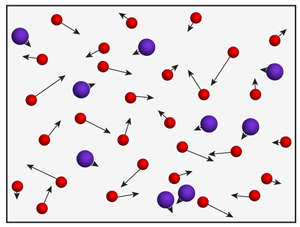
We see gasses everyday, whether it be the atmosphere that we breathe, the substances that drive pneumatic controls, or the air that flows through air conditioner. However, we also know that the temperature and kinetic energy of a gas is contingent upon the speed of the gas itself. The problem is, since gases are composed of individual particles moving with only weak connections to one another, measuring the average velocity of the entire system probably sounds like a near-impossible task! Luckily, due to the labors of countless scientists, it turns out that such an endeavor is not impossible at all with the use of a conceptual tool known as the root-mean-square-speed. The root-mean-square-speed states that the average speed of all of the individual particles in a gas is proportional to the square root of the temperature of the gas divided by the molar mass of the molecules that compose the gas, all of which can be represented symbolically as vrms=3*R*T/(Molar-mas) ., with R being the gas constant 0.08205 Liter atm/molar * k, and T being the temperature in kelvin.

Electron affinity

Electron affinity

Electron affinity

10/23/16

“How can we measure the energy used when an electron is added?”


We know that the energy of an atom changes when an electron is added. But how can we measure so? Well, we know that electrons are always placed into orbitals. And we know that an element’s oxidation state is contingent upon the numbers of orbitals filled. And on top of that, the more orbital shells are filled, the smaller the radius becomes, therefore magnifying the force. So wouldn’t it make sense that it is easier for an electron if most of the valence shells are filled? Therefore, electrons become easier to add the higher occupancy of orbitals.This makes sense because as we move from left to right, elements tend to become more negative in their reactions. Scientists have termed this principle electron affinity.

Voltage

Voltage

Voltage

10/16/16

“What is voltage?”


Often times, when you read about electronics, you hear about some abstract measurement called voltage, but what exactly is this concept? Well, Voltage is defined as the difference in electrical potential between two points in space. Basically,  one can think of voltage like the electrical equivalent of pressure difference between two points in space, so the more voltage there is between two points, the more “push” there is associated with it. For example, just like a high pressure piping system is necessary to drive a turbine, a higher voltage system might be necessary to power more powerful electronic equipment. The unit for voltage is measured in volts, which is defined as one potential energy per meter, meaning that this would be the work done moving one unit charge. Voltage is occasionally called the “EMF” (especially in respect to batteries).

Normal stress

Normal stress

Normal stress

10/08/16

“What happens when stress acts upon an area parallel to the axis of an object?”
The concept of stress is one of the premier foundations of all of engineering science. So, what happens when a stress is applied to an area that is parallel to the axis of the object? Well, this type of action is very simple. Since all of the stress acts through the axis of an object, the only deformations will be parallel to the axis as well. This type of stress would cause tensile or compressive deformations (depending on the direction and strength of materials). Scientists and Engineers have termed this phenomena normal stress. You can find the magnitude of normal stress very simply, as the stress is just the force distributed over the area that it is acting upon (we can represent this symbolically with the equation (sigma)=F/A, with being (sigma) the stress, F being the force, and A being the geometric area)

Spin quantum number

Spin quantum number

Spin quantum number

10/05/16

“How can we describe the angular momentum of an electron?”


The orbits of electrons around the central nucleus of an atom is a very complex matter. And because of this, we will have think to think of creative ways to describe the myriad of elements that make it up. So to make things simpler break this problem down into smaller components, such as the angular momentum. When an electron transits around the central nucleus, it has both an angular momentum from the orbit and another one resulting from the spin around it’s own axis. The combination of these two elements will result in a vector quantity called the spin quantum number. The spin quantum number represents the magnitude (½) and the direction 9+ or -) hat the angular momentum of the current electron. When electrons enter into subshells, they enter each orbital that is currently unoccupied. If the elements only has unpaired electrons, then this spin quantum number will be considered positive, and if the electrons begin to pair up, then the spin quantum number will be considered negative.

Quantized energy

Quantized energy

Quantized energy

10/04/16

“How does energy work on the quantum scale?”
Energy is a most bewildering phenomena. It is the very thing that literally drives the physical universe, yet we have no complete understanding of it. I fact, our understanding of energy breaks down even further when we go into the quantum world. On this scale, energy is not a continuous but a discrete phenomena! This means that energy comes in chunks instead of being “On a scale”. Let me elaborate using a metaphor. on the human scope, energy is measured like the volume of a liquid, it’s size can occupy a whole range of values, going into myriads of different decimals places, while on the quantum magnitude, energy is measured like drops of the liquid, being indivisible (for example, you can’t have half a drop of water). Energy in the quantum world through waves of light in units called quanta, Which are equal to a measurement called Planck’s constant (numerically equivalent to 6.63*10^-34 joules seconds) times the wavelength of the light. This relationship can be symbolically represented as E=h*lambda, with E being energy h being Plank’s constant, and lambda being the wavelength of light.

Hydrophobic substances

Hydrophobic substances

Hydrophobic substances

10/03/16

“Are there substances that are repelled by water?”
You are probably familiar with water. I mean, it’s the basic principle of all life on this planet! And this importance derives from the fact that water can form bonds with nearly all sets of compounds. However, are there substances that are not only insoluble by water but actively repel it? Well, let’s think about how such a substance could exist. The first thing we should analyze is what makes water so bondable, and that comes as a consequence of the polar nature it’s structure. So logically speaking, shouldn’t nonpolar elements have difficulty bonding with water? This is the operating principle behind hydrophobic substances. Examples of hyrophobic molecules include alkanes, oils, and fats.

Equivalent forces

Equivalent forces

Equivalent forces

09/13/16

“How can we simplify force diagrams?”


When working in physics or engineering, we all have to work with forces. Sometimes, we will have a multitude of forces, all going in different direction. However, how could we simplify all of these different elements of a problem to get the big picture and streamline our solution process? Well, let’s think about it. First we should think of our objective, and that is to see what happens when all of these forces are combined. So how about we take the components of each of the separate forces and moments, add them together, and find the equivalent force for all of these values? For example, let’s suppose that we had a bar of length 6 meters, with one force of 20 acting on the far left from the top and another one of 20 newtons acting at the far right coming in from the bottom. When we do all of the calculations, the equivalent force in the x direction will be 0 Newtons (Since none of the forces have an x component), The net force in the y direction will be 0 Newtons (since both forces are going in opposite directions, they will subtract each other) and the net moment will be 135 N-m (Since they are both in the same moment direction, 3m*20N+3m*25N=135N-m). With the use of equivalent forces, we can analyze an unlimited amount of problems, ranging from structural engineering to electrodynamics