Category: Physics

The biot-savart law

The biot-savart law

The biot-savart law

11/25/16

“How can we symbolically describe the magnetic field generated by an electric current?”


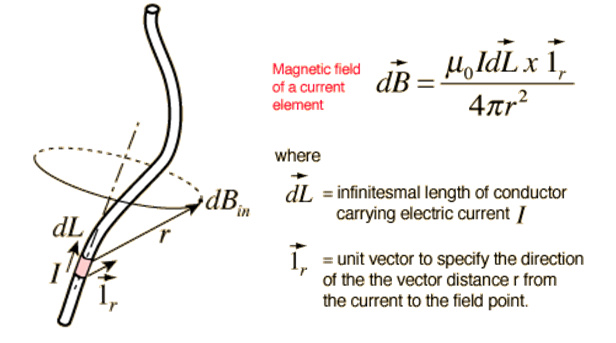
As stated before, an electric current will generate a magnetic field. However, how can we put this into symbolic form for quantitative purposes? Well, thanks to the hard labor of prior scientists, we have a mathematical relationship known as the Biot-Savart law. The biot savart law defines the relationship between a magnetic field and an electric current as dB = (Mu_0*I *dL*l_r)/(4*pi*r^2) , with Mu_0 being the permittivity of free space, I being the current, and dL being the displacement vector (the distance between the current and some location in the field).  

The scientifically optimal way to cook a Turkey

The scientifically optimal way to cook a Turkey

The scientifically optimal way to cook a Turkey

11/24/16

“What is the most efficient way to cook a Turkey?”

Thanksgiving is a most special holiday in the hearts of Americans. It represents a time when friends and family coming together to  participate in social activities and dine on delicious food. And the most important food of all of Thanksgiving is the Turkey, with it’s rich, savoring flavor. However, cooking a Turkey is not always an easy task. Specifically, the plump and rounded shape of a Turkey is most inefficient for heat conduction, forcing it to have a high cooking time (especially if one wants to cook the Turkey to an internal temperature 74 degrees celsius to prevent salmonella).  So how can we apply our scientific knowledge to solve this problem? Well, let’s think about it. We know that the temperature of objects raise based upon the amount of heat added, and that if an object has more surface area, then it has more heat it will receive. So how about we do just this? First, let’s take the Turkey out. Then, flip it over, and cut off the back bones. Subsequently, flip it over again, and apply pressure to break the breastbone. Once this has been completed, you can put the Turkey. Chefs have termed this process the spatch cocking method, and it can save the chef anywhere from 45 to 80 minutes of cooking time!.

Finally, in the Thanksgiving spirit, I would like to give a big thanks to Sarah Kaplan of the Washington Post for teaching the world about this most innovative method.
Emission and absorption spectrum

Emission and absorption spectrum

Emission and absorption spectrum

11/22/16

“Why do elements absorb light?”


Light is something that we literally see everyday, whether it be from the sun shining down on civilization during the day, the incandescent light bulbs lighting up our night, or the flashlights we use to read in bed. However, as light is both a wave and a particle, it has to interact with material objects when it makes contact, so what happens when it does so? Well, let’s think about it. We know that light is composed of atomic-size forms of matter known as photons, and we also know that as a result of the wave-particle dualistic nature of light, these photons will have a wavelength associated with them. And since light is emitted by radiation, these photons will have a distributions of multiple wavelengths, all of which have a corresponding energy. Furthermore, all material objects are comprised of atoms, which have discrete energy levels. So when a photon wave hits a material object, the atom can only absorb the photon if it corresponds to the precise energy level. This energy level will stay elevated for a limited amount of time, and will soon fall back down to the original energy level, emitting  a wave of the same energy level. If one were to take an empirical measurement of the wavelengths being emitted by constructing an emission and absorption spectrum, then one would be able to identify the element present! 

Liquid meniscus

Liquid meniscus

Liquid meniscus

Isaac Gendler

“Why do liquids have a bent top when put in containers?”


Have you ever placed a liquid in a container, and noticed that there was a bend in the top it’s shape? And have you ever wondered why this happens? Well, let’s use our knowledge of science to find this out. As discussed earlier, we know that liquid molecules exhibit cohesive forces towards one another and adhesive forces towards molecules of other substances, such as a solid beaker. So what if these two types of forces do not cancel one another out? This would mean that one side (the beaker or the liquid) would have a greater force than the other side, causing a pull on the liquid towards it. This in turn would cause a “bent” shape called a meniscus to form in the liquid. If the liquid exhibits a concave shape, then the adhesive forces are more powerful, and if it exhibits a convex shape, then the cohesive forces are more powerful. The net forces resulting from a meniscus will frequently result in the spectacular phenomena of capillary action.  

Capillary action

Capillary action

Capillary action

11/16/16

“Why is it that liquids can move up against gravity in containers?”


Liquids are objects that we often see everyday, whether it be in the water that we drink or in the blood that runs through our veins. We also know that objects are held down to the Earth by gravity, but for some ominous reason liquids seem to have the ability to move upwards by themselves in a container against gravity. Why is this so? Well, like I always say, let’s think about it. When liquids are placed in containers, a concave meniscus will form from adhesive forces. If the diameter of the containing vessel is small enough, then the adhesive forces from the container will cause a vertical force on the fluid, and if these adhesive forces are more powerful than the internal cohesive forces will pull the liquid along with it, therefore causing vertical movement. Because this phenomena is so special not only has it been given a special name by scientists and engineers (Capillary action), it is found in many wonderful applications in nature. Plants use capillary action to absorb water from the soil using their roots, and human eyes utilize capillary action using two small diameter tubes called the lacrimal ducts to drain tear fluid in the eyes.

London dispersion

London dispersion

London dispersion

11/11/16

“What is the weakest of the intermolecular forces and how does it form?”


As a result of the nature of quantum mechanics, we know that in atomic structure, electrons do not orbit around the nucleus in a newtonian fashion, but instead are located in probability densities surrounding the core. Since electrons will move around in such a manner, the charge distribution of an atom is bound to become slightly asymmetric with time. Consequently, these asymmetric atoms will interact with other asymmetric atoms to form very subtle electric dipoles, resulting in a very weak intermolecular force. Scientists and Engineers have termed this phenomena to be London dispersion, and it is found to be the weakest of all the intermolecular forces. Despite this, as a result of it’s universal nature, all molecules are found to exhibit london dispersion
  

How quantum mechanics poses problems with reality

How quantum mechanics poses problems with reality

How quantum mechanics poses problems with reality

11/09/16

“What are some of the most counter-intuitive aspects of quantum mechanics?”


At the turn of the 20th century, physicists began discovering that the Newtonian mode of the universe was inadequate. In classical mechanics, one is able to predict the entire motion of an object using only a simple set of equations, giving the universe a deterministic structure. However, this simplicity collapses as one enters the quantum scale. Instead, every time objects collide with one another, only a probability of possible trajectories can be given by a mathematical tool known as a wave function. Since this phenomena is so strange, physicists are divided into two discrete worldviews regarding the properties of the wave function; instrumentalists believe that the wave function is only a conceptualization invented by humans, and that there is no absolute way of knowing reality, while naturalists believe that the wave function is in fact a property of nature itself. Whatever it is, a most intriguing aspect of this facet of nature is that all of these semi-random chaotic quantum processes will eventually coalesce to emerge into the materialist universe that we can observe and experience. So everytime you think that everything is dull and boring, just think about the myriad of secluded wondries going on in the smaller scale!

Adhesive forces

Adhesive forces

Adhesive forces

11/07/16

“What causes liquids to stick to surfaces?”


Have you ever wondered why liquids seem to have sticky properties? Well, let’s think about it. We know that molecules of a liquid substances are attracted to each other through the phenomena of intermolecular forces, but since all materials in the universe are made up of molecules, wouldn’t it be logical that molecules of these liquid substances could also be attracted to molecules outside of the substance? This is the fundamental idea behind adhesive forces. Because of adhesive forces, liquids have the ability to “stick” to the containers in which it rests. And most peculiar application of adhesive forces are utilized by the insect known as water striders, who can literally glide upon water.

Cohesive forces

Cohesive forces

Cohesive forces

11/06/16

“What causes liquids to stick together?”


Liquids are a most peculiar state of matter. Their shape will change depending on the container that they’re in (just like gases) , but at the same time their volume will remain consistent (just like solids). Why do liquids have this paradoxical combination of features? Well, let’s investigate it. On a microscopic level, the molecules of liquids move around in semi-free state, not being as rigidly bound as a solid but not having the level of separation as a gas. The molecules of a liquid are attracted to one another through a phenomena known as cohesive forces, in which molecules of the same type experience an intermolecular force attracting one another. Now with this fact, we can deduce something very interesting. Volumes of a material are composed of units of molecules. And since molecules in liquid experience cohesive forces that makes them stick together, the amount of molecules in this liquid will not change unless a more powerful force rips away some of the molecules, therefore giving liquids a constant volume! Due to cohesive forces, liquids can be fluid like gases but maintain their volumes when poured into another container or experience mechanical stresses, or exhibit properties such as surface tension.