Author: Isaac Gendler

Quantized energy

Quantized energy

Quantized energy

10/04/16

“How does energy work on the quantum scale?”
Energy is a most bewildering phenomena. It is the very thing that literally drives the physical universe, yet we have no complete understanding of it. I fact, our understanding of energy breaks down even further when we go into the quantum world. On this scale, energy is not a continuous but a discrete phenomena! This means that energy comes in chunks instead of being “On a scale”. Let me elaborate using a metaphor. on the human scope, energy is measured like the volume of a liquid, it’s size can occupy a whole range of values, going into myriads of different decimals places, while on the quantum magnitude, energy is measured like drops of the liquid, being indivisible (for example, you can’t have half a drop of water). Energy in the quantum world through waves of light in units called quanta, Which are equal to a measurement called Planck’s constant (numerically equivalent to 6.63*10^-34 joules seconds) times the wavelength of the light. This relationship can be symbolically represented as E=h*lambda, with E being energy h being Plank’s constant, and lambda being the wavelength of light.

Hydrophobic substances

Hydrophobic substances

Hydrophobic substances

10/03/16

“Are there substances that are repelled by water?”
You are probably familiar with water. I mean, it’s the basic principle of all life on this planet! And this importance derives from the fact that water can form bonds with nearly all sets of compounds. However, are there substances that are not only insoluble by water but actively repel it? Well, let’s think about how such a substance could exist. The first thing we should analyze is what makes water so bondable, and that comes as a consequence of the polar nature it’s structure. So logically speaking, shouldn’t nonpolar elements have difficulty bonding with water? This is the operating principle behind hydrophobic substances. Examples of hyrophobic molecules include alkanes, oils, and fats.

Boron carbide

Boron carbide

Boron carbide

10/02/16

“Why is bullet proof armor bullet proof?”
We are all probably familiar with bullet proof vests. These amazing pieces of technology have saved countless of lives through their simple yet intuitive design. However, what makes these vests so durable? Well, the answer lies in it’s composition, specifically, the fact that it’s made out of a very special compound called Boron carbide. A single molecule of Boron carbide is derived from four boron atoms and one carbon atom. But this is not just what makes boron carbide special. What makes this molecule special is it’s extreme durability. Namely, the fact that it is the third hardest substance known to humanity behind diamond and cubic boron nitrade. And out of these three substances, it is the only one that can be easily mass-produced! Because of this, Boron carbide is the number one choice for application in military necessities such as ballistic armor, tank covering, and even nuclear plating! Boron carbide also has non-military applications found in high pressure jet cutter nozzles, padlocks, and for control rods in nuclear power generation.

Lipids

Lipids

Lipids

Isaac Gendler

“What is your fat made out of?”
Everyone has fat on their bodies, but have you ever wondered what it is made out of? Well, it turns out that body fat is composed of an interesting class of molecules called lipids. Lipids are molecules that contain hydrocarbons and are insoluble in water due to their non-polar structure. This composition also makes them hydrophobic. These liquids form an essential part of a creature’s biology. In fact, we can obtain a reasonable amount of lipids by consuming the fat of other animals.

Empirical formula

Empirical formula

Empirical formula

09/30/16

“How can we obtain the structure of a chemical just by knowing the percentage of it’s components?”
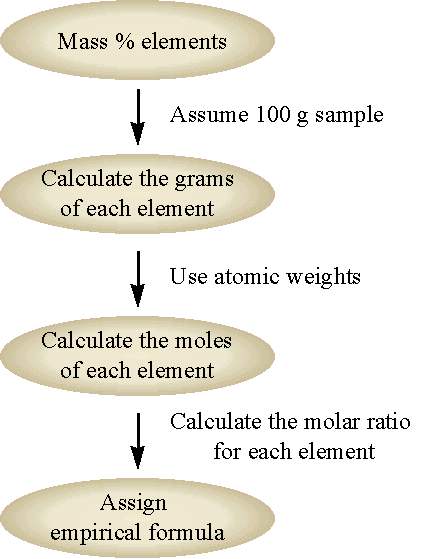
Wouldn’t it be really cool if just by knowing the percentage composition of the different atoms in a compound, you could obtain the chemical formula? Well, let’s figure out how to do it by completing an example. Let’s say that you obtain a chemical with percentage 58.64% Carbon [C], 8.16% Hydrogen [H], and 43.20% Oxygen [O]. The first step we must take is to change this percentage into something more realistic, such as mass. To make the math easy, let’s use a mass sample of 100g. This means that this compound will have 58.64 grams of carbon[C], 8.16 grams of hydrogen [H], and 43.20 g of oxygen [O]. The second step will be to take these masses and change it into moles. After doing the math, we will end up with 4.409 moles of carbon [C], 8.905 moles of hydrogen [H], and 2.7 moles of oxygen [O]. if you notice, all of the moles are in “messy” values, so we need to simplify this somehow. We can accomplish this by dividing the moles by the lowest number (In this case, the lowest number is 2.7). After we do the math, we will end up with 1.5 moles of carbon [C], 3 moles of hydrogen [H], and 1 mole of oxygen [O]. Now, we simply have to make everything a whole number. We could do this by multiplying all of mole values by 2, giving us 3 moles of carbon [C], 6 moles of hydrogen [H], and 2 moles of oxygen [O]. Our final compound formula will be C3H6O2, which just so happens to be the chemical formula for Acetate. Since this process will always give you the formula with the simplest amount of proportions, it is called the empirical formula.

Platonic solids

Platonic solids

Platonic solids

09/29/16

“What are some of the most symmetric polyhedra?”


Polyhedra are quite fascinating mathematical objects. Are there any special type of polyhedra that are especially symmetric? Well let’s think about it.We know that polyhedra are constructed by having flat shapes meet at each vertex. What if were to find polyhedra that have an equal number of shapes meet at each vertex? If that happened, then each vertex will have an equal angle, therefore the entire object will be completely symmetric! These solids are classified as the platonic solids, of which there are five of (proven by Euclid): The tetrahedron, the cube, The octahedron, the dodecahedron, and the icosahedron. These shapes can be found everywhere in nature, from the chassis of viruses to the framework of bee hives.

Polyhedra

Polyhedra

Polyhedra

09/28/16

“How do we classify geometric objects with flat faces?”


Think of an object in three dimensions. Any object. You can probably come up with a wide array of diverse and seemingly unending chaotic shapes. But in geometry, we need to organize everything into patterns with special properties. So since we have already started with three dimensional objects, let’s go classify the simplest possible three-dimensional objects. But what exactly are they? Well, let’s think about it. We know that two dimensional objects are simply flat faces. So what if we took many of those flat faces and strung them together in an organized manner? This is the primary principle behind polyhedrons. Polyhedrons are three dimensional objects made completely out of two dimensional faces, with no opening. Did you know that every day objects such as cubes and pyramids are polyhedra?

Vertices

Vertices

Vertices

09/27/16

“How can we classify the point where two lines meet?”


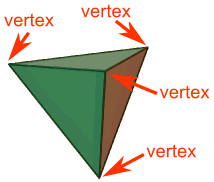
When working with Geometry, We will have to deal with alot of different and divergent phenomena. In order to organize all of this for practical use, we will have to give such special phenomena special terminology. So let’s do an example with the intersection of two lines.. Geometers (Mathematicians who research geometry) have decided to name this intersection a vertex. Since all vertices involve the intersection of two lines, vertices always include an angle.
But let’s not limit ourselves to just simple lines, let’s look at an interesting application of vertexes to more complex three dimensional structures. When two vertices meet in a polyhedron, a mathematical object called an edge is formed. But what is even more fascinating is that if you take all of the faces (the 2-dimensional shapes that make up the outer surface) of a polyhedron, and add the difference of the Vertices and angles, the answer will always equal two! We can represent this symbolically as F+E-V = 2

Shock absorbers

Shock absorbers

Shock absorbers

09/26/16

“How can we stop unexpected vibration from occurring?”


When working as an engineer, one has to look out for many unexpected vibrations occurring when designing a machine. With this in mind, how can make a system to integrate and solve this problem? Well, lets think about it for a moment. We know that vibrations have kinetic motion, which means that they have energy associated with them. And we also know that we can transfer this energy into other forms such as heat. So how about we create a device that transfers this vibrational energy into other forms of energy? This is the operating function behind a shock absorber. Shock absorbers work as follows. When a shock occurs to a machine, springs are attached to the part to absorb this energy and become compressed. Since this compression will store unbalanced potential energy, it must release itself. In order to prevent all of the energy from spilling out, the shock absorbers will now come into play. The shock absorbers will be constructed as a piston with oil in a tube, all inside of the spring. As the spring moves, it will cause a force on the piston, which will in turn cause oil to be forced through tiny holes in the piston that will precisely control the level of resistance to motion, therefore transferring much of the enegry in to heat. Automobiles make great use of shock absorbers, where they control the up and down motion of a wheels vehicles.