
Month: April 2019

Why the Oceans Are Becoming More Acidic
Why the Oceans Are Becoming More Acidic
04/22/19
“How are CO2 emissions changing our oceans?”
Every second of every minute of every hour more and more carbon dioxide is being pumped into our atmosphere. Since the carbon intensity in the air will increase, the ocean will absorb more CO2. This larger amounts of this element will react with the H2O in water to form Carbonic Acid (H2CO3) and Hydrogen ions (H+). With a higher volumetric makeup of the latter elements, the oceans will become more acidic, threatening the stability of sea-life. This is Why the Oceans Becoming More Acidic.

Why Offshore Wind in the U.S Might Soon Face Logistic Bottlenecks
Why Offshore Wind in the U.S Might Soon Face Logistic Bottlenecks
04/21/19
“Why is offshore wind in the U.S having logistic problems?”
Offshore wind in the United States is expanding at a rapid pace, particularly in the Northeast. However, since offshore wind turbines tend to extremely large in nature, it takes a large amount of transportation infrastructure such as cranes and heavy trucks for transportation logistics. Due to the limited supply of these components, these projects face the possibility of being stalled. This is Why Offshore Wind in the U.S is Facing Logistic Bottlenecks.
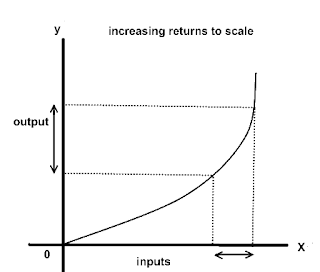
Returns to Scale
Returns to Scale
04/20/19
“How does cost scale with physical production?”
Cost tends to scale with increased production of a particular element. However, the amount of cost of each item might get larger or smaller! The rate of change of each element to increased production is known as the Returns to Scale. This information is vital for the renewable energy industry, as the optimal deployment size will depend on the best return to scale.
Image credit
https://sites.google.com/site/economicsbasics

Power Factor Tariff
Power Factor Tariff
04/19/19
“Why do some facilities seem to obtain less power than they receive and how are they penalized in a tariff?”
Every facility connected to the grid can receive energy. But the amount that it receives versus what was apparently sent is known as the Power Factor Tariff. The lower the power factor tariff, the more generators and transformers, and other power infrastructure is needed to keep the system running. Since this increases the amount of upkeep needed, utilities implement a Power Factor Tariff to penalize users who draw too much from the grid.

My Post-Graduation Summer Plans
Many of you have been asking about my post-graduation plans. After long deliberation, I am happy to say that I will be spending this summer researching at Carnegie Mellon University’s Engineering and Public Department in Pittsburgh Pennsylvania! My work will be focused on uncovering resilience strategies for cascading power failures and how communities can adapt. This will involve a thorough literature review of the causes of these events, what agencies have recommended to adapt, and interviewing individuals who’ve directly experienced these problems.
I hope to leverage these insights into not only shape what type of graduate programs I would like to apply for but also help Northern Californians living in fire-prone areas deal with planned electricity shutdowns by PG&E. It’s going to be a big matter of discussion now that the effects of climate change are really upon us and the most vulnerable communities have to deal with it first.
Without a doubt, I am thankful for the Sally Casanova Scholars Program and Professor Parth Vainshav for making this happen and will work my hardest to make this Summer a success.
East coast friends, let me know if you want to come over to Pittsburgh this Summer. I’m always happy to host you and discuss energy!
Interested in what happens to me after this Summer? Stay tuned to learn more.
Image credit
https://www.cmu.edu/assets/images/site/meta-image-cmu.jpg

Maximum Demand Tariffs
Maximum Demand Tariffs
04/18/19
“How can we design a two-part tariff specifically catered to the maximum demand of a system?”
Two-part tariffs are great for controlling system-level energy use. But sometimes we would like to focus it on controlling the maximum demand for energy use. We can use something called a Maximum Demand Tariff which not only charges in proportion to energy used but levels an extra tariff based on the max power they drew for the given time period.

Two-Part Tariffs
Two-Part Tariffs
04/17/19
“How can we have an energy tariff that charges both at a fixed and proportional rate?”
Energy tariffs come in all shapes and sizes. One of the most interesting ones is those that not only charge at a proportional rate but also at a fixed rate. This Two-Part Tariff can be used in the case of optimization for grid network loads.

Block Rate Tariffs
Block Rate Tariffs
04/16/19
“How can we make an electricity tariff that becomes progressively cheaper as you use more energy?”
Charging less for increased energy consumption makes sense in many cases such as incentivizing renewable energy production. One way to accomplish this is to use a tariff structure in which energy consumption amounts are divided into discrete blocks and each succeeding block of energy used is cheaper. These Block Rate Tariffs can be implemented by utilities to accomplish their infrastructure and market goals.
 Isaac's Science Blog