Month: September 2016

Empirical formula

Empirical formula

Empirical formula

09/30/16

“How can we obtain the structure of a chemical just by knowing the percentage of it’s components?”
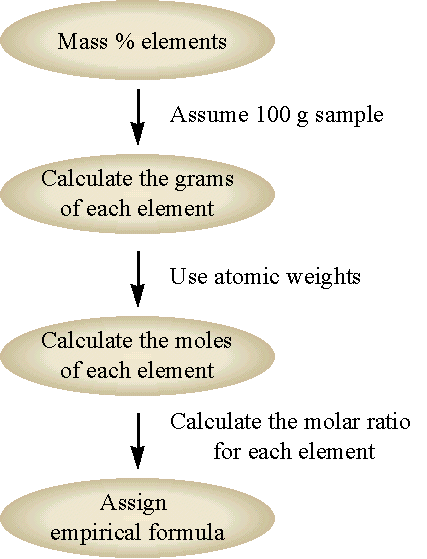
Wouldn’t it be really cool if just by knowing the percentage composition of the different atoms in a compound, you could obtain the chemical formula? Well, let’s figure out how to do it by completing an example. Let’s say that you obtain a chemical with percentage 58.64% Carbon [C], 8.16% Hydrogen [H], and 43.20% Oxygen [O]. The first step we must take is to change this percentage into something more realistic, such as mass. To make the math easy, let’s use a mass sample of 100g. This means that this compound will have 58.64 grams of carbon[C], 8.16 grams of hydrogen [H], and 43.20 g of oxygen [O]. The second step will be to take these masses and change it into moles. After doing the math, we will end up with 4.409 moles of carbon [C], 8.905 moles of hydrogen [H], and 2.7 moles of oxygen [O]. if you notice, all of the moles are in “messy” values, so we need to simplify this somehow. We can accomplish this by dividing the moles by the lowest number (In this case, the lowest number is 2.7). After we do the math, we will end up with 1.5 moles of carbon [C], 3 moles of hydrogen [H], and 1 mole of oxygen [O]. Now, we simply have to make everything a whole number. We could do this by multiplying all of mole values by 2, giving us 3 moles of carbon [C], 6 moles of hydrogen [H], and 2 moles of oxygen [O]. Our final compound formula will be C3H6O2, which just so happens to be the chemical formula for Acetate. Since this process will always give you the formula with the simplest amount of proportions, it is called the empirical formula.

Platonic solids

Platonic solids

Platonic solids

09/29/16

“What are some of the most symmetric polyhedra?”


Polyhedra are quite fascinating mathematical objects. Are there any special type of polyhedra that are especially symmetric? Well let’s think about it.We know that polyhedra are constructed by having flat shapes meet at each vertex. What if were to find polyhedra that have an equal number of shapes meet at each vertex? If that happened, then each vertex will have an equal angle, therefore the entire object will be completely symmetric! These solids are classified as the platonic solids, of which there are five of (proven by Euclid): The tetrahedron, the cube, The octahedron, the dodecahedron, and the icosahedron. These shapes can be found everywhere in nature, from the chassis of viruses to the framework of bee hives.

Polyhedra

Polyhedra

Polyhedra

09/28/16

“How do we classify geometric objects with flat faces?”


Think of an object in three dimensions. Any object. You can probably come up with a wide array of diverse and seemingly unending chaotic shapes. But in geometry, we need to organize everything into patterns with special properties. So since we have already started with three dimensional objects, let’s go classify the simplest possible three-dimensional objects. But what exactly are they? Well, let’s think about it. We know that two dimensional objects are simply flat faces. So what if we took many of those flat faces and strung them together in an organized manner? This is the primary principle behind polyhedrons. Polyhedrons are three dimensional objects made completely out of two dimensional faces, with no opening. Did you know that every day objects such as cubes and pyramids are polyhedra?

Vertices

Vertices

Vertices

09/27/16

“How can we classify the point where two lines meet?”


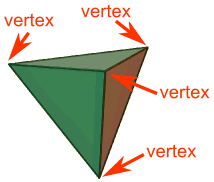
When working with Geometry, We will have to deal with alot of different and divergent phenomena. In order to organize all of this for practical use, we will have to give such special phenomena special terminology. So let’s do an example with the intersection of two lines.. Geometers (Mathematicians who research geometry) have decided to name this intersection a vertex. Since all vertices involve the intersection of two lines, vertices always include an angle.
But let’s not limit ourselves to just simple lines, let’s look at an interesting application of vertexes to more complex three dimensional structures. When two vertices meet in a polyhedron, a mathematical object called an edge is formed. But what is even more fascinating is that if you take all of the faces (the 2-dimensional shapes that make up the outer surface) of a polyhedron, and add the difference of the Vertices and angles, the answer will always equal two! We can represent this symbolically as F+E-V = 2

Shock absorbers

Shock absorbers

Shock absorbers

09/26/16

“How can we stop unexpected vibration from occurring?”


When working as an engineer, one has to look out for many unexpected vibrations occurring when designing a machine. With this in mind, how can make a system to integrate and solve this problem? Well, lets think about it for a moment. We know that vibrations have kinetic motion, which means that they have energy associated with them. And we also know that we can transfer this energy into other forms such as heat. So how about we create a device that transfers this vibrational energy into other forms of energy? This is the operating function behind a shock absorber. Shock absorbers work as follows. When a shock occurs to a machine, springs are attached to the part to absorb this energy and become compressed. Since this compression will store unbalanced potential energy, it must release itself. In order to prevent all of the energy from spilling out, the shock absorbers will now come into play. The shock absorbers will be constructed as a piston with oil in a tube, all inside of the spring. As the spring moves, it will cause a force on the piston, which will in turn cause oil to be forced through tiny holes in the piston that will precisely control the level of resistance to motion, therefore transferring much of the enegry in to heat. Automobiles make great use of shock absorbers, where they control the up and down motion of a wheels vehicles.

Kidney stones

Kidney stones

Kidney stones

09/25/16

“What are Kidney stones?”


You have probably heard of Kidney stones, those mysterious solid objects that cause major pain to everyone. But what are they and how do they form? Well, it turns out that kidney stones is caused by simple chemistry, insoluble compounds. When your urine contains too many insoluble components such as calcium, they begin to build up and cause kidney stones to form. In order to avoid Kidney stones, you should commit to regular exercise and avoid diets that are too high in protein, sugar, and sodium.

Screw thread

Screw thread

Screw thread

09/24/16

“What do those grooves on screws do?”


Have you ever wondered what those helical grooves on screws do? I mean, they need to have some sort of purpose, or else why would have mechanical engineers even have included them. Well, believe it or not, the functions of these groves, usually termed screw threads, is to convert between rotational and linear force, therefore enabling the entire operation of a screw!  This is as a result of the screw thread helical geometry, since the thread both wraps around and along cylinder, a rotation against object will cause it to be pushed into the object. The power of screw threads are contingent upon how close the grooves are to each other (called the pitch) and the diameter of the grooves (called the lead). When the lead undergoes a full rotation, the screw will move the size of the lead. Because of these properties are so important to functioning, screws are classified by the size of their pitch and lead.

Washers

Washers

Washers

09/23/16

“How can we distribute the loads of threaded fasteners in a simple way?”

 
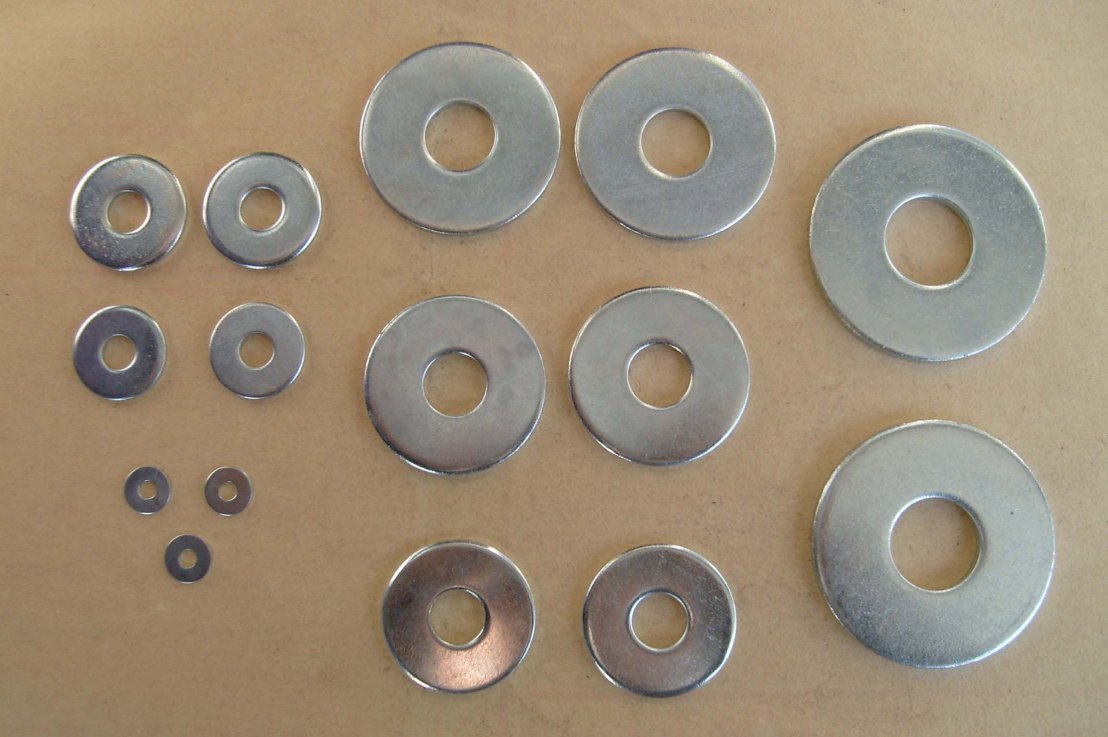
When working in engineering, we often have to consider how the loads of threaded fasteners such as a nut will impact a project. Often times, these parts will cause damage onto surrounding objects due to their threaded nature. So, how could we prevent such problems from happening without having to add too much complexity to the system? Well, let’s use our engineering mindset to think about it for a moment. If we do some research, we can find out that circular geometries are superb ways to safely distribute a load due to their symmetric nature. Also, since nuts are usually on the very small scale, we don’t have to have too much weight to absorb the resulting load. So what if we were to create thin, ring-like materials to cover up the burden resulting from the fastener? This is the exact idea behind a very common piece used in engineering called a washer. Washers can be not only be used to intake loads from a fastener, but can also be used  spacers, springs, locking devices,  and vibration reducers. Different sizes of washers can be identified by the size of their inner hole and their outer diameter. All in all, washers are another example of the ingenuity of the human species.

Telescoping expansion joint

Telescoping expansion joint

Telescoping expansion joint

09/22/16


“How can we implement an expansion joint for tubular geometries?”

Expansion joints are very useful devices. However, how can we create affordable versions to implement on tubular geometries such as in pipes? First of all, let’s look at the problem at hand. Thermal expansion causes a material to change it’s size depending upon the surrounding temperature, and as such there needs to be “breath gaps” to ensure that a structure will not collapse. However, using something like a plaster or a soft filling will not be strong enough to sustain the expected pressures on a pipe, and having loose material might cause a leakage into the fluid flow. Therefore, we will have to think of an adjustable solid part. Well, how about we take some design inspiration from one of humanity’s greatest achievements, the telescope. Part of what makes telescopes the machines they are is the fact that they have a telescoping build, which means that solid parts are made so that they can slide past each other. Now, how about we take this mechanism and apply it to our thermal expansion joints?


Well, what we could do is have two concentric expansion tubes, one with a larger tube and the other with a smaller one. The smaller diameter tube will connect to the two joints of the mechanism, and will expand and contract upon need. The larger diameter tube will act as a fixed support in order to center the smaller diameter tube, and as such have a smaller diameter. You can analogize the larger diameter tubes as being like the “braces” of the smaller diameter tube. O-rings are often used to seal these parts to ensure that all operations are smooth. This layout is known as a telescoping expansion joint. Telescoping expansion joints are very useful due to their simple yet effective design, and the fact that they can be curated for tubular geometries.