“What happens when an object experiences multiple types of loading simultaneously?”
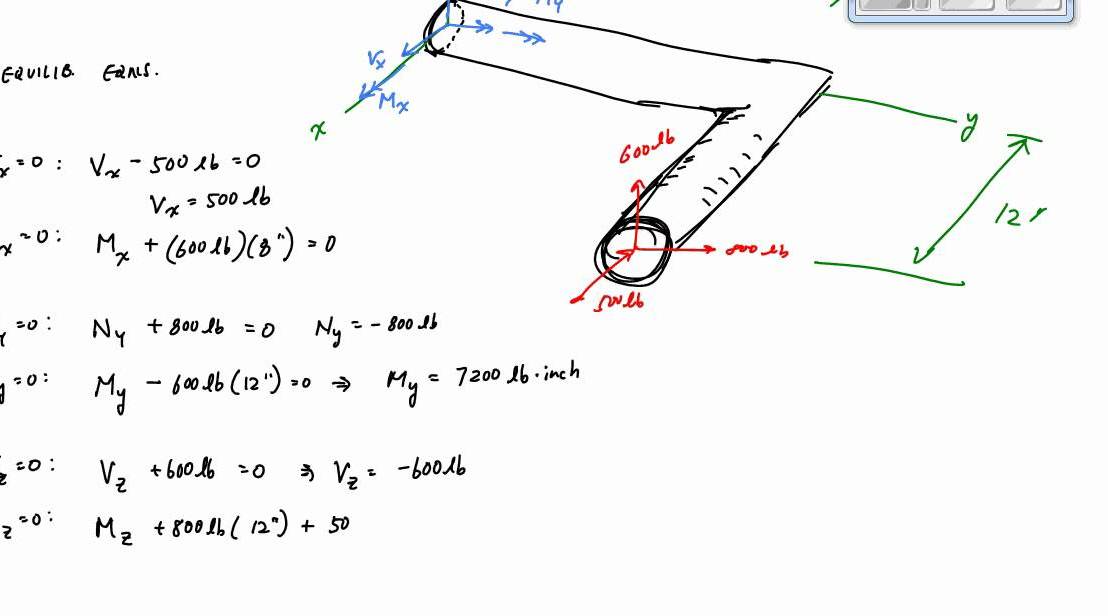
Objects are subjected to loading all the time, whether it be torsion or bending. However, sometimes objects have to experience both at the same time. So what can we do to analyze these cases? Well, Engineers have developed a technique known as combined loading which takes into account both factors and produces a more accurate output.
“What is the measure of energy in a strained material?”
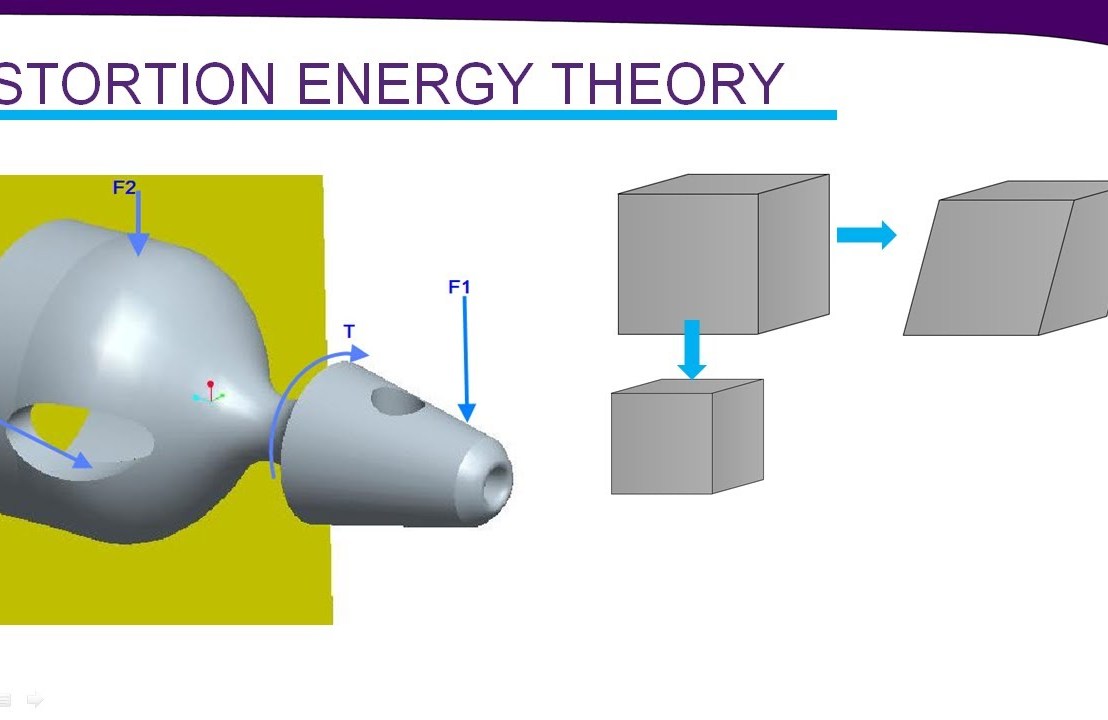
When springs are stretched, potential energy is added into their bodies. A similar phenomenon happens when one stretches a solid object. Inside their body will be a value known as distortion energy and is the basis for evaluating the von Mises yield criterion.
“How can we more accurately predict an object’s failure?”
One of the most important duties of a design engineer is to ensure that objects do not fail. However, classical failure theory does not always suffice. Instead, we must use more advanced concepts. One example of this is the Von Mises Stress, which is characterized by a superposition of all of the stresses on the object. If the Von Mises Stress is greater than the yield stress, then failure will occur. The formula for Von-Mises Stress is given by sigma_v = sqrt (sigma_1^2+sigma_2^2+sigma_3^2-sigma_1*sigma_2-sigma_2*sigma_3-sigma_1*sigma_3), where sigma_v is the Von Mises Stress and sigma_1,sigma_2, and sigma_3 are all stress superposition values. The Von Mises Stress can be visualized as an ellipse in 2 and 3 dimensions.
“What is the maximum amplitude of an oscillating system?”
In the physical world, systems can vibrate at different frequencies with different outputs. But when the system achieves maximum vibration at a certain frequency, it is called a resonance. Resonance has large impacts on the design of systems, from constructing electrical circuits to achieve certain characteristics to analyzing vibrational characteristics of bridges
“Are there materials that retain their strength at exceedingly high temperatures?”
For processes such as nuclear power generation or incinerators, materials must be able to withstand heavy loads. However, the high temperatures that they operate at often destroy the useful properties of most materials. So are there materials that can withstand high temperatures? Well, after many years of hard work spent in research, Materials Engineers and Scientists have been able to classify such materials as refractory materials. Refractory materials can be divided into two types, acidic refractories with SiO2 content more than 93% used for their erosion resistance, and basic refractories for higher thermal resistance
“How can we quantify a material’s resistance to permanent shape change?”
When under a compressive force, materials tend to deform. However, some materials are more resistant to deformation than others. This resistance to compressive deformation can be quantified the concept of hardness. Hardness can be measured by varying a controlled force and recording the resulting deformations.
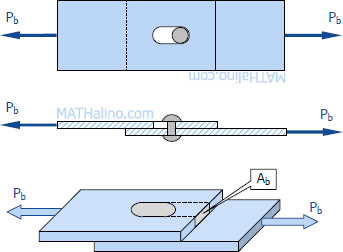
“What happens when stress acts upon an area perpendicular to the axis of an object?” The most well-known types of engineering stress are normal stress, (when a stress acts upon an area parallel to the axis of an object) and shearing stress (when a stress acts perpendicular to said axis). But is there a third type of stress? Well, to know more, let’s scientifically analyze such a phenomena. Well, when two bodies are in contacts and move in opposite directions, they will exert a force upon one another. Furthermore, this force will be distributed over their area of contact, creating a stress. This form of stress is known as a bearing stress and can be symbolically described using the equation (sigma)_ bearing = force/area
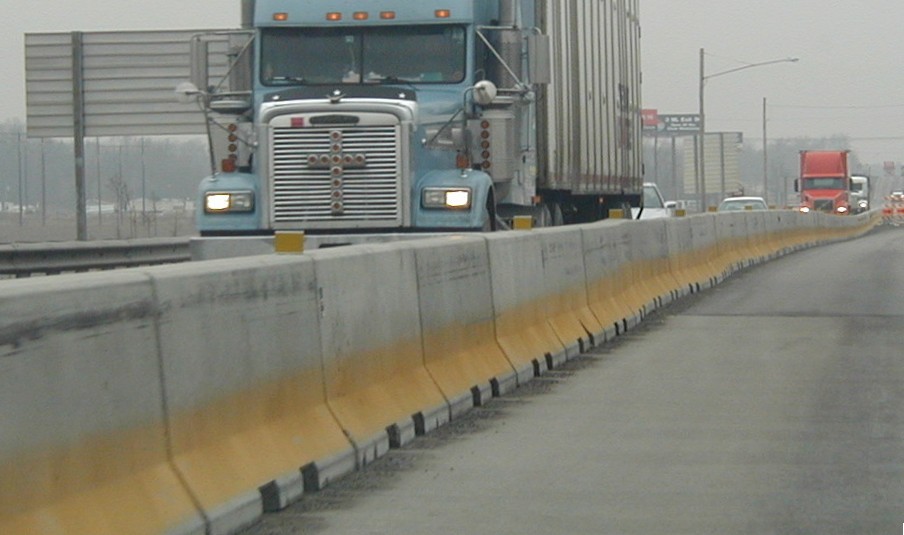
“How can we control the flow of traffic away from dangerous road elements?” Personal vehicle transportation is one of the most used forms of transportation throughout the world. However, due to the autonomous nature of such machines, drivers can non-intentionally make collisions with errant road elements such as trees, boulders, and walls, or even the air if they run off an elevated freeway! So how could we change roads to make them much safer for general use? Well, let’s use our engineering mindset to figure this problem out. Well, we know that one way to stop an object from moving is to have it collide with a rigid object that will absorb all of its kinetic energy. So what if we were to take this idea and put it into reality? This is the exact type of thinking behind something known as a traffic barrier, which can be seen omnipresently around roads throughout the road. Examples of traffic barriers range from the exotic guard rail to the tiny traffic cone!
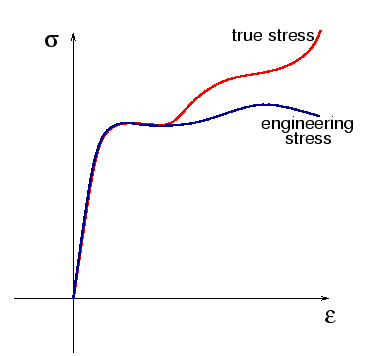
“Why is there a negative slope on a stress-strain diagram and how can we fix it?” The stress-strain diagram is probably one of the most used concepts in all of engineering. However, there seems to be one counterintuitive aspect to it. Specifically, after the ultimate strength is reached, the stress-strain slope seems to become negative. This can’t be, since the stress can only increase with strain, not the other way around. So what exactly is behind this incongruity? Well, it all comes down to one simple fact. When constructing an engineering stress-strain curve, the cross-sectional area of the object is assumed to be static. However, due to the law’s of Poisson’s ratio, an elongation in length must be countered by a decrease in the associated cross-sectional area. And since this cross-sectional area will have s smaller capacity to carry force, the force distribution will go down. Therefore, if we do not include an updated area with the force, the stress will decrease with strain. Structural Engineers and Materials Scientists have recognized this flaw and have created true stress-strain diagram in response, which uses an ever-changing cross-sectional area. True stress-strain diagrams never have negative slopes, and are commonly used for research purposes.


 Isaac's Science Blog