Tag: HVAC

Building Automation Systems

Building Automation Systems

Building Automation Systems

12/27/17

“How can we make an intelligent building?”


With the advent of the internet of things, automation has become a very trendy topic. Due to its generalized nature, it can be applied to almost anything. And buildings are no exception. Building Automation Systems are computerized networks that take input from temperature, pressure, and humidity sensors to actualize adjust internal settings in the building,. This includes adjusting the HVAC setpoints and air handler settings. Building Automation Systems are often referred to as smart buildings and can pave the way to the future in energy efficiency.

Direct Digital Control

Direct Digital Control

Direct Digital Control

12/26/17

“How can we control a building automation system?”


Building components can consume quite a bit of energy. However, this energy usage can be mitigated greatly if devices were able to obtain data from the surrounding environment and communicate it to one another. This IoT-like technique is known as Direct Digital Control, and can be a great investment by increasing productivity while lowering utility costs, occupant complaints, and maintenance fees.

Solar Air Conditioning

Solar Air Conditioning

Solar Air Conditioning

12/23/17

“How can we have solar powered air conditioning?”


Solar PV is set to take the world of residential energy by storm, with its low-cost and emission-free technological prowess. However, it currently faces one serious bottleneck, HVAC systems. HVAC systems consume tremendous amounts of energy, and an affordable solar system powerful enough to run it could prove expensive.


Or at least it used to be.


With the advent of higher efficiency AC systems and cheap PV, Solar Air Conditioning is more science fact than science fiction. Solar AC not only has the potential to save on a voluminous emission load but also energy bills. With this milestone reached, expect even higher adoption rates of residential PV!

Cooling Towers

Cooling Towers

Cooling Towers

12/20/17

“How can we cool a large flow of water?”


Water is often used to cool buildings. However, during the process, it absorbs heat from its surroundings, thereby warming it up and making it less usable for future use. So how can we ensure that this water can be cooled down to usable levels? Well, let us use our engineering mindset to find out. We know that if water comes into contact with surrounding air, it will cool down a bit, and some may even evaporate. So what if we were to take our stream, move it through condensers, causing some to evaporate and the rest to cool down to a workable state? Well, this technology is known as cooling towers and is used in industrial processes all over the world.

Energy Recovery Ventilation

Energy Recovery Ventilation

Energy Recovery Ventilation

12/15/17

“How can we use stagnant building air to do something productive?”


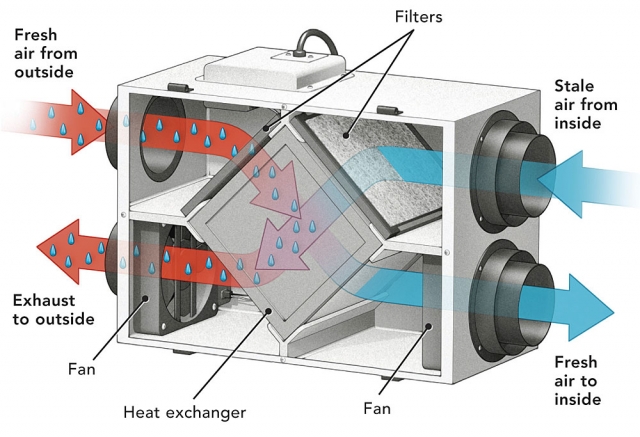
When air is trapped inside a building for too long, it can become unhealthy and stagnant. However, could we possibly use our engineering mindsets to do something productive with this? Well, we know that heat exchangers can be used to make use of any fluids. And oftentimes, incoming air into buildings is suboptimal. So what if we were to use a heat exchanger to cycle the external air with the old interior air to keep our building fresh? This system is known as  Energy Recovery Ventilation and holds much promise for the future of the HVAC industry.

ASHRAE Standard 90.1

ASHRAE Standard 90.1

ASHRAE Standard 90.1

12/10/17

“What is the basis for building energy efficiency in the U.S and much of the world?”


With the onset of global warming, energy efficiency has become a great necessity. As such, buildings in the U.S must now follow a certain standard so that after construction they will meet the sustainability requirements dictated by ASHRAE Standard 90.1. ASHRAE Standard 90.1 is a compilation of all of the codes for building energy efficiency (with the exception of low rise residential units) and is updated every three years to ensure that the next set of codes will be 15 percent more efficient than the previous.

Pitot Tubes

Pitot Tubes

Pitot Tubes

11/29/17

“How can we measure the velocity of a fluid without using any moving parts?”


Measuring the velocity of a fluid is one of the most useful things we can do. With this, we can find out how much mass is flowing within a system, and adjust all calculations accordingly. But since fluids lack any form of defined shaped, measuring their average velocity can be very difficult. So how can we use our engineering mindset to solve this problem? Well, to begin, let’s look at how pressure moves within a system. A fluid’s total pressure is made of up both static pressure (the default, inert pressure) and velocity pressure (the pressure associated with the momentum of the fluid).


Since it is rather simple to obtain the total and static pressures and use their values to find the final velocity, let’s build a machine to do exactly that. Since fluids move steadily through a pipe, let’s start with that. And since we want to find the total velocity of a fluid, let’s also put the fluid through the hole. Then let’s also have holes perpendicular to the main tube to measure the static pressure. Then let’s subtract the difference to get the velocity pressure, and divide by the fluid’s density to obtain the fluid velocity. This machine is known as a pilot tube and is used widely in airplanes to measure the airspeed and HVAC systems to find the refrigerant flow rate.

Water Cooling

Water Cooling

Water Cooling

11/28/17

“How can we remove without using a gas?”
When most people think of a heat removal device, they probably visualize a fan based systems which released cooled air. However, using a gas can be hard to control, and may also require a lot of room. So how can we use our engineering mindset to solve this problem? Well, what if we were to replace the primary medium with a liquid, such as water? This would allow us to take advantage of water’s higher specific heat capacity, density, and thermal conductivity to optimize efficiency while ensuring that operations are non-toxic and inexpensive. This increased capacity made water cooling very popular in computer and automotive hardware enthusiasts since this process takes less space and can deliver more cooling. On the downside, using water might accelerate corrosion in metallic substances.

Vapor Compression Cycle

Vapor Compression Cycle

Vapor Compression Cycle

11/27/17

“How do most AC systems work?”


While absorption refrigeration systems are great for many applications, sometimes we just want a more traditional technology for our cooling needs. So how exactly do most AC systems actually work? Well, let’s use our engineering mindset to find out.


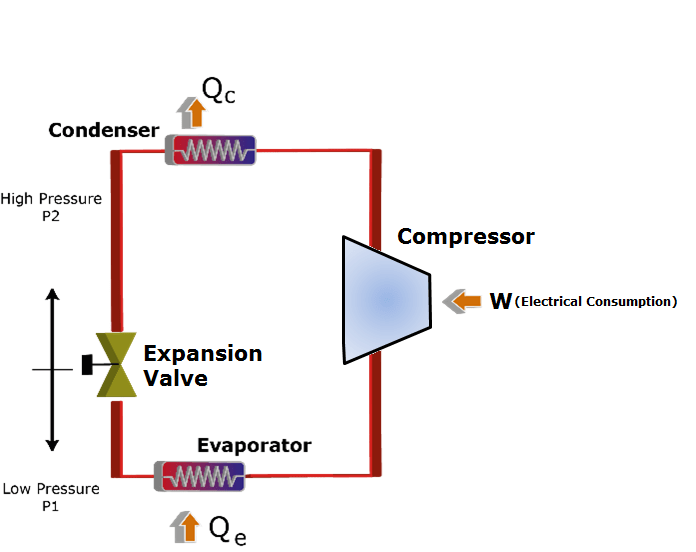
Let’s start with the basics. Our goal is to take heat from one space and transport it to another. One very common way to do this is to use a heat exchanger. But to ensure continuous cooling, we must ensure that we have a constant supply of fluid at a temperature we desire. To build this system, let’s start with four components: a compressor, a condenser, an expansion valve, and an evaporator. Then, let’s have a refrigerant enter the compressor at a low temperature in a gaseous state, and do work on it to increase its temperature and pressure. Then, let’s have it enter the condenser, where heat is transferred into a nearby medium. Afterwards, let’s run it through an expansion valve to cool it and release pressure while turning some of the gas into a liquid. Finally, let’s pull it through an evaporator, which is basically a heat exchanger that allows the cold fluid to absorb heat from the surrounding medium (and therefore cool it) and gasify it. Once the fluid leaves the evaporator, it enters the compressor and the process (known as the vapor compression cycle) will start again.