“How are water and electricity directly interrelated?”
Water and electricity, two of humanity’s most vital resources, are often thought as being from completely different worlds. However, the reality is that the generation of one resource uses some of the other! To illustrate, water needs to be pumped through mechanical pumps reliant on electricity while power plants use water for their operation. In this way there is Water and Electricity Interdependence. So every time you let the faucet run, you’re not only wasting water but also electricity!
“How can different infrastructures be interdependent without any direct connection?”
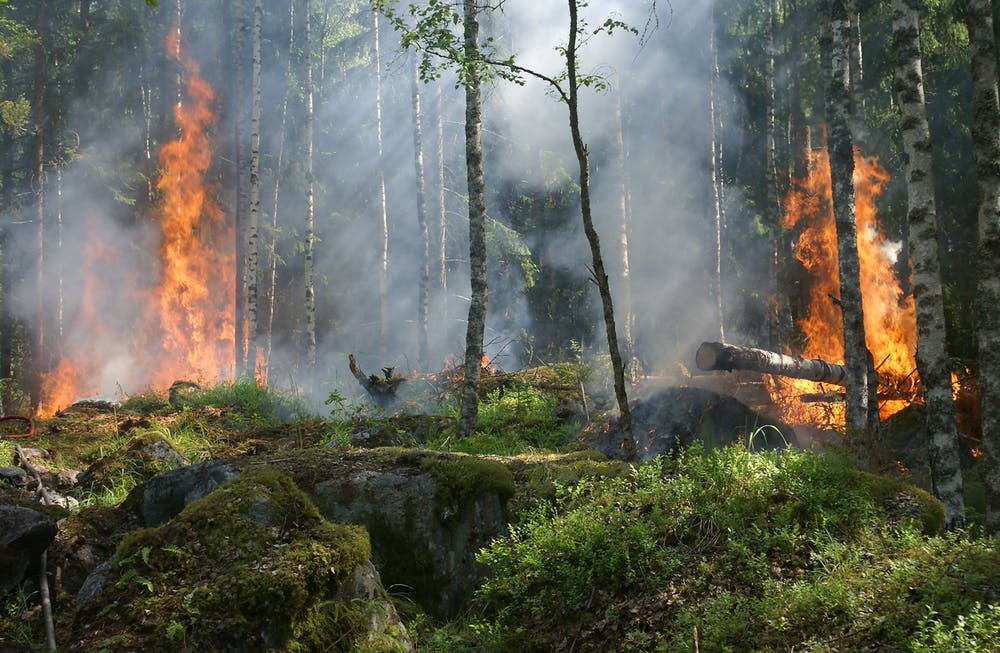
Infrastructures can be interdependent in numerous ways. However, one of the most subtle forms is through cause and effect, in which the consequences of one infrastructure failure will carry over into another one. Take for example the 2018 Northern California Wildfires. When the fallen transmission line caused a fire, the smoke that swept into the Bay Area caused the air pollution levels to skyrocket. This made people rush to the hardware stores to purchase protective masks, emptying stocks within hours. Through Logical Interdependence, the supply of gas masks was contingent on the fire resilience in Northern California.
The Trade-Offs Between Distributed and Concentrated Energy Generation for Resilience
06/04/19
“What resilience trade-offs are there between using distributed and concentrated energy generation?”
Both distributed and concentrated energy generation supporters argue that their preferred energy generation method is superior. Distributed supporters say that their preferred method allows for generation to be much closer to consumption loads, undercutting the need for long transmission lines, while concentrated supporters say that their base load profiles allows for the necessary amount of energy to be delivered throughout the day. When selecting new energy methods, these must be taken into consideration during construction. These are The Trade-Offs Between Distributed and Concentrated Energy Generation for Resilience.
Why Situational Awareness of the Grid Is Crucial for Electricity Resiliency
06/03/19
“Why is monitoring the grid so crucial for electricity resilience?”
One of the most fundamental parts of building resilience is preventing cascading outages. If even a single transmission line snaps, then it could overwhelm other ones, eventually resulting in a large-scale power loss. One of the key tools to preventing this is having situational awareness of what is going on in the grid, so one can react fast enough to mishaps. This is Why Situational Awareness of the Grid Is Crucial for Electricity Resiliency.
How a Downed Transmission Line Can Trigger a Cascading Power Failure
06/02/19
“How can a single failed transmission line cause a whole power grid to shutdown?”
The electricity grid is the backbone of modern human infrastructure. However, if a single transmission line becomes faulty and goes down, then power will need to be redistributed throughout the entire system accordingly. If no care is taken, then the extra surge of electricity can overwhelm other transmission lines and cause them to fail, repeating the process until a cascading power failure occurs such as in The Northeast Blackout of 2003. This is How a Downed Transmission Line Can Trigger a Cascading Power Failure.
Why Informing Citizens of the Risk of Power Outages Is Important for Making Public Resilience Decisions
05/31/19
“What is the importance of informing people about the risk of power outages?”
Power outages occur from time to time. And when they do, it could cause great harm to existing infrastructure, both public and private. HVAC systems will shut down, food in fridges will rot, and pipes might freeze over. That being said, there are a large amount of citizens who are not aware of the totality of the risks. If they become informed, then they can make better decisions and help contribute to making better public decisions about infrastructure. This is Why Informing Citizens of the Risk of Power Outages Is Important for Making Public Resilience Decisions.
“How do multiple infrastructure systems affect one another?”
Critical Infrastructure Systems are woven into the fabric of our everyday life. Whether it be the electricity we use to power our computers or the water pumps that we drink from, there is some resource behind it. And in the modern world, all of these systems seem to be interconnected, such as electricity for water-pumps or water for agriculture. As a consequence, if one of these systems go haywire then there will be consequences across all infrastructure systems. This coupling is known as Infrastructure System Interdependence and is used by policy-makers and engineers to analyze resilience risk.
Digitization and Its Implications for Manufacturing
05/26/19
“What is digitization and how will it affect manufacturing?”
With the rise of the industrial internet of things, engineering processes are moving more and more towards the digital realm. This means that components once limited to the physical realm, such as mail and design models, are moving into the virtual one as e-mail and CAD. This digitization will have a lot of ramifications for the manufacturing sector, where processes will now be less prone to human error and move a lot faster while being more prone to cyber-security issues. This are the Implications for Manufacturing from Digitization.
“How can we ensure that the bits in a CAN bus are all synchronous?”
CAN buses are a vital part of control infrastructure. Whether it be in the vehicles we drive or the drones that fly around us, CAN buses are there to make sure things work well. However, their synchronization needs to be ensured during operation. This can be achieved through the use of Bit Stuffing, in which any part of the data which has 5 bits of the same polarity 5 times in a row will have a bit of opposite polarity inserted after it. The bits can be unstuffed by the receiver once it takes it in.






 Isaac's Science Blog
