Category: Physics

Avogadro’s law

Avogadro’s law

Avogadro’s law              06/09/16

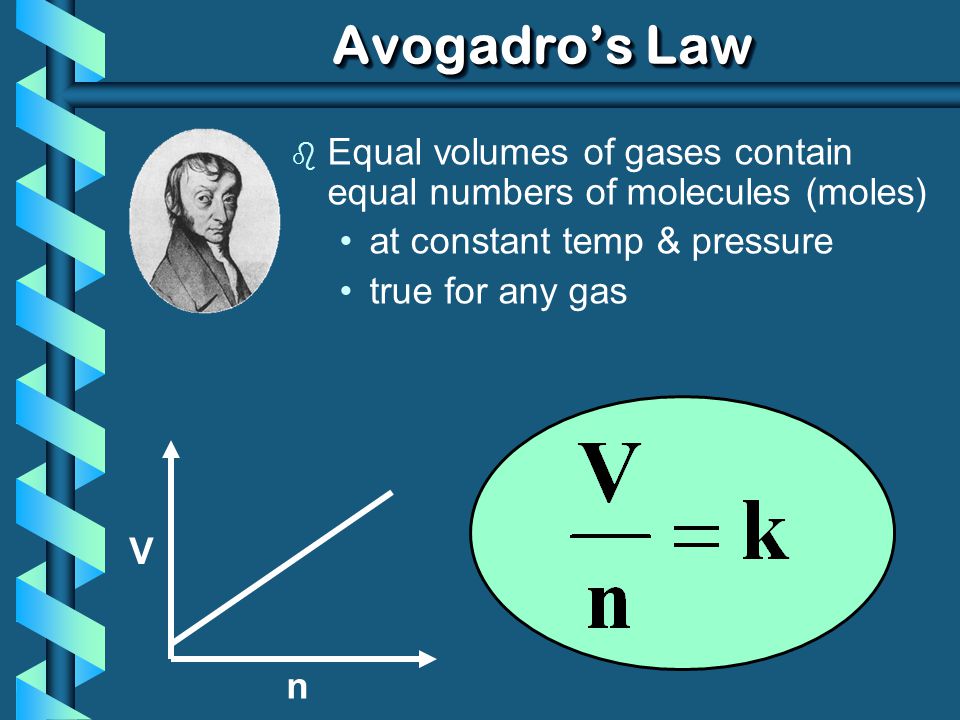
“Do gases of the same volume, temperature, and pressure have the same amount of molecules?”

Through thorough experimental observation, it has been shown that Gasses of the same volume, temperature, and pressure have the same amount of molecules. This can be neatly summarized as Avogadro’s law, which symbolically states that Vn=k, with Vbeing the volume of the gas nbeing the number of molecules and kbeing some constant.

Charle’s law

Charle’s law

Charle’s law                  06/08/16

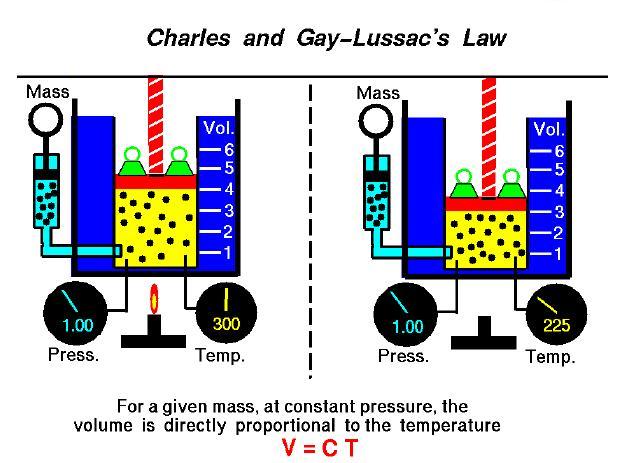
“ What is the relationship between a gas’ volume and temperature?”

For a gas, the relationship between it’s volume and temperature is very simple. As a gas’s temperature increase, it’s volume will increase proportionally. This is because the molecules of a gas are relatively unbounded to one another, and when their temperature increases, their average speed will increase, and the volume encapsulating the gas will increase as a result. This can be symbolically summarized in Charle’s law, in which VT=k, with Vbeing the volume, T being the temperature, and k being a constant.

Boyle’s law

Boyle’s law

   Boyle’s law          06/07/16

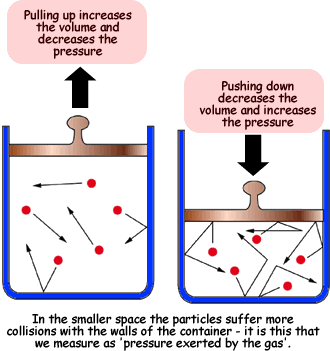
“What is the relationship between Pressure and Volume in a gas?”

The relationship between Pressure and volume can be neatly summarized in a simple concept known as Boyle’s law. Boyle’s law states that for a gas the pressure multiplied by the gas is simply equal to some constant k. To put this numerically, P*V=k. We can expand upon this by the fact that if the pressure and volume change, their product will be equal to the same multiple, so P1*V1=P2*V2.

Ideal gas

Ideal gas

Ideal gas                06/06/16

“What model can we use to describe a gas?”

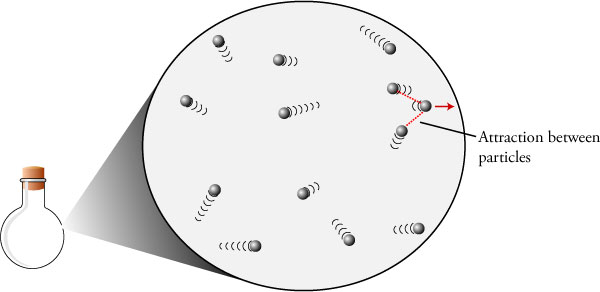
Let us visualize all of the particles in a gas in their pure intricateness. Think of all of those individuals particles bumping around in semi-random number. There are numerous factors that affect this gas, such as temperature T (how quickly each of these particles are moving around) pressure P(the density of each of the gas particles bouncing against the tank), Volume V (the amount of geometric space the gas takes up), The amount of gas . All of these facets are fundamentally related to each other with something known as the ideal gas law P*V=n*R*T, with R being a constant. This equation is insurmountably amazing because it means we can find out so many properties of a gas by just knowing a few factors!

Electric Dipole

Electric Dipole

          Electric dipole           Isaac Gendler

        06/01/16

“What happens when you have a separation of equal and opposite charge?”

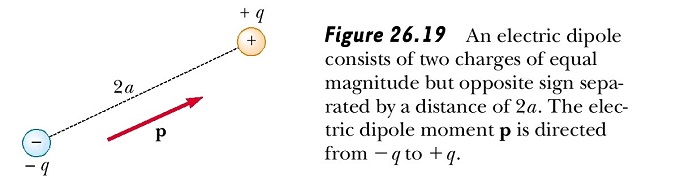
The answer to this interesting little question is that you would end up with an electric dipole. And electric dipole is the separation of an equal amount of opposite charges. Dipoles are characterized by their dipole moment, which is a vector quantity. The dipole moment points from the negative to the positive charge.

Pseudo-elasticity

Pseudo-elasticity

  Pseudo-elasticity          

        05/31/16

“Are there reversible responses to stress?”

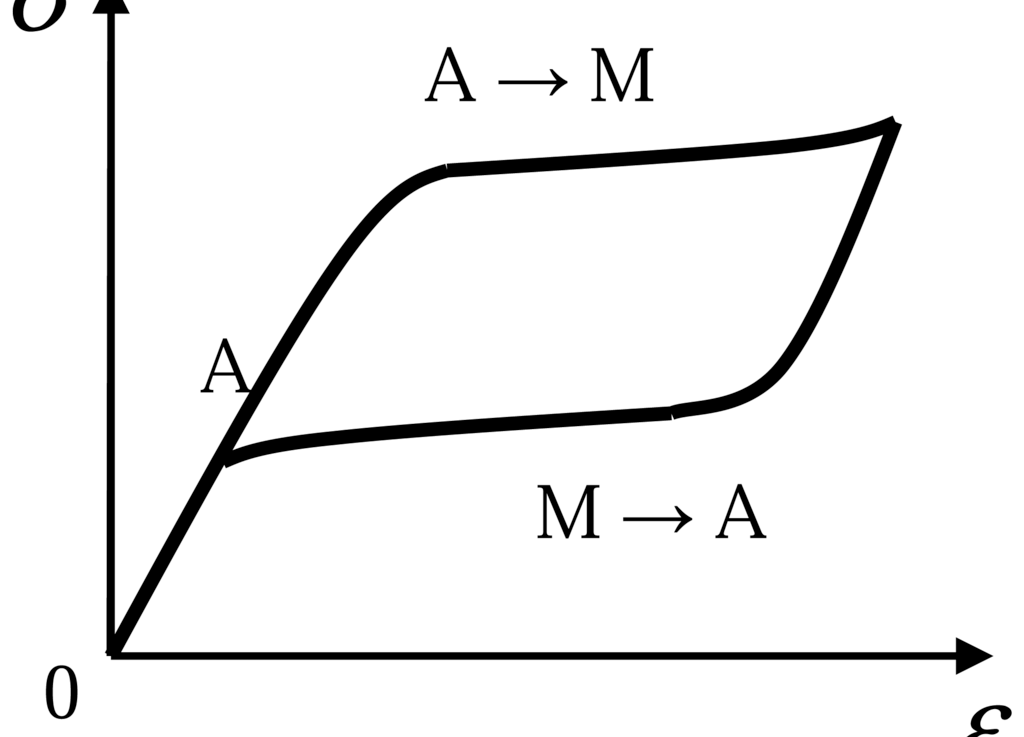
If you have thought about this, then I recommend that you research about a most interesting effect known as Pseudo-elasticity. Pseudo-elasticity is an elastic (also known as reversible) response to applied stress. This effects is a result of the crystal lattice structure of materials.

Shape-memory alloy

Shape-memory alloy

Shape-memory alloy                 05/30/16

Are there materials that “remember” their shapes such as the ones seen on television?

Believe it or not, the answer to this question is yes! Shape-memory alloys are alloys that have the ability to “remember” their original shape (which means that they return to their original form after a deformation). This effect is a result of the material’s unique crystal structures, which allows it to reverse after a deformation. Shape-memory alloys have a wide domain of applications (tweezers used to remove foreign objects), ranging from medical appliances to military technology and even into clothing!!!

Einstein’s general theory of relativity

Einstein’s general theory of relativity

Einstein’s general theory of relativity         05/24/16


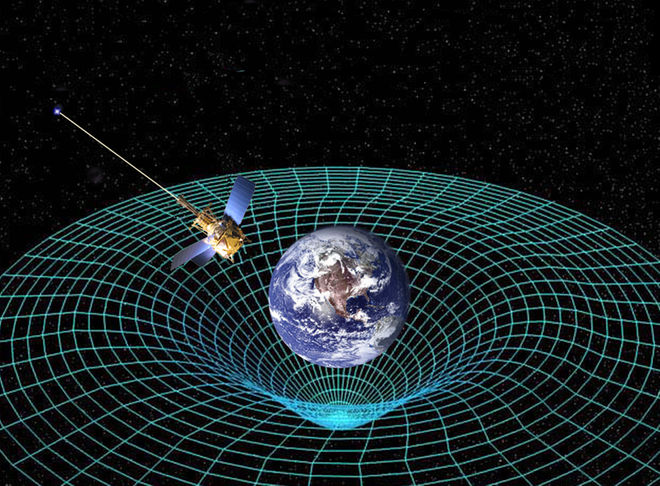
Einstein’s general theory of relativity is one of the most astounding accomplishments in the entire history of human thought. When Einstein originally published his theory of special relativity in 1905, it only worked for a constant velocity. But what if we take into account acceleration? Einstein pondered that, and spent the next 10 years working on such a ominous issue. After he was finished, he published his General theory of relativity. In General relativity, All of space is like a bedsheet, and objects like planets are like marbles. By putting one on the bedsheet, we cause a disturbance, which affects other planets. Also, space and time are not separate but one in the same! This is how higher masses cause disturbances in time as well as in gravitation. In this end, gravity is not a force but a geometric disturbance. This effect accounts for gravitational lensing

Einstein’s theory of special relativity

Einstein’s theory of special relativity

      Einstein’s theory of special relativity    05/23/16

Why can you not go faster than the speed of light?


This is one question that many great thinker have pondered ever since Maxwell demonstrated that the speed of light is fixed for every reference frame. How can it be possible to accommodate newtonian Mechanics, which states that all velocities are in reference to one another, with Electrodynamics, which states that there is an absolute limit for light? One great thinker who thought about this was known as Albert Einstein. After a considerable amount of thinking, he came up with his most brilliant idea in 1905. By taking the above two contradictions as postulates, he came upon to an amazing epiphany. All time is relative. Let us see how this works symbolically. Einstein came up with an equation for Time dilation t’=t1-v2c2, with t’being the shift in time, tbeing the change in time, vbeing the velocity, and cbeing the speed of light. If one were to have a velocity, then they would experience time as going slower around them. In this special theory of relativity, Einstein derived his most famous expression, E=mc2, which relates the mass of an object to the energy. What is even more amazing is that this shows that mass is directly proportional to energy, so if energy increase, mass increases! Furthermore, when an object approaches the speed of light, it’s mass increases so much that it becomes impossible to accelerate, therefore nothing can go past the speed of light.