Category: Physics

Concave mirrors

Concave mirrors

Concave mirrors

05/14/17

“How does a mirror that bends inwards behave?”
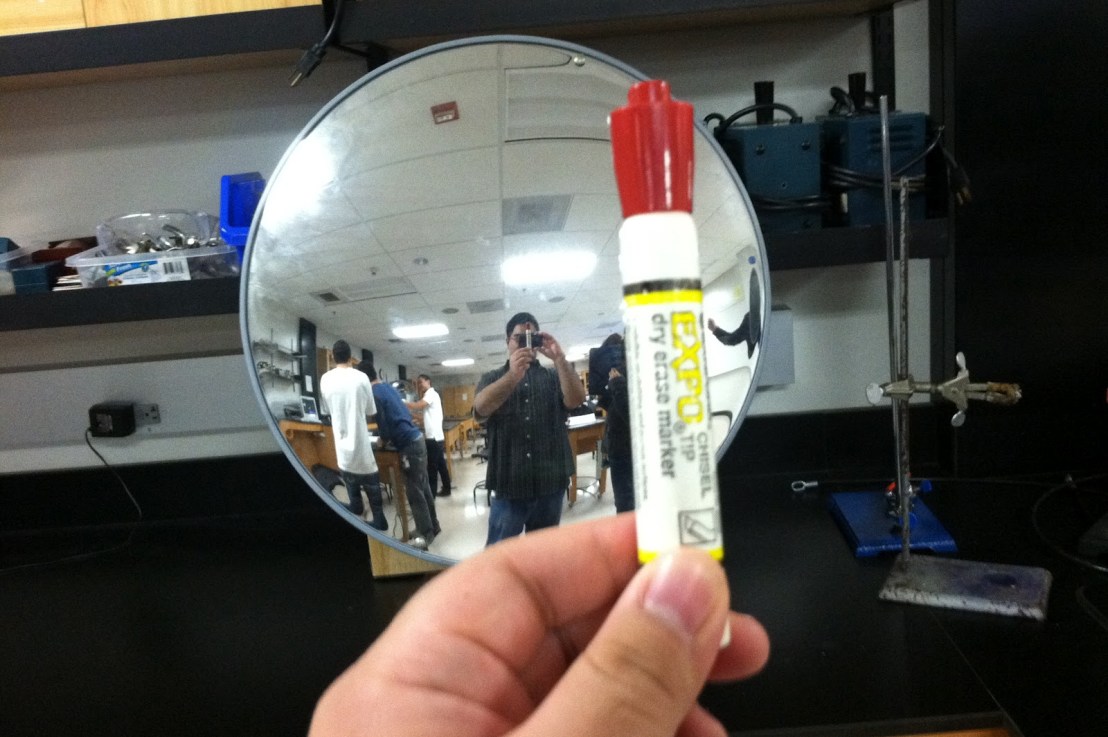
Mirrors come in all different shapes and sizes. Some are straight like a piece of paper, some bend outwards, some inwards. However, what are some of the defining physical characteristics of mirrors? Well, let’s analyze it with our scientific mindsets. When an object is beyond the center of curvature, then an image real, inverted, and minimized will be produced. If the object is at the center of curvature, then a real inverted image of equal size will be produced. If the image is between the center length and focal point, then an image real, inverted, and magnified will be produced. If the object is at the focus, then the image will form at – infinity. And if the object is just beyond the focal point, then a magnified virtual image will be formed. Concave mirrors have numerous applications, ranging from the headlights of cars to shaving mirrors and even to visual bomb detectors!

How to calculate change in entropy

How to calculate change in entropy

How to calculate change in entropy

05/13/17

“How can we calculate the change in entropy for a thermodynamic process?”


It is well known that for all thermodynamic processes, there is a corresponding increase in entropy in the entire system. However, how can we quantitatively measure such a change? Well, after many years of research, physicists and engineers have been able to come up with an equation which states that the change in entropy for a reversible process is equal to the time integral of change of heat divided by the initial temperature, or (delta)s=integral(dq/T). From this, we can derive that for an isothermal expansion or contraction, the equation will be (delta)S=nRln(vf/v0), and (delta)d=-nRln(pf_p0), while in cooling or heating a system it will be (delta)s=ncln(tf/t0) and for a phase transition it will be (delta)s=(delta)h/T.

Complex fluids

Complex fluids

Complex fluids

05/02/17

“What happens when there is a fluid with more than one phase present?”
Most engineering or physics applications of fluid mechanics deal with only one phase of matter. However, what happens when there is there is a multiphase solution present, such as in shaving cream? Well, after much investigation, engineers and physicists have determined that such materials can not be treated as typical fluids and instead must be classified as complex fluids. Complex fluids exhibit often unusual stress-strain relations, are highly nonlinear, and relatively unknown. Perhaps readers of this blog will pursue research into this subject and illuminate us on this subject.

Adiabatic process

Adiabatic process

Adiabatic process

05/01/17

“Is there a thermodynamic process with no heat exchange?”
When most people think of thermodynamics, one of the first thing that pops into people’s minds is one phenomenon, heat flow. However, is it possible to have such a process with no heat flow? Well, let’s think about it. If we were to take our system and completely isolated it inside an insulator, no heat would be able to flow in or out. Therefore, all of the work done must come from the internal energy. This phenomenon is known an adiabatic process. In an adiabatic process, the pressure multiplied by the volume raised to the ratio of the specific heats of the gas is always equal to a constant (PV^(c_p/c_v)), leading to a steeper PV diagram than the isothermal process.

Isothermal process

Isothermal process

Isothermal process

04/30/17

“Can we have a thermodynamic process in which the temperature of the system remains constant?”
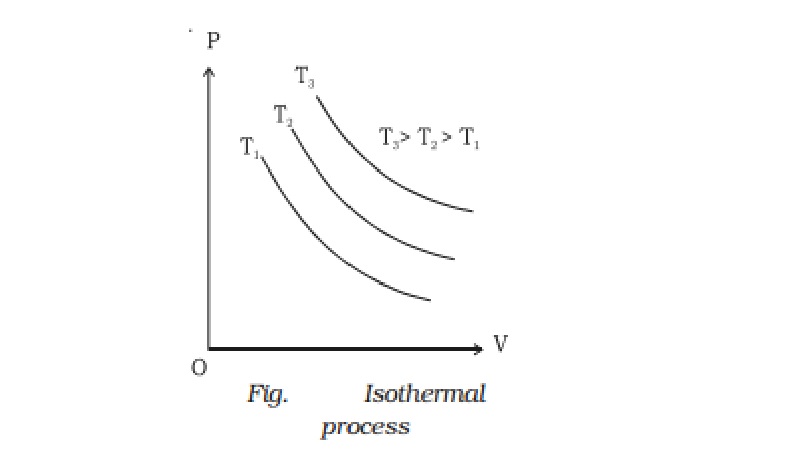
When working with thermodynamic systems, it is very easy for the internal temperature to change when other properties change as well. However, is it possible to have a fixed constant temperature process? Well, let’s think about how this can be accomplished. We know that when a system does work (such as a gas expanding) it will lose some of its internal energy and therefore cooling it. However, if we were to then supply heat to counteract this loss, the temperature would remain consistent, therefore resulting in what engineers and scientists call an isothermal process. In an isothermal gas expansion, the change in volume is directly equal to the number of moles present in the gas times the (fixed) temperature times universal gas constant divided by the change of pressure, which can be summarized symbolically as (Delta)V=nRT/(Delta)P. Isothermal processes are used to study highly structured mechanical systems such as Carnot cycles and chemical reactions.

Carnot cycle

Carnot cycle

Carnot cycle

04/29/17

“What is the most efficient possible heat engine?”
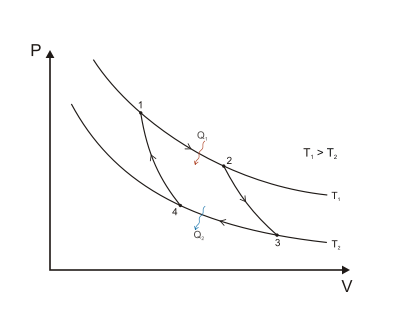
The Heat engine is one of the most productive inventions of humanity, allowing our civilization to take in exterior heat and channel it into useful energy. However, since there are so many different processes to choose from, which one is the most efficient? Well, let’s think about it. A heat engine cycle can be boiled down (pun definitely intended) to one core principle, an oscillation between a hot temperature and a cold temperature. One very efficient way to accomplish this is to have an isothermal process to expand the gas for a given amount and then use an adiabatic one to cool it down while further expansion takes place. Then, one can reverse this process by using an isothermal compression combined with an adiabatic one to raise the temperature and pressure back up to the original value, therefore completing the process known as a carnot cycle.

Carnot efficiency

Carnot efficiency

Carnot efficiency

04/28/17

“How can we calculate the maximum efficiency of a heat engine?”


Due to the second law of thermodynamics, physics proves that there is a limit to the efficiency of all heat engines. However, we know that from practical experience that some heat engines are more efficient than others. So how can we predict what the maximum efficiency of a heat engine can be? Well, engineers and physicists have thought about this same problem for many long years, and after deep exploration into the subject an equation known as the carnot efficiency has been fabricated. This equation states that the maximum efficiency of an engine is the difference between the maximum temperature and the minimum temperature divided by the max temperature, or that (nu) = (T_max-T_min)/t_max. As a result, the efficiency can never be greater or equal to 100%, and if there is no difference in the temperature the maximum possible efficiency is 0%

Heat engine theory

Heat engine theory

Heat engine theory

04/27/17

“How can we turn heat into useful energy?”
It is a well-known fact that energy can be converted into heat. However, is it possible to accomplish the opposite? Well, let’s think about it. We know that if we connect two points with different temperatures, then a heat flow will take place. And since this means that there is a  transfer of energy, it can be redirected into useful work. A machine that accomplishes this is known as a heat engine, which is used in everyday life from jet engines to electricity generators.

Liquid fluoride thorium reactors

Liquid fluoride thorium reactors

Liquid fluoride thorium reactors

04/17/17

“How can we actually make thorium energy a reality?”
Thorium energy is definitely not like your grandparent’s form of nuclear energy. Because of this, the engineering design for its reactors must be significantly different. First, instead of using liquid water to power this system, why not use liquid fluoride? This element is chemically stable, strong against radiation damage, have a high volumetric heat capacity, and can operate at high temperatures while remaining at normal pressures. Next, let’s think about how to implement this. First, let’s feed the salt into the reactor core. The fission from the thorium/uranium decomposition will heat this salt, which can then be transferred through a pipe to heat up a gas which drives a turbine which created electricity. We can then use the excess salt to flow back into the core to be recycled, and the waste heat from the gas can then be used to desalinate water