Category: Mathematics

The T-Test

The T-Test

The T-Test

05/05/18

“How can we measure the difference between two sample populations?”


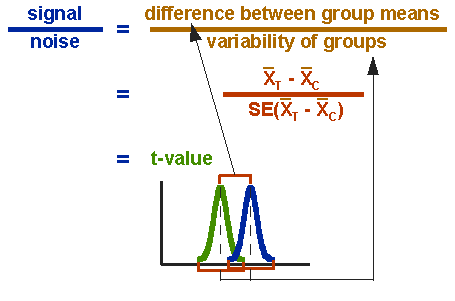
As Engineers and Social/Natural Scientists, we often like to measure the differences between sample populations. However, how can we know how far apart they truly are and whether or not these sample populations are representative of the entire population? Well, what if we were to measure the difference between their median values and then divide that by difference of their standard distributions? This is known as the T-Test and is used to quantify two population’s difference and its measurement accuracy.

Detection Theory

Detection Theory

Detection Theory

03/07/18

“How can we discern real data from noise?”


When working with signal processing, we often want to try to discern real data from random noise. However, doing so requires complex thinking. So how can we use our engineering mindset to solve this? Well, we can simply use an organization of mathematical theorems known as detection theory to solve these problems.

Simpson’s Rule

Simpson’s Rule

Simpson’s Rule

03/05/18

“What is a more accurate way for approximating integrals?”


If we have a particular function, then there are many simple ways to approximate the area under the curve without integrating. However, is there a more accurate way to do this? Well, let’s use our mathematical mindset to find out. If we were to fit a third-degree polynomial over our function and then take its integral, we would arrive with an area very close. This method is known in the English speaking world as Simpson’s Rule, and is represented by the formula Area = (b-a)/6 * ( f(a) + 4f((a+b)/2) + f(b) ), with a being the start point and b being the endpoint.

Traffic Simulations

Traffic Simulations

Traffic Simulations

03/02/18

“Is it possible to simulate traffic to improve it?”


If you have ever ridden a car in a crowded area, then you probably have experienced traffic. It’s slow, annoying, and worst of all unsustainable. Because of this traffic engineers are trying to design better and better ways to assist people with their daily commutes. One of the tools that they use at their disposal is known as a traffic simulation. Traffic simulations use mathematical frameworks to model how travel moves and what can be done about it. With the data generated by these systems, urban planners can optimize future city designs, making our living space safer, quieter, and ultimately less congested!

X-bar Charts

X-bar Charts

X-bar Charts

02/12/18

“How can we use statistics to describe industrial quality?”


Even with the most perfect manufacturing processes, flaws are expected to happen during production. As such, we need a way to quantify how stable a given industrial output is. So how can we use our engineering mindset to solve this? Well, we know that if an item’s measurements become three standard levels of deviations outside of the mean, then it is probably unusable. So what if we were to create a chart that would graph the average of all measurements for each part with along with the mean and the tolerance levels so we can visually see anything out of the ordinary? Well, this is called an X-bar Chart and the control limits can be calculated by the formula UCL/LCL = (mean of all measurements) +/- 3*(standard deviation of all measurements)/sqrt(number of measurements per sample).


Dimensional Similitude

Dimensional Similitude

Dimensional Similitude

11/16/17

“How can we analyze grand scale engineering projects without spending too much money?”


Engineering projects can really range in scale. They can go as large as skyscrapers pushing over a hundred floors, or as small as microdevices that inhabit the mystical world of quantum mechanics. However, if we want to perform any tests at this scale, it would be prohibitively expensive. So how can we use our engineering mindset to get around this problem? Well, we know that equations for physical phenomena tend to be the same regardless of scale. So what if we were to build a model at a more manageable size, perform our tests, retrieve the data, and then use the scale ratio to convert it? Well, this method known as dimensional similitude is used every day by engineers to drastically reduce costs. Dimensional similitude is often employed in wind tunnel tests when full scale aircraft become prohibitively expensive.

Pulse-width Modulation

Pulse-width Modulation

Pulse-width Modulation

09/18/17

“How can we use a digital signal to control power appliances?”

Using sinusoidal analog signals for control applications has drawbacks. Specifically, the constantly changing signal can cause the resistors on a circuit to heat up and induce damage. However, how can we use our engineering mindset to fix this problem? Well, what if we were to replace this analog system with a discrete one operating at a duty cycle? That way we can imitate the perpetually switching signal while avoiding the issues that come along with it. This type of signaling is known as pulse-width modulation and is one of the fundamental ideas of modern control theory


Quadratic programming

Quadratic programming

Quadratic programming

09/10/17

“How can we optimize a nonlinear phenomenon using math?”


Linear programming is great for optimizing first order models. However, most real world systems are actually nonlinear in nature and thus require something further than linear programming. So how can we devise a method new, more optimal method? Well, let’s think about it. First, let’s boil everything down into matrices. Then, let’s introduce their constraints. The equation should now be in the form f(x) = 0.5*x^T*B*x – x^T*b subject to A1*x = c and A2*x = d, where x is the set of all independent variables, B and b are any quadratic objective function on these variables, and A1/c and A2/d are the inequality and equality constraints. Once we have the system set up, we can enter it into a computational package and achieve our results. This method is known as quadratic programming and is frequently used to solve problems fields ranging from energy analysis to finance

Deadband

Deadband

Deadband

09/05/17

“Do some control systems have a zone with no feedback?”
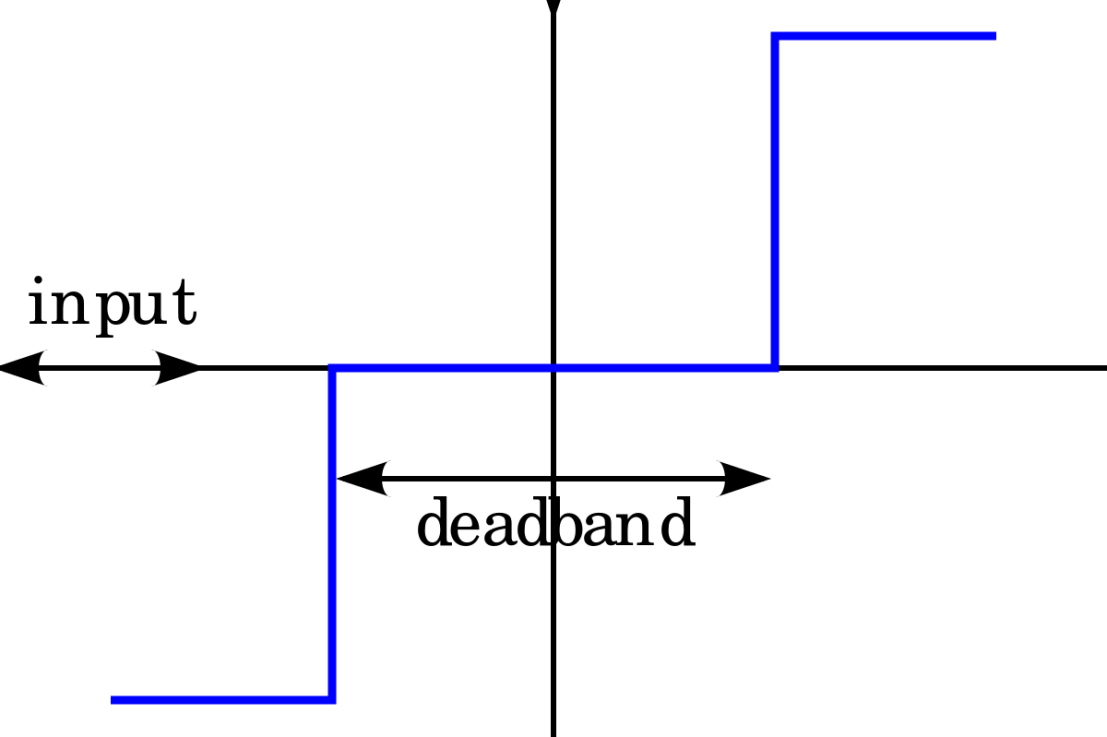
Ideal controls systems are available to take in all possible frequencies. Some controls systems have a zone where the input frequency will return nothing. This region is known as the deadband and can be used to prevent unwanted side-effects.