Category: Mathematics

Phase margin

Phase margin

Phase margin

08/28/17

“How can we measure the difference between a control signal and a half phase shift?”


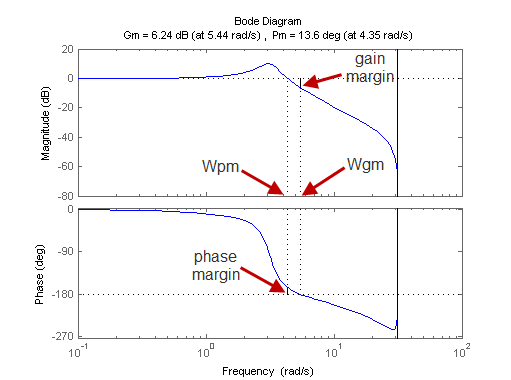
When working with electronic amplifiers, the phase of an input signal might be shifted, which might introduce instability. And if this phase shift is greater than 180 degrees, then the system will be unstable. To standardize all measurements, electronics researchers have introduced the concept of a phase margin, or how far off from a 180-degree phase shift this new phase is. The phase margin can be calculated with the simple equation P_margin = |180-phase|.
Gain Margin

Gain Margin

Gain Margin

08/27/17

“What is the margin of stability for a gain Bode Plot?”


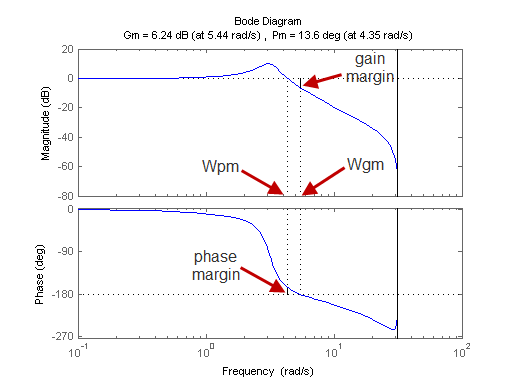
One of the most useful features of a Bode Plot is the ability to find the stability of a system. One way to do that is to find the frequency at which the phase shift becomes 180 degrees, get the amplitude of the gain at the point, and then make a gain margin extending out to both sides equal to the magnitude of 1/|Amplitude value|, such that anything within that range will be stable.

Undamped oscillations

Undamped oscillations

Undamped oscillations

08/26/17

“What are steady oscillations called?”


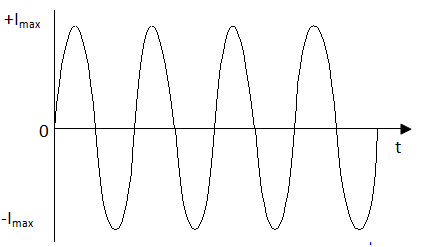
Many physical systems exhibit oscillating behavior. However, the natures of these oscillations can be different from one another. And in the most ideal oscillations, the amplitude is constant and unchanging. These oscillations are known as undamped oscillations and are rarely found outside equations and simulations.

Control Time Shifts

Control Time Shifts

Control Time Shifts

08/22/17

“Can we have built-in time delays into control systems?”


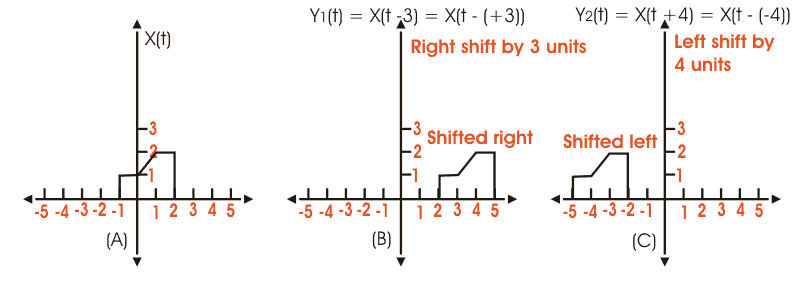
When working with control systems, sometimes we don’t want all actions to occur instantaneously. For example, we might want to have an elevator door wait to close a few seconds after everyone has entered. This can be modeled as a time shift within the system. A time shift for a function in the time domain can be represented by f(t) = x(t-tau) where tau is the time constant and in the Laplace domain by the equation f(s) = e^(-tau*s) *X(s).

Resonance

Resonance

Resonance

08/22/17

“What is the maximum amplitude of an oscillating system?”


In the physical world, systems can vibrate at different frequencies with different outputs. But when the system achieves maximum vibration at a certain frequency, it is called a resonance. Resonance has large impacts on the design of systems, from constructing electrical circuits to achieve certain characteristics to analyzing vibrational characteristics of bridges

Robust Control

Robust Control

Robust Control

08/22/17

“How can we make controllers that deal with uncertainty?”
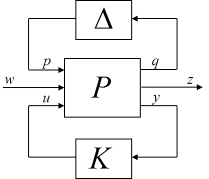
In an ideal implementation, controllers will have to deal with no uncertainty. However, reality is not always as nice as we would like it to be, and often times things happen that we can not prepare for. Because of this, controls engineers have invented something known as robust control to deal with such events. Robust control works by having an internal operation error boundary such that any system can handle any stimulus within the zone of error.

Feedback

Feedback

Feedback

08/21/17

“Can an output be used to affect input?”


Systems take an input and produce an output. However, a portion of this output can be cycled back to affect the input as feedback. Feedback that makes the input smaller is known as negative feedback while ones that make the input larger is known as positive feedback. Negative systems are much more stable while positive ones tend to instability. Feedback is vital for closed loop control systems

All Pass Systems

All Pass Systems

All Pass Systems

08/21/17

“What are systems with a constant frequency response magnitude for all frequencies?”


We know that control systems are dependent upon frequency responses and that the magnitude of these responses is usually dependent on the input frequency. However, some systems have a constant frequency response magnitude for all input frequencies, which are termed All Pass Systems.  

Step Response

Step Response

Step Response

08/21/17

“What is the reaction to an abrupt change in conditions for a system?”


Complex systems are easily controlled by external forces, such as the flip of a switch. And when these forces do cause change, they can be quite quick and drastic, changing all of the conditions of the system. And since the reaction to such changes can be very quick and drastic as well, engineers and scientists have decided to term these changes as the step responses to the system. An example of a step response includes a mechanical body’s friction to moving forces.