Category: Earth/Climate science

Chernozem

Chernozem

Chernozem

04/24/19

“What are some of the most fertile soils in the world?”

Soil is quite literally one of the bedrocks of human society. And just as Earth’s geography is greatly diverse, so are its soils. Some of the most fertile soils have a high percentage (upwards of 16%) of humus and other nutritious substances. This Chernozem is commonly found in Eastern Europe, Central Asia, and parts of the upper North American Midwest. Because of its recognizable dark color, the word Chernozem comes from the Russian words for black soil (chorny + zemlya).

Humus

Humus

Humus

04/23/19

“Why is broken down organic matter so important to soil quality?”

Organic matter can be found everywhere in the soil. This is typically broken down by plants over time, and when it becomes decomposed enough it will take on very important properties. This structure will be able to hold on to a large amount of nutrients, water, air, and microbes. These give humus great potential to supply plant matter the essentials for life.

Why the Oceans Are Becoming More Acidic

Why the Oceans Are Becoming More Acidic

Why the Oceans Are Becoming More Acidic

04/22/19

“How are CO2 emissions changing our oceans?”

Every second of every minute of every hour more and more carbon dioxide is being pumped into our atmosphere. Since the carbon intensity in the air will increase, the ocean will absorb more CO2. This larger amounts of this element will react with the H2O in water to form Carbonic Acid (H2CO3) and Hydrogen ions (H+). With a higher volumetric makeup of the latter elements, the oceans will become more acidic, threatening the stability of sea-life. This is Why the Oceans Becoming More Acidic.

Why Undergrounding Power Lines Makes Them More Vulnerable to Flood Damage

Why Undergrounding Power Lines Makes Them More Vulnerable to Flood Damage

Why Undergrounding Power Lines Makes Them More Vulnerable to Flood Damage

04/12/19

“Why is undergrounding power lines not recommended for flood-prone areas?”

Undergrounding power lines is a recommended course of action to build resilience against forest fires, storms, and heavy winds. However, this also makes them more prone to flood damage, as they will become submerged in water in the event of one. This is Why Undergrounding Transmission Lines Makes Them More Vulnerable to Flood Damage.

Climate Change Attribution

Climate Change Attribution

Climate Change Attribution

04/09/19

“How can we attribute what is responsible for climate change?”

One of the biggest debates going on about climate change is what is causing it. Many political pundits will claim that everything can be explained entirely through natural factors such as the Earth’s tilt or volcanoes. However, to prove causation, mathematical analysis will need to be done to isolate each component and observe its effects. Using this Climate Change Attribution, we can see that these effects do not contribute greatly to global warming and that carbon emissions is the primary driver behind climate change.

Carbon Sequestration

Carbon Sequestration

Carbon Sequestration

04/01/19

How can we remove and store carbon dioxide from the atmosphere?

Climate change is one of the most if not THE most dangerous event happening right now. And much of this is driven by the increased levels of carbon dioxide in the atmosphere. While most efforts are currently concentrated on limiting further emissions, there are currently efforts underway to actually remove carbon from the atmosphere. Known as Carbon Sequestration, this can be accomplished through a variety of methods such as increasing plant biomass or having large-scale fans suck up great amounts of CO2. If things become very drastic, then we may have to significantly increase the scale of carbon sequestration.  

The Lithosphere

The Lithosphere

The Lithosphere

03/31/19

“What is the outermost layer of the planet?”

The Earth as we know it is not a continuous object but made up of a continuum of layers. The outermost layer known as the Lithosphere contains the crust and the upper mantle, which not only composes the hardest layer but also reacts chemically with the biosphere, atmosphere, and hydrosphere as a result of being at the edge.

Image credit KnowledgeHouse

How Building More Housing in California Would Drastically Reduce Climate Change

How Building More Housing in California Would Drastically Reduce Climate Change

How Building More Housing in California Would Drastically Reduce Climate Change

03/26/19

“How can we fight climate change by building more housing in California?”

Although my home state of California is a global leader in Renewable Energy, Energy Efficiency, and Electric Vehicle Adoption, we are seriously lagging behind in critical area: housing development.

As a result of California’s neglection of residential construction combined with a booming economy over the past few decades, millions have been drawn to the Golden State without making more room for them. This has created a lack of supply with heavy demand, making housing costs skyrocket and pushing out residents further and further away from job centers. This has caused commute lengths to increase, releasing more pollution into the atmosphere and exacerbating climate change.

If California is truly committed to fighting climate change, then it needs to commit to building much more housing near transit and job centers. Upcoming Bill SB-50 holds much promise, which allows for construction of apartment buildings a half-mile from a railway station, quarter-mile of a high-frequency bus stop, or within “job-rich” neighborhoods.


How Solar Panels Can Help With Bee Conservation

How Solar Panels Can Help With Bee Conservation

How Solar Panels Can Help With Bee Conservation

03/22/19

“How can solar panels be apart of bee conservation?”

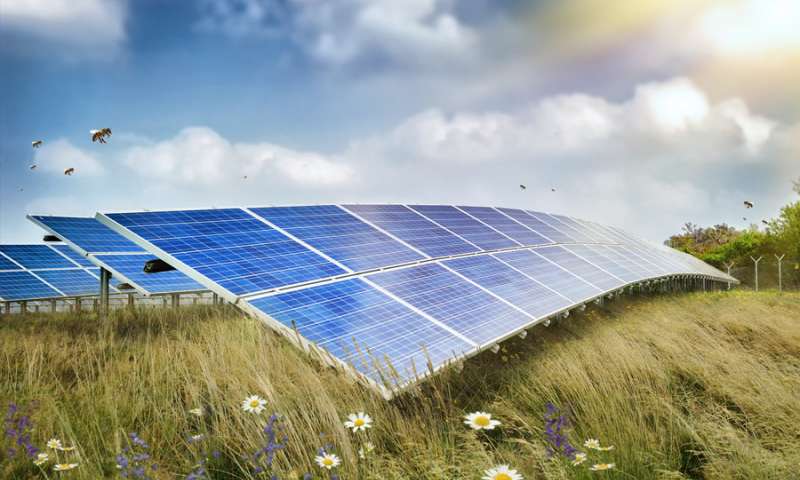
As a result of climate change and human activity, bees are dying at astonishing rates. Since these creatures are vital for pollination, their survival is crucial for the success of human civilization. But how can we accomplish this? Well, part of this will involve growing plants that are vital for pollinator life. Although this will involve a large amount of land, around and inside utility scale solar panels there is a considerable number of unused green space. This can be converted into pollinator habitats and become a safe space for bees. Not only would this help grow their population, but it would also re-mediate the environmental consequences of solar energy and help convince farmers to install renewable energy. This is How Solar Panels Can Help With Bee Conservation.

Image credit: Argonne National Labs