Category: Chemistry

Avogadro’s law

Avogadro’s law

Avogadro’s law              06/09/16

“Do gases of the same volume, temperature, and pressure have the same amount of molecules?”

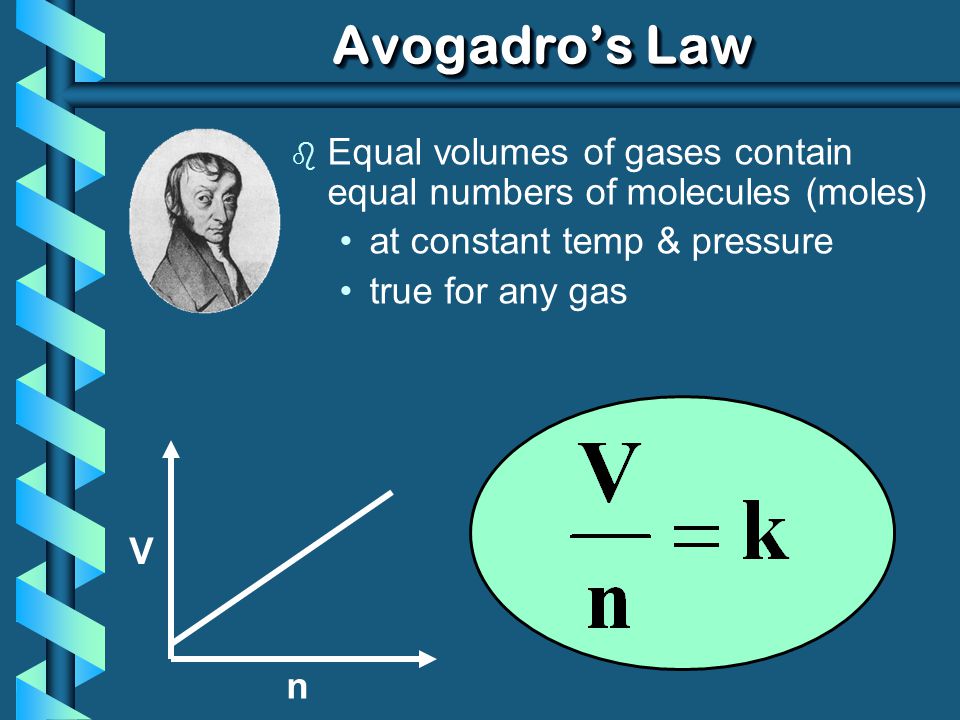
Through thorough experimental observation, it has been shown that Gasses of the same volume, temperature, and pressure have the same amount of molecules. This can be neatly summarized as Avogadro’s law, which symbolically states that Vn=k, with Vbeing the volume of the gas nbeing the number of molecules and kbeing some constant.
Charle’s law

Charle’s law

Charle’s law                  06/08/16

“ What is the relationship between a gas’ volume and temperature?”

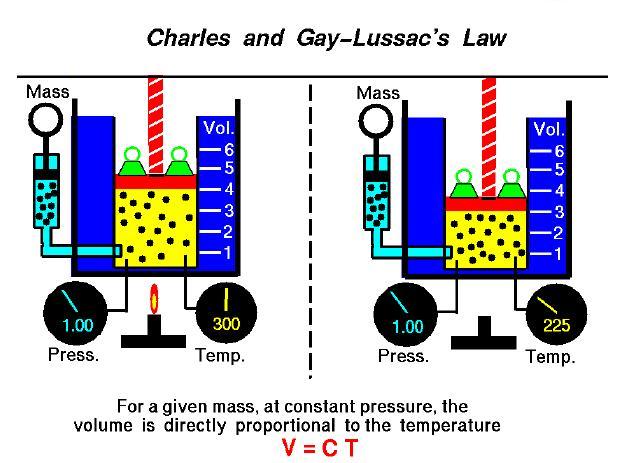
For a gas, the relationship between it’s volume and temperature is very simple. As a gas’s temperature increase, it’s volume will increase proportionally. This is because the molecules of a gas are relatively unbounded to one another, and when their temperature increases, their average speed will increase, and the volume encapsulating the gas will increase as a result. This can be symbolically summarized in Charle’s law, in which VT=k, with Vbeing the volume, T being the temperature, and k being a constant.

Boyle’s law

Boyle’s law

   Boyle’s law          06/07/16

“What is the relationship between Pressure and Volume in a gas?”

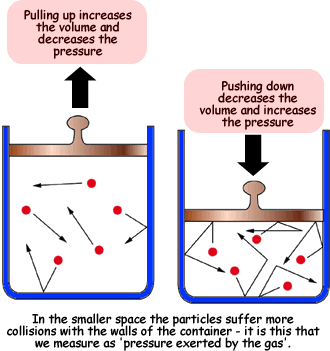
The relationship between Pressure and volume can be neatly summarized in a simple concept known as Boyle’s law. Boyle’s law states that for a gas the pressure multiplied by the gas is simply equal to some constant k. To put this numerically, P*V=k. We can expand upon this by the fact that if the pressure and volume change, their product will be equal to the same multiple, so P1*V1=P2*V2.

Ideal gas

Ideal gas

Ideal gas                06/06/16

“What model can we use to describe a gas?”

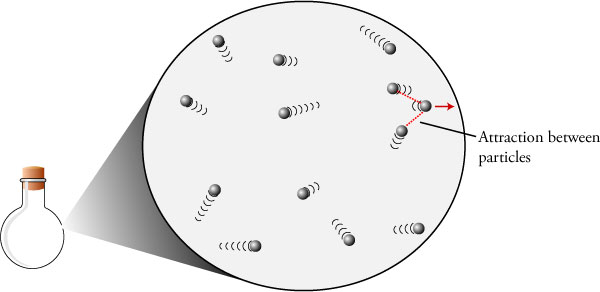
Let us visualize all of the particles in a gas in their pure intricateness. Think of all of those individuals particles bumping around in semi-random number. There are numerous factors that affect this gas, such as temperature T (how quickly each of these particles are moving around) pressure P(the density of each of the gas particles bouncing against the tank), Volume V (the amount of geometric space the gas takes up), The amount of gas . All of these facets are fundamentally related to each other with something known as the ideal gas law P*V=n*R*T, with R being a constant. This equation is insurmountably amazing because it means we can find out so many properties of a gas by just knowing a few factors!

Pseudo-elasticity

Pseudo-elasticity

  Pseudo-elasticity          

        05/31/16

“Are there reversible responses to stress?”

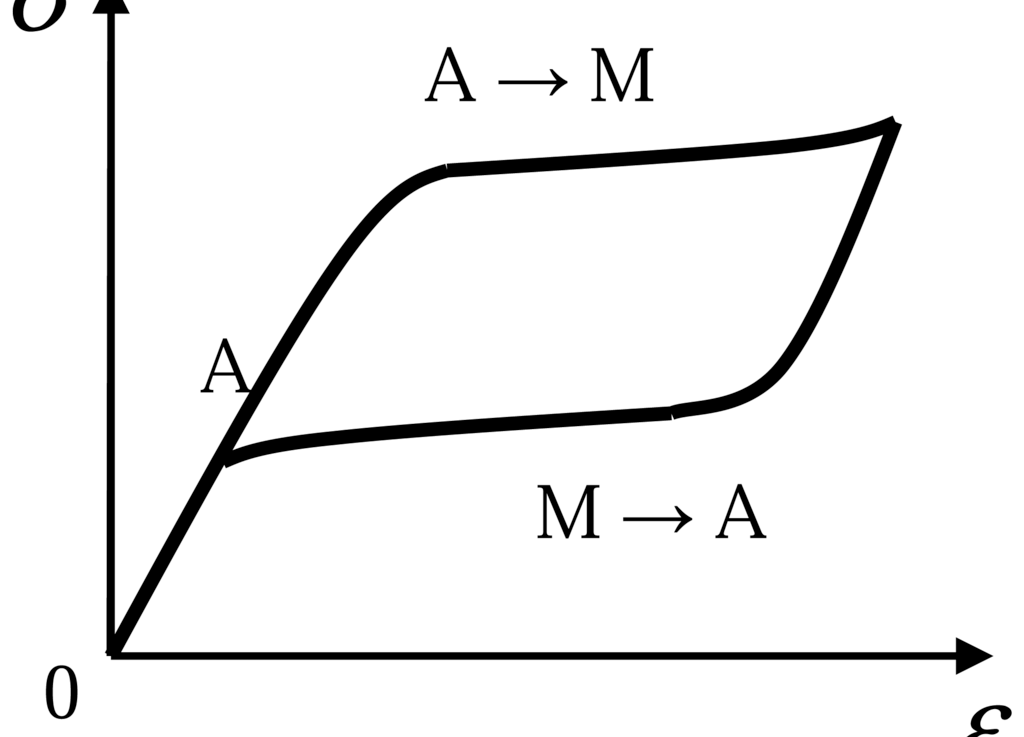
If you have thought about this, then I recommend that you research about a most interesting effect known as Pseudo-elasticity. Pseudo-elasticity is an elastic (also known as reversible) response to applied stress. This effects is a result of the crystal lattice structure of materials.

Shape-memory alloy

Shape-memory alloy

Shape-memory alloy                 05/30/16

Are there materials that “remember” their shapes such as the ones seen on television?

Believe it or not, the answer to this question is yes! Shape-memory alloys are alloys that have the ability to “remember” their original shape (which means that they return to their original form after a deformation). This effect is a result of the material’s unique crystal structures, which allows it to reverse after a deformation. Shape-memory alloys have a wide domain of applications (tweezers used to remove foreign objects), ranging from medical appliances to military technology and even into clothing!!!

Non- Newtonian fluid

Non- Newtonian fluid

                     Non- Newtonian fluid           05/14/16


Non newtonian fluids are fluids in which viscosity changes with applied force. To illustrate, let’s examine how this is differentiated from a Newtonian fluid. In a newtonian fluid, if an object is placed in to a fluid, the fluid will coalesce around the object no matter the force. In a non-newtonian fluid, the fluid will become more viscous in response to the larger force. In fact, the particles of the system behave more like a solid. Some other Non-newtonian fluids have the reverse effect, with a larger force producing a lower viscosity. An example of the most strange effects of a non-newtonian fluid is corn starch. When one pours corn starch, it flows in a very smooth manner. However, if one attempts to hit the Cornstarch with a mallet, it acts almost as it is a solid. You can even jump up and down on the corn starch!!!

Environmental stress cracking

Environmental stress cracking

   Environmental stress cracking                 04/24/16


One of the most common unexpected brittle failures of all thermoplastic materials is environmental stress cracking. ESC occurs when polymers are exposed to liquid chemicals that accelerate the crazing process, which results in cracking at pressures below standard air temperature. The study of ESC has application within the automobile industry, where the need to keep polymers stable is paramount

Brittleness

Brittleness

Brittleness          04/23/16


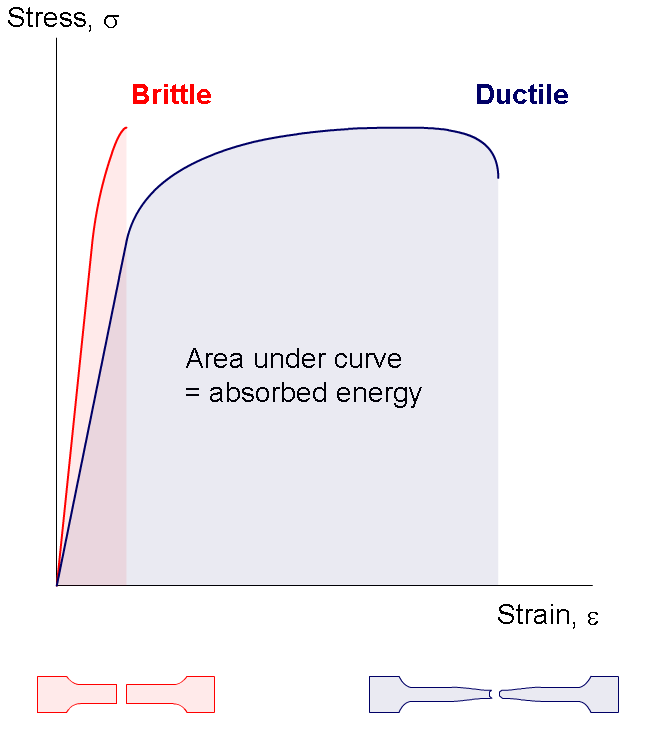
An object is considered brittle if it breaks from stress without significant deformation. Such an object requires little energy to be broken. The brittle strength of an object can be increased by subjecting it to pressure.