Category: Chemistry

How to predict if chemical bonding will be ionic or covalent

How to predict if chemical bonding will be ionic or covalent

How to predict if chemical bonding will be ionic or covalent

Isaac Gendler

07/19/16

“How can we predict if chemical bonding will be  ionic or covalent?”

During one’s study of chemistry, one will come across two distinct forms of chemical bonding, ionic and covalent. However, how can we predict which one the elements will undergo? Chemists have discovered that a simple rule of thumb is that can determine which one is which. If the two elements have significantly different group numbers (such as one one on group 1 or 2 on the periodic table and another on group 5-7) then an ionic bond will take place as a result of the difference of electronegativity. If the two chemical are in a similar group, then a covalent bond will take place.  

Partial pressure

Partial pressure

Partial pressure

07/07/16

“How can we quantify the different pressures contributed by different gases in a container?”

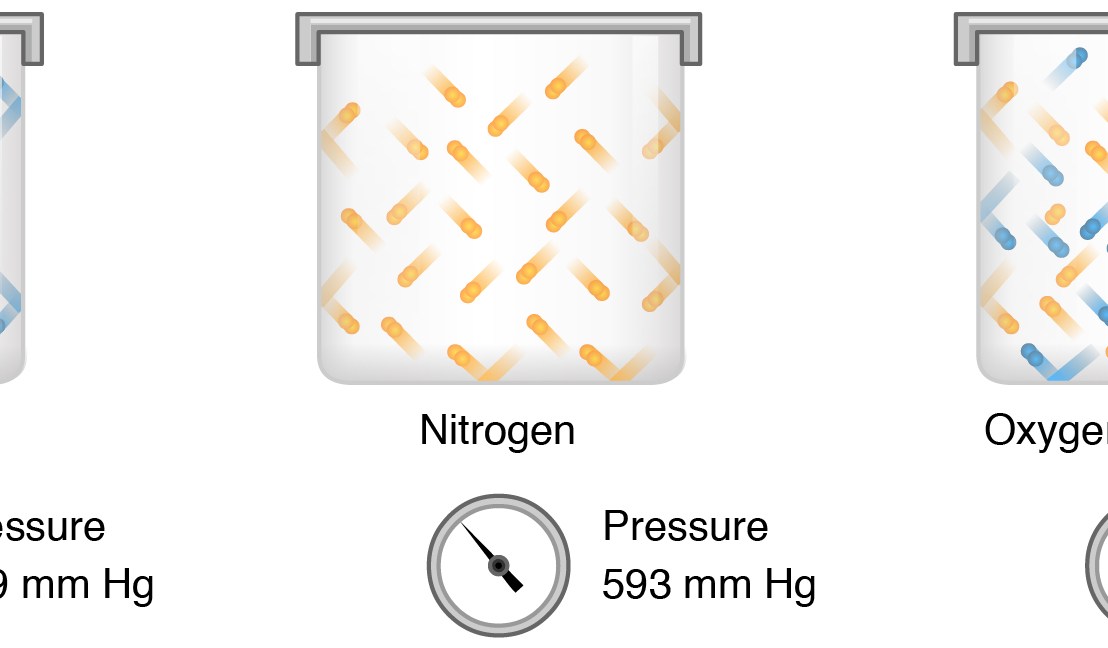
Let’s think about something. We know that a mixture is a combination of different gases held within a given volume. We also know that different gases are made up of different molecules. And we also know that different molecules come in different sizes and forms, giving them different quantitative properties. And one of these different quantitative properties happens to be pressure. So therefore, gases of different chemical makeup will have different pressures. So how can we mathematically determine the pressure that each gas contributes to the mixture? Well, this is actually one of the easiest things to solve for in chemistry. All one has to is find the total percentage contribution to the mixture that one of the gases contribute, then multiply that concentration by the total pressure, and one can get the amount of pressure that the individual gas contributes. Scientists and Engineers have termed this the partial pressure of the gas.

Calorimetry equation

Calorimetry equation

Calorimetry equation

07/06/16

“How can we measure the change in energy of an object when it changes temperature?”

Let’s consider something. We know that temperature is a measure of the average internal kinetic energy of an object. So logically, if there is a change in temperature, there is a change in the energy of an object. But how is it possible to measure this change? Well, luckily for us, Scientists and Engineers have come up with a special relationship relationship known as the calorimetry equation. This equation can be represented numerically as q=m*c*t, with q being the change in energy, m being the mass of the object, c being the specific heat capacity (a constant based on the material), and t being the change in temperature.

Ionic bonding

Ionic bonding

Ionic bonding

07/05/16

“What happens when ions of opposite and equal charge react?”

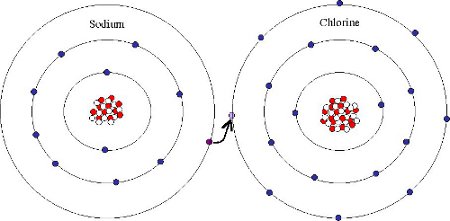
Let’s think about something. We know that ions are atoms with a net electric charge. We also know that when a positive and a negative charge are close to each other, there will be an electric force that pulls them together. So what happens when ions with charges of equal magnitude and opposite sign come within the vicinity each other? Well, if we use our own scientific intuition, then we would know that there will be an attractive force between the objects, causing them to be pulled together. These atoms will form a bond which chemists have decided to term an ionic bond. Ionic bonds are between metals and non-metals, are very hard to break (often melting only at high temperatures), and can be conductive when they are in liquid form.

Covalent bonding

Covalent bonding

Covalent bonding

07/04/16

“What happens when atoms share electrons?”

Atoms often have free space for electrons in their valence shell, which makes them unstable and prone to reaction. However, is it possible for atoms to share their electrons in order to fill the void? Let’s look at an example. Oxygen has only six of its eight valence electrons occupied, while hydrogen has one out of two. This means that oxygen needs to find a way to retrieve two electrons and the hydrogen needs to find a way to receive one electron. This can be accomplished if two hydrogen atoms shared their electrons with the oxygen atom. Then the oxygen would have it’s valence shell filled and the hydrogen would also. This will for a chemical bond known as a covalent bond. Covalent bonds are completely made up of non-metals, and they are extremely strong and durable, making it very difficult to dissolve a covalent bond.

Numerical electron configuration

Numerical electron configuration

Numerical electron configuration

07/03/16

“How can we quantify electron configuration?”

When dealing with electron configuration, wouldn’t be usefull if we could somehow create a framework to conceptualize everything? As discussed earlier, the electrons of an atom are organized into shells and orbitals, the former dealing with the distance from the center of the nucleus, and the latter dealing within the probabilistic location To start off, we will assign a number to each of the atomic shells, with the first shell being called the “first shell”, the second the “second shell”, and so on. Furthermore, each of these shells will be divided into subshells. Subshells are the set of atomic orbitals that are most similar to each other. The first shell will have one subshell (called the 1s subshell), the second shell will have two (the 2s and 2p respectively), the third will have three (3s, 3p, and 3d), and so on. Each of the letters indicate a different orbital of the subshell. Each orbital can hold two electrons, and each subshell will be able to hold 4L+2 electrons, with L being the orbital value of the subshell (for example, the s subshell will have an orbital value of 0,the p a 1, and so on).

Now, how do we incorporate the change in electrons into this system? When electrons flow into an atom, they will enter the orbital with the lowest level of energy associated with it, as that is the easiest one to deal with. The two factors that affect the energy level are the shell and orbital value. As a result, it is possible to have an shell with a higher value but a lower orbital be filled before  one with a lower value shell but higher orbital. For example, the 4s orbital will be filled before the 3d one since the 3d has a higher energy level. The pattern for this phenomena can be seen on the picture for this article.

Finally,  this brings us to the outermost shell of the atom. If this shell, termed the valence shell by chemists, has a lack of filled space, then it will be able to react with other chemicals to create chemical reactions and make chemical bonds.

Intro to electron configuration

Intro to electron configuration

Intro to electron configuration

07/02/16

“How can we find out how much free space an atoms has for electrons?”

All atoms have the potential to have electrons. However, how can we find out how many electrons an atoms has and how much it can hold? To solve this question, let’s start off with one fact. All electrons revolve around the nucleus. Because there is a mutual interaction between the two particles, there will be a certain level of energy associated with the two particles that binds them together. Furthermore, as a consequence of the laws of quantum mechanics, all energy levels are in discrete forms.  When the electron receives enough energy to surpass the binding energy, they will jump to the next possible level. The energy required to surpass the binding force is called the ionization energy and the different levels are called valence shells. As a result of the Heisenberg uncertainty principle, these electrons will have different possibilities of location within these valence shells, and that probability depends on the amount of electrons inside. These probabilistic locations are called orbitals. Chemists have termed these series of classifications to be the electron configuration of the system. 

Solubility

Solubility

Solubility

07/01/16

“How do substances dissolve in other substances?”

Have you ever wondered why some substances can dissolve in other substances? For example, how is it that salt can be completely submerged into water.?To solve this problem, we have to think about it from another perspective, specifically a molecular perspective. To illustrate, let’s start with a an ionic bond-based molecule, such as salt. The salt molecule will be made up of positive sodium ions, and negative chloride ions. And let’s take this salt and put it into an electric dipole molecule based substance such as H20 (water). Because The H20 molecule will have a net charge depending on the location (being more positive closer to the hydrogen, and more negative closer to the oxygen), these parts of the molecules will be attracted to their respective oppositely charged ions of salt. This attraction will be so strong that the water molecules will rip away the intenral bonds of the salt molecule to disperse all of the atoms throughout the substance. Scientists and Engineers have termed the resulting mixture of substances a solution, the substance whose bonds get ripped away the solute, and the substance that absorbs the solute the solvent. The measure of how well a solute can be dissolved in a solvent is called the solubility of the substance

Solutions have numerous peculiar features. Because the solute is so homogeneously dispersed throughout the solvent, a solution can not be filtered. In fact, the solute is so immersed into the solvent that light will not be able to reflect it! However, both substances will still have different boiling points, so the solution can be separated through evaporation, as one of the substances will boil away before the other one.

Because of the laws of physics,  polar compounds will be able to dissolve ionic and polar compounds, but only non-polar compounds will be able to dissolve other non-polar compounds. That’s why you can put water into plastic and not have to worry about chemichal reactions (as plastic is a non-polar substance). Solid solutes dissolve better in liquid solvents when they have a higher temperature (due to closer entropy levels to the liquids) and Gaseous solvents work better when they have lower temperature (for the same reason). Gaseous solvents also have better solubility with increased pressures

Pressure volume diagrams

Pressure volume diagrams

Pressure volume diagrams              06/13/16

“How can we empirically model the change in pressure and volume of a gas?”

In order to model the change in pressure and volume of a gas, Scientists and Engineers have created a framework known as Pressure volume diagrams. P-V diagrams are very simple, the Pressure and volume of an object will be represented by a cartesian coordinate system with the Pressure on the vertical axis and the Volume on the horizontal. When work is added to the system, the change in volume and pressure is recorded along an arc length. The volume under this curve represents the change in work in the system. The return process does not have to be symmetric, so often a P-V diagram could possibly have a different return curve.
Let us illustrate with the following example. Imagine gas with a piston in a machine.The state of the gas gas starts at point 1 on the graph. Heat is then added, which the increase the pressure. The normalization process then starts, which decreases the pressure and increases the volume, causing the state to go to poin 2. Heat is then extracted, which causes the state to go to point 4, and the reverse normalization process starts, which causes everything to go back to the begining at point 1.