Author: Isaac Gendler

Greenhouse gases

Greenhouse gases

Greenhouse gases

12/06/16

“What causes global warming in our atmosphere?”


On the news and social media, you will probably hear much discussion relating to a planet destroying phenomena called “global warming” which raises the temperatures of the Earth’s atmosphere. However, what exactly causes this malignant circumstance? As scientific thinkers, let’s get to the bottom of this. To start with, it would be rational to understand what keeps heat on our planet in the first place. In our atmosphere, there are components known as greenhouse gases (namely carbon dioxide, methane, and others) which are capable of absorbing infrared radiation, thereby trapping the warmth emitted by our sun on to our terrestrial home. Before the beginning of the industrial revolution, the levels of greenhouse gases present were just enough to keep the Earth in a temperature equilibrium. However, the many fuel sources used by humanity such as coal, petroleum, and natural gas emit greenhouse gases themselves, therefore adding to this stockpile, and causally a higher amount of heat will be trapped. This rising buildup is most worrying to the future of humanity, with the amount of  CO2 in the atmosphere being over double pre-industrial levels and the average temperature rising over 2 degrees celsius! However, with the use of non-greenhouse gas emitting technology such as solar power and wind turbines, humanity can finally get of this trepidation-filled trend.

Hess’s law

Hess’s law

Hess’s law

12/05/16

“How can we find the change in enthalpy for a chemical reaction without actually performing the reaction?”

Finding the change in enthalpy for a chemical reaction is a rather straightforward procedure, one simply carries forward with the necessary steps and measures the temperature before and after the reaction took place. However, some reactions take an extraordinary long time to perform, or their process is highly volatile. So how can we find the change in enthalpy for such reactions? Well let’s think about it. We know that if we were to take one chemical reaction and reverse it, then the resulting change in enthalpy would reverse in sign. And we know that if we add one element of a chemical equation to the opposite side of an equation containing that element, then they would cancel out. So what if were to take the results of some reactions that we already know, modify them if necessary, and then add them together to fashion the equation of the reaction that we desire? This is the operating principle behind Hess’ law.

To illustrate, let’s examine the reaction Mg(s) + H2O(l) → MgO(s) +H2(g). Since Mg does not react with water, completing this experimentally would be a nightmarish process. However, we can easily obtain the results for Mg(s) +2HCL(aq) → MgCl2(aq) + H2 and MgO(s) + 2HCl(aq) → MgCl2(aq) + H2O. If we were to take the former equation and subtract the latter from it, we would be able to obtain our desired equation. All we need to do is obtain the change in enthalpies for these reactions, and then proceed forward with the mathematics, and next thing you know we would obtain our necessary results!

Change in Enthalpy

Change in Enthalpy

Change in Enthalpy

12/04/16

“How can we measure the change of energy in a thermodynamic system when the system itself changes?”


All thermodynamic systems have the summation of the parts of their energy represented by enthalpy. However, the universe is almost never in a static state, and is always changing. Consequently, all thermodynamic systems will be in perpetual change as well. And it turns out that this change in enthalpy has very practical results for scientific use. A change in enthalpy can be quantitatively described by taking the difference of the enthalpy of the system after the change and before the change. If the  enthalpy has gone up, then that means that energy must have been added to the system, making it an endothermic process. If the enthalpy has gone down, then heat was removed from the system and it was an exothermic process. The change in Enthalpy is often symbolically represented using a (delta)H

Enthalpy

Enthalpy

Enthalpy

12/03/16

“How can we model the total energy inside a thermodynamic system?”


As a scientist or engineer, if you ever work with thermodynamics systems, then you will have to understand the amount of energythat you are working with. However, how can we represent this concept in more concrete terms? Well, luckily for us, after many years of hard labor, scientists and engineers have formulated the very concept of enthalpy of this very matter. Enthalpy can be defined as the amount of energy stored within a thermodynamic system, which can be symbolically defined as H = u + p*V, with H being the enthalpy, u being the internal energy of the system, p being the pressure and V being the volume.

Energy density and it’s importance

Energy density and it’s importance

Energy density and it’s importance

12/02/16

“How do scientists and engineers measure the density of energy within a system and why is it important?”

Energy is a quantity that is used omnipresently for calculations in all branches of science and engineering. However, energy is more than a theoretical abstraction, and since it is tied to the material universe, it must be stored somewhere in reality, such as in objects. And since objects of the same size can have different abilities to hold energy , we will need some conceptual way to understand this. As a result, scientists and engineers have developed the concept of energy density to represent the amount of energy stored within in object. Energy density is an important concept because when analyzing energy storage mechanisms such as batteries and capacitors, once must take in to consideration the volume vs power limitations that a project might have. To illustrate, let’s say that you want to build an autonomous boat. Since this boat will have no people on board, it will need a mechanism to power it’s systems. However, the boat can not uphold too much weight, or else it will sync. Therefore, when designing such a contraption, engineers will have to choose an energy storage technology with a high energy density.

Ion-dipole forces

Ion-dipole forces

Ion-dipole forces

11/27/16

“What exactly causes ionic compounds to be dissolved in dipole solvents?”


One of the first facts one will learn in a Chemistry course is that ionic compounds such as salt (NaCl) will dissolve in dipolar solvents. However, have you ever wondered why does this phenomena take place? Well, as scientifically minded people, we should explore anything that we don’t know. Ionic compounds are held together by ionic bonds, which are the result of two or more atoms sharing electrons. And since these ionic bonds depend upon factors of charge distribution, they susceptible to the influence of external electric forces. As such, if they come into close contact to polar substances such as dipole solvents, the resulting ion-dipole force would rip apart the compounds.

Offshore windpower

Offshore windpower

Offshore windpower

11/30/16

“How can we use coastal winds to enhance wind power?”

One of the primary criticisms launched against sustainable energy advocates is the systems for extrapolating such energy forms are too limited in geography, time of day, and energy density. However, thanks to the strong willpower of renewable energy engineers, we could have a new technology that could fundamentally upset this paradigm. In the past, wind turbines were only built on solid terrain. Even though this was the simpler way of doing things, it had a major drawback due to the fact that wind is not omnipresent. However, thanks to the flat and low friction nature of water, winds currents are much stronger and consistent over the ocean. And since higher wind current means higher wind power, wouldn’t it be logical to have wind turbines placed in the ocean? This is the exact behind offshore wind power. Offshore wind turbines only have 2 percent of the energy payback time as regular onshore turbines, are less noticeable to the common public, and can be located near a high number of population centers. However, like with everything in engineering, there are always drawbacks with offshore windpower, such as the fact that it takes much more materials to construct such turbines, and the technology is only nascent, requiring further development. But even with this, the future of offshore windpower looks bright, and many countries have already begun investing in to it, such as the gargantuan 630MW London array in the United Kingdom, the 600 MW Viking wind farm in Scotland, and the 400 MW Anholt windfarm in Denmark.

How heat affects capillary action

How heat affects capillary action

How heat affects capillary action

11/29/16

“How does the temperature of a liquid affect it’s capillary action?”


Heat has an effect on a myriad of different properties of materials, but could it possibly have an effect on capillary action? Well, let’s use some of our scientific thinking to find out. We know that increasing the temperature of an object will weaken the intermolecular force of it, and we also know that the strength of capillary action is based upon the relative strength between the adhesive and cohesive forces of a liquid (Which we can symbolically summarize as cohesive force = adhesive – cohesive). So wouldn’t it be logical that if we could weaken the internal cohesive forces of a liquid through heating, that the adhesive forces would have more pull? According to scientific research, this hypothesis proves to be empirically valid!

How intermolecular forces affect the boiling of a substance

How intermolecular forces affect the boiling of a substance

How intermolecular forces affect the boiling of a substance

11/28/16

“How does the molecular bond type of a chemical affect the boiling point of a substance?”


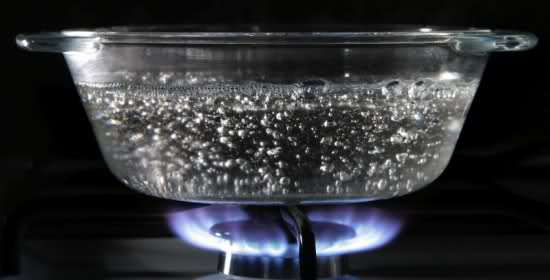
In a Chemistry class, you will probably learn that a chemical’s intermolecular force type will have an effect on the boiling point of a substance. However, there is also a good chance that you will never be explained why such a phenomena occurs. And since we were just told a fact without an explanation, we must investigate. Well, first of all, we know that raising the temperature of a substance will increase the kinetic energy of molecules, and if the kinetic energy is raised high enough, then the molecules will be able to escape from their intermolecular constraints. consequently, if the molecules in a liquid are able to escape, then a the free molecules will form a gas, causing the liquid to boil. And since the different types of intermolecular forces have different strengths, then these more powerful bonds will have more force, and as a result the more powerful the type of bond, the higher the boiling point. To give an example, let’s examine two different chemicals with a similar molecular geometry but different types of bond, Water [H2O] and Hydrogen Sulfide [H2S]. Even though H2S has a higher electron count than H2O, since H2O exhibits hydrogen bonding, the boiling point of H2S (-60 C)  is far lower than the boiling point of H20 (100 C)