Author: Isaac Gendler

Ohm-meter

Ohm-meter

Ohm-meter

11/27/16

“How can we measure the resistance in an electronic component?”


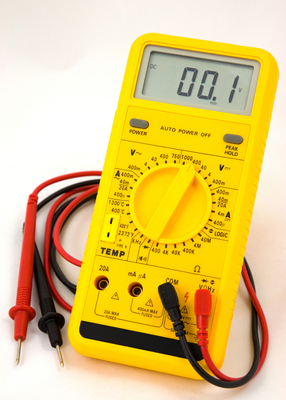
Electronic structures such as resistors play a vital part in the workings of electrical devices through the use of resistance. However, how can we measure such a phenomena empirically? Well, let’s use our engineering mindset to figure it out. Firstly, we should be aware that it is possible to experimentally measure both the voltage and current between two points, and that the resistors of a circuit is equal to the voltage divided by the resistance (R = V/I). Therefore, it would be most rational to combine these two facts, and synthesize a most useful device known as the ohm-meter.

Using the ideal gas law to calculate the molar mass

Using the ideal gas law to calculate the molar mass

Using the ideal gas law to calculate the molar mass

08/26/16

“How can we use the ideal gas law to calculate the molar mass of an object?”

During a student’s course in Chemistry, they will probably realize that the ideal gas equation is one of the most useful equations in the entire subject. However, is it possible to use this equation to do more, such as calculate the density of a gas? Well, let’s use our mathematical skills to find out. We know of course that the ideal gas equation is PV=nRT, with P being the Pressure in atm, V being the volume of the gas, n being the number of moles, and T being the temperature. Now, there seems to be no appearance of density anywhere in this equation, but let’s take a closer look at the value n. Since n is the number of moles in an object, we can use the molar mass equation to derive that n = mass/(M), with M being the molar mass. However, we still do not have density in our equation, but could we go any further? Well, it turns out that density is mass per volume, so mass can be represented as density times volume (rho*v). By substituting these value back into the ideal gas law, we can obtain PV=(rho*V/M)*RT, and after doing a bit of rearranging we will be obtain rho = M*P/(R*T).

The biot-savart law

The biot-savart law

The biot-savart law

11/25/16

“How can we symbolically describe the magnetic field generated by an electric current?”


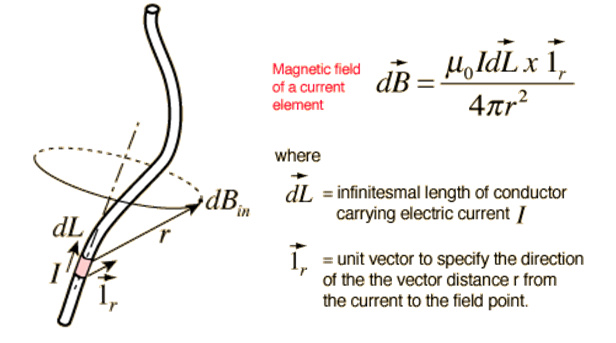
As stated before, an electric current will generate a magnetic field. However, how can we put this into symbolic form for quantitative purposes? Well, thanks to the hard labor of prior scientists, we have a mathematical relationship known as the Biot-Savart law. The biot savart law defines the relationship between a magnetic field and an electric current as dB = (Mu_0*I *dL*l_r)/(4*pi*r^2) , with Mu_0 being the permittivity of free space, I being the current, and dL being the displacement vector (the distance between the current and some location in the field).  

The scientifically optimal way to cook a Turkey

The scientifically optimal way to cook a Turkey

The scientifically optimal way to cook a Turkey

11/24/16

“What is the most efficient way to cook a Turkey?”

Thanksgiving is a most special holiday in the hearts of Americans. It represents a time when friends and family coming together to  participate in social activities and dine on delicious food. And the most important food of all of Thanksgiving is the Turkey, with it’s rich, savoring flavor. However, cooking a Turkey is not always an easy task. Specifically, the plump and rounded shape of a Turkey is most inefficient for heat conduction, forcing it to have a high cooking time (especially if one wants to cook the Turkey to an internal temperature 74 degrees celsius to prevent salmonella).  So how can we apply our scientific knowledge to solve this problem? Well, let’s think about it. We know that the temperature of objects raise based upon the amount of heat added, and that if an object has more surface area, then it has more heat it will receive. So how about we do just this? First, let’s take the Turkey out. Then, flip it over, and cut off the back bones. Subsequently, flip it over again, and apply pressure to break the breastbone. Once this has been completed, you can put the Turkey. Chefs have termed this process the spatch cocking method, and it can save the chef anywhere from 45 to 80 minutes of cooking time!.

Finally, in the Thanksgiving spirit, I would like to give a big thanks to Sarah Kaplan of the Washington Post for teaching the world about this most innovative method.
Why do rechargeable batteries wear out?

Why do rechargeable batteries wear out?

Why do rechargeable batteries wear out?

11/23/16

“So why do they?”

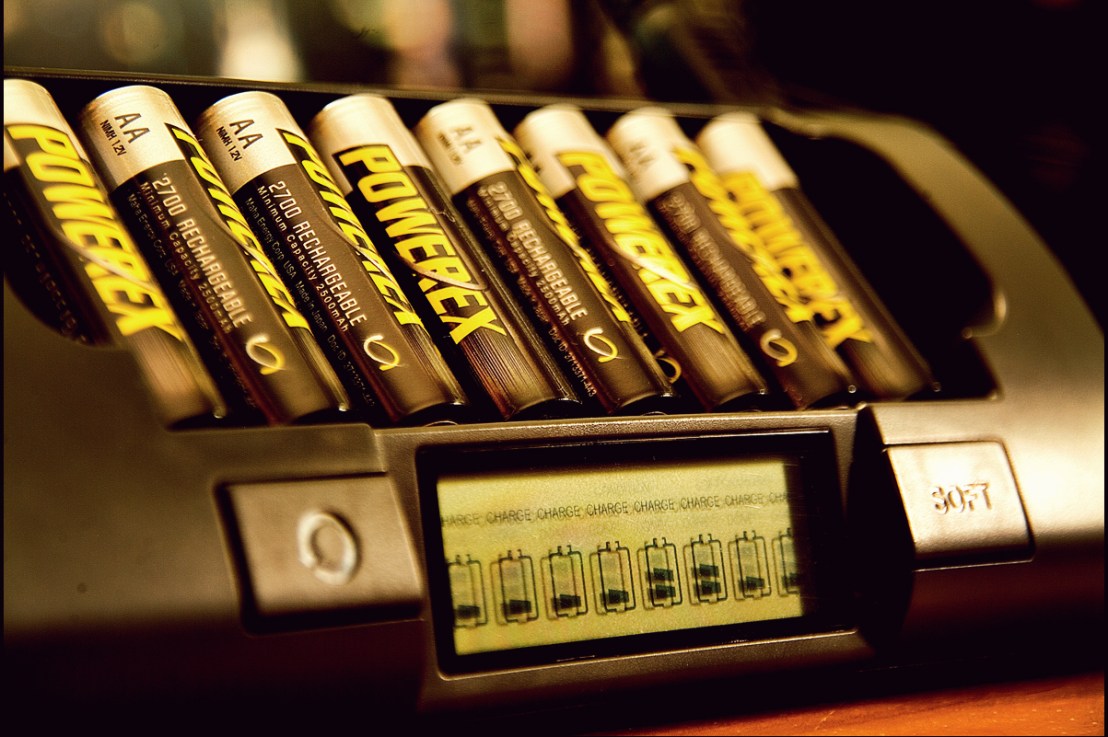
Rechargeable batteries can be a very worthwhile investment. For just a small amount of money, one can save not only save the environment but also much pain irritation from having to unceasingly find new batteries . However, something one very vexatious impinging factor on their worthwhileness is the fact that rechargeable batteries tend to wear out. Specifically, the more one recharges a battery, the less charge the battery will be able to hold. But why does this happen? Well, it all comes down to a the way that it works. Rechargeable batteries charge by using a transfer of ions through an anode and a cathode to convert active energy into potential energy  . However, this process will wear down the anodes and cathodes over time, leading to a degradation of internal materials which in turn leads to increased inefficiency. Therefore, the more time one charges a battery, the less productive it will be.

Emission and absorption spectrum

Emission and absorption spectrum

Emission and absorption spectrum

11/22/16

“Why do elements absorb light?”


Light is something that we literally see everyday, whether it be from the sun shining down on civilization during the day, the incandescent light bulbs lighting up our night, or the flashlights we use to read in bed. However, as light is both a wave and a particle, it has to interact with material objects when it makes contact, so what happens when it does so? Well, let’s think about it. We know that light is composed of atomic-size forms of matter known as photons, and we also know that as a result of the wave-particle dualistic nature of light, these photons will have a wavelength associated with them. And since light is emitted by radiation, these photons will have a distributions of multiple wavelengths, all of which have a corresponding energy. Furthermore, all material objects are comprised of atoms, which have discrete energy levels. So when a photon wave hits a material object, the atom can only absorb the photon if it corresponds to the precise energy level. This energy level will stay elevated for a limited amount of time, and will soon fall back down to the original energy level, emitting  a wave of the same energy level. If one were to take an empirical measurement of the wavelengths being emitted by constructing an emission and absorption spectrum, then one would be able to identify the element present! 

Schmidt hammers

Schmidt hammers

Schmidt hammers

11/21/16

“How can we learn about the compressive strength of a material without destroying it?”


In engineering, knowing the compressive strength of the materials that you are working with is vital for all forms of analysis work. However, many testing methods are very expensive, and involve actually deforming some of the material. So what if we were to have a material that is both expensive and irreplaceable? Well, luckily for us, engineers are a very clever people, and have invented a device known as a Schmidt hammer to solve this problem. The schmidt hammer is comprised of three main parts, a solid chassis, a cylinder going through the center of, and a spring in the inside of the cylinder. When held vertical and pressed against a solid surface, the cylinder will stand in place, causing the chassis to move downwards, compressing the spring. When the cylinder moves all the way down, the user can press a button on the chassis, which in turn will release the compressed spring, and the resulting rebound will give a reading on the body of the chassis which corresponds to compressive strength.

Operating temperature

Operating temperature

Operating temperature

Isaac Gendler

“In what temperatures can a machine operate?”


As a modern civilization, we operate and use machinery everyday. Whether it be something as simple using an alarm to wake us up in the morning or something as exciting taking as plane to another continent, technology has firmly integrated itself into the nuances of human life. However, as engineers, we must realize that such machines have constraints to them. One such constraint is the temperature that the system can operate in, also known as the operating temperature. Since objects and materials have different properties at different temperatures, a system will change depending on the temperature input. And since machines, (both mechanical and electrical) require all parts to work in a highly precise manner, such perturbations in properties could cause drastic failures. To illustrate, let’s analyze a device very familiar to us, the computer. If the internal temperature of a computer exceeds the operating temperature, then component failures will ensue, causing a shutdown. As a result, when designing as an engineer, one must always take into account the operating temperature.

Factor of safety

Factor of safety

Factor of safety

11/19/16

“How do engineers deal with loads near the failure point?”


When doing engineering, one has to deal with the maximum load that a system can handle. However, in the real world, it would be quite unwise to have loads even near this limit. The rationale behind this is that such a system could experience an unexpected impingement. To illustrate, let’s suppose that enough people stand in an elevator to have it at maximum capacity, if even a rat were to climb into this elevator, then this capacity would be overloaded and the elevator would experience failure. Luckily, engineers tend to be foresightful people, so when developing structures, instead of designing them just to sustain the expected loads, they are created in respect to a factor of safety. A factor of safety an extra “margin” that a structure can support (in terms of a multiple of the expected load), and can be calculated using the formula FoS =Ultimate stress/actual stress . An example of the factor of safety in use is the famous Eiffel tower, which is designed to sustain 4.5 times as much stress than it typically does. In summation, the factor of safety is an intrinsically necessary tool in modern engineering, and has saved countless of lives all over the world.