Month: December 2017

The Ideal Diesel Cycle

The Ideal Diesel Cycle

The Ideal Diesel Cycle

12/04/17

“How can we analyze a diesel engine?”


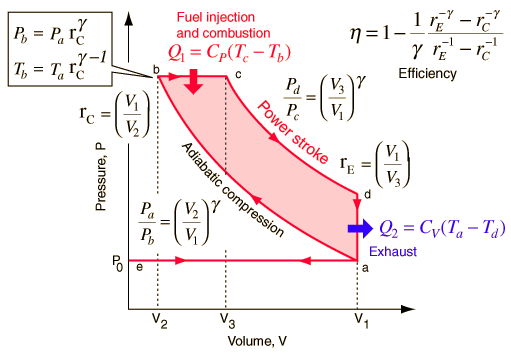
For better or worse, diesel engines are one of the most utilized technologies across the world. And as engineers, it would be logical to analyze how they operate. When a diesel engine starts, it draws in a fluid at a constant pressure. Afterwards, this fluid will be compressed in an adiabatic manner in Stage 1. Then, more heat is added in Stage 2. The system will then spark and go through an adiabatic expansion in Stage 3. Heat is then removed from the system in Stage 4. When everything is completed, the fuel will be ejected. This cycle is known as the Ideal Diesel Cycle and is used by Mechanical Engineers around the world for energy analysis (as well as undergraduate engineering students to power their way through thermodynamics!)

Anti-Bourdon Tubes

Anti-Bourdon Tubes

Anti-Bourdon Tubes

12/03/17

“How can we improve upon the Bourdon tube design?”


Bourdon tubes are excellent for measuring pressure in a pipe. However, due to their C shaped geometry and oval cross-section, they can be difficult to manufacture. So how can we use our engineering mindset to solve this problem?


Well, luckily for us, there is a solution out there called an Anti-Bourdon Tube. An Anti-Bourdon tube has an initial circular cross-section and straight body.  However, the hole is not centered in the center of the tube and is instead located more towards another side. When fluid is used to fill the device, the tube will expand and bend towards the thicker side. This bending motion can then be used to turn a gear to read the pressure. Anti-Bourdon Tubes are easier to fabricate than their regular counterparts, making them a good choice for pressure measurement projects.

Bourdon Tubes

Bourdon Tubes

Bourdon Tubes

12/02/17

“How can we measure a tube’s pressure without sensors?”


Most engineering systems built in the modern day use a great variety of sensors to achieve quick and easy measurement. However, how can we accomplish a pressure measurement in a tube using more old-fashioned methods? Well, let’s use our engineering mindset to learn more about a shrewd device known as a Bourdon tube.


Bourdon tubes work as follows. A hollow, oval-shaped tube will be wrapped in a “C” shape. As air moves into the tube, the profile will fill into a circular geometry, causing a contraction. When the end of the “C” moves downward, a link connected to a sector/pinion will move, turn a gear that turns a pressure dial which allows users to read the measurement of the total pressure.     


In a way, Bourdon tubes are fundamentally like an inflatable glove. When air goes through, the hand will inflate and turn the dial.


Corrosion

Corrosion

Corrosion

12/01/17

“How do metals waste away with time?”


Metals are some of the most widely used materials in the world. However, nothing within the realm of physics lasts forever. If a metal is immersed in an atmosphere, then it will be surrounded by chemicals alien to its own. Chemical reactions are bound to occur, and over time this metal will decay and waste away in a process known as corrosion. Corrosion is a very important engineering factor, especially for public infrastructure. So much so that in 1998 alone the total annual direct cost of corrosion in the U.S. was around. $276 billion!