Tag: Thermodynamics

Hydronic Heating

Hydronic Heating

Hydronic Heating

08/25/17

“How can we make an energy efficient and evenly spaced heating system?”


Most traditional space heating systems push heated gas through air ducts to warm the surrounding area. However, this system is energy inefficient and creates an unevenly heated area. So how can we use our engineering mindset to solve this problem? Well, what if instead of shoving a fluid over the ground, we actually run it underground, through the tiling of the building? And instead of using a gas, we use a boiler to cycle out heated water and cycle in cooled water? This system would allow for evenly distributed heating through the tiles, as well as use less energy to heat the fluid. This system is known as hydronic heating and is rapidly gaining popularity throughout the world.

The State Postulate

The State Postulate

The State Postulate

08/23/17

“What is the minimum amount of properties do we need to specify a thermodynamic system?”


In Thermodynamics, systems need to be specified by properties. But what is the minimum amount of properties do we need to specify a thermodynamic system? Well, after many hard years of research, Thermodynamicists have developed something known as the state postulate. With the State Postulate only two independent intrinsic variables are needed to specify a system. Once we have these variables, everything else can be derived through relationships.

Polytropic process

Polytropic process

Polytropic process

08/16/17

“What process in Thermodynamics holds the pressure and volume to a constant?”


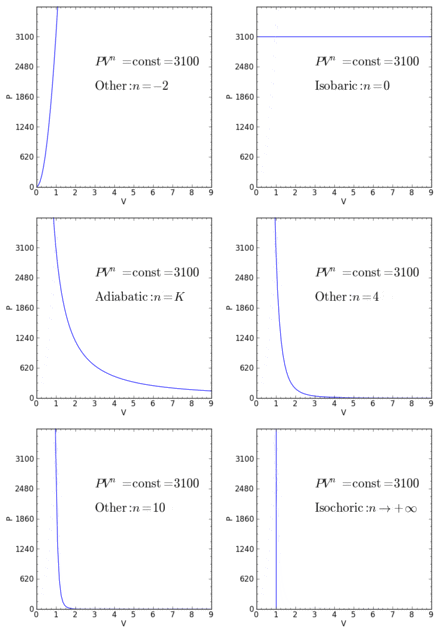
Thermodynamics is known for its intense reliance on processes. Some of the most important types are classified as Polytropic processes. In polytropic processes, the pressure and volume are held to the constant given by the relation pv^n=c, where p is pressure, v is volume, n is the polytropic index, and c is a constant. A process is polytropic if it obeys the ideal gas law and if the heat to energy transfer as work at each infinitesimal step of the process is kept constant


Part-load efficiency

Part-load efficiency

Part-load efficiency

08/15/17

“Can machines operating at part loads have different efficiencies than full loads?”


Machines can operate at variable loads. For example, an electric grid might be providing electricity to its entire network during the daytime and only a few houses at night. Because these different loads have different parameters, machines operating at partial loads have something called a part-load efficiency, or the efficiency when not at full (100%) loading.

Thermal energy storage

Thermal energy storage

Thermal energy storage

08/12/17

“How can we optimize our cooling systems?”


We often run into problems when using air conditioning. Sometimes we don’t have enough refrigerant or we it might be too expensive to make some more.


But there is a simple solution to this!


What if we were to make the ice needed for HVAC systems overnight? This way, we will not have to worry about it being used and we can take advantage of the lower utility night rates. This strategy is known as thermal energy storage and is used for cooling systems worldwide

A visualization of reversible vs nonreversible processes

A visualization of reversible vs nonreversible processes

A visualization of reversible vs nonreversible processes

08/08/17

“What exactly is the difference between reversible and non-reversible systems?”


Reversible and non-reversible systems are two of the most fundamental and confusing concepts in thermodynamics. But this visualization should help clarify them. Let’s take a ping pong game. If we are playing without score, then after a round is over, everything goes back to normal with no change in the system, making it reversible. However, if we are keeping score, then after every round the number of points change forever, making this process non-reversible

Processes

Processes

Processes

08/07/17

“What do we call it when a system’s state changes?”


Thermodynamic systems have a variety of properties, ranging from temperature to pressure to volume, which all make up its state. However, these properties are subject to change if the system is not in equilibrium. So what do we call this change in properties? Well, after much investigation, thermodynamicist have come up with the term process to describe this change. Processes can be of many types, such as changes in volume or pressure.

Shell and tube heat exchanger

Shell and tube heat exchanger

Shell and tube heat exchanger

07/31/17

“What is the most popular type of heat exchanger?”


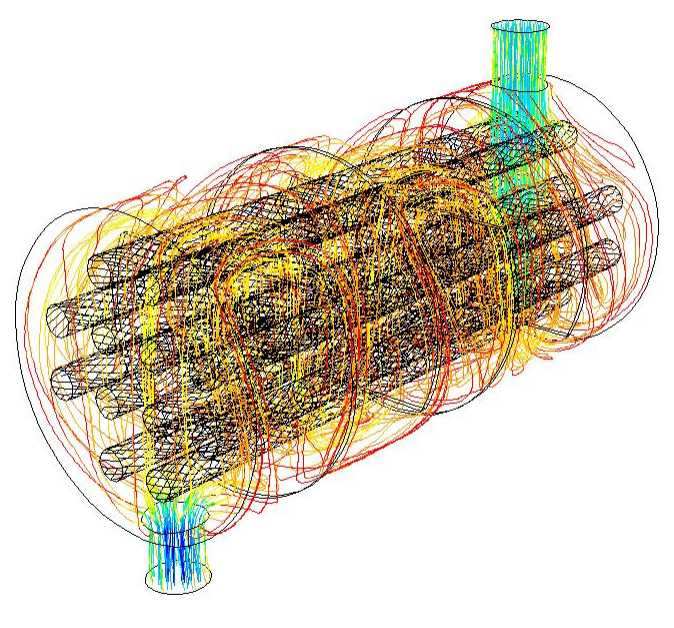
Let’s think of a design for a simple heat exchanger. First, let’s take a bundle of tubes and put it into a shell. Then, let’s run one fluid through the tubes and another around the tubes, both at different temperatures. Over time, the heat from the hotter one to the colder one. This setup is known as a shell and tube heat exchanger. Shell and tube heat exchangers come in two varieties, single phase (which have the fluids in only one phase) and multiphase (which uses both gases and liquids simultaneously). Because of their simple construction, shell and tube heat exchanger have become the most popular in the world.


District heating

District heating

District heating

07/29/17

“How can we carry waste heat to an end user?”
We have a problem. Residential communities often require heat for their everyday needs. But for each building to have their own heating unit would be very difficult, costly, and inefficient. So how could we use our engineering mindset to solve this problem? Well, what if we were to have a central energy generation location that would heat up fluids which would be transferred throughout a network using insulated pipes? Well, this is the idea behind district heating and is used to warm homes everywhere.