Tag: Thermodynamics

Entropy Changes of an Ideal Gas

Entropy Changes of an Ideal Gas

Entropy Changes of an Ideal Gas

12/05/17

“How does the entropy of an ideal gas change with time?”


When an ideal gas undergoes a nonadiabatic process, it’s entropy is bound to change. However, how can we quantify such a change? Well, let’s use our engineering mindset to figure this out. One way would be to look at a thermodynamic property table, find the specific enthalpies for different temperatures, and then take the difference in values. Another way would be to plug in the equation delta s = C_v*ln(t2/t1) + R*ln(v2/v1) or delta s = C_p*ln(t2/t1) – R*ln(p2/p1).

The Ideal Diesel Cycle

The Ideal Diesel Cycle

The Ideal Diesel Cycle

12/04/17

“How can we analyze a diesel engine?”


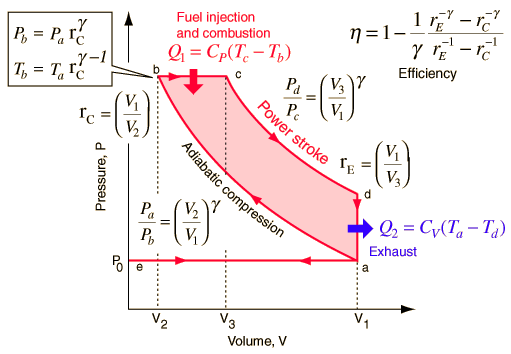
For better or worse, diesel engines are one of the most utilized technologies across the world. And as engineers, it would be logical to analyze how they operate. When a diesel engine starts, it draws in a fluid at a constant pressure. Afterwards, this fluid will be compressed in an adiabatic manner in Stage 1. Then, more heat is added in Stage 2. The system will then spark and go through an adiabatic expansion in Stage 3. Heat is then removed from the system in Stage 4. When everything is completed, the fuel will be ejected. This cycle is known as the Ideal Diesel Cycle and is used by Mechanical Engineers around the world for energy analysis (as well as undergraduate engineering students to power their way through thermodynamics!)

The Otto Cycle

The Otto Cycle

The Otto Cycle

11/30/17

“How can we describe the operation of a spark ignition engine?”


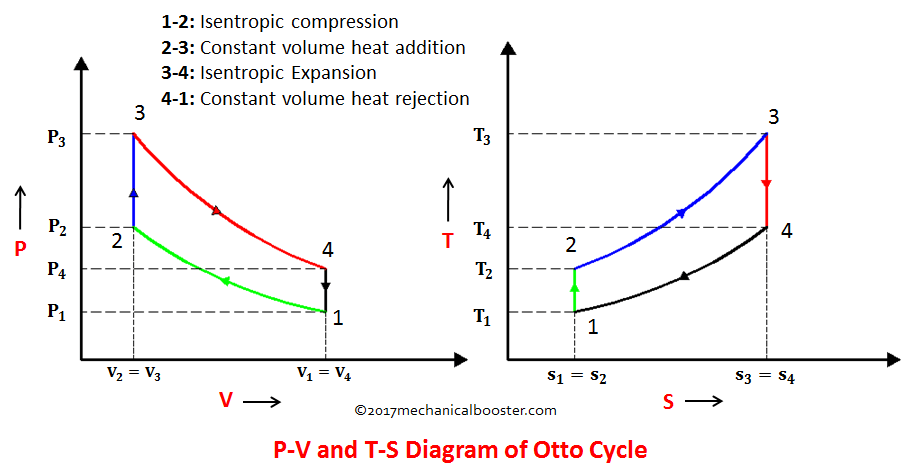
Spark ignition engines (also known as Internal Combustion Engines) were the backbone of 20th-century vehicles. And since us engineers love to describe things, how can we do so in a systematic manner? Well, to start, let’s analyze how several key variables change over time. To start, let’s draw in some air into the piston/cylinder under a constant pressure. Also, let’s label this process 0-1. Then, let’s move the piston such that an adiabatic compression takes place from the bottom dead centre (maximum height) to top dead centre (minimum height) in process 1-2. Afterwards, let’s represent the ignition as a constant volume heat transfer in process 2-3. This should soon cause an adiabatic expansion back to bottom dead center in process 3-4. Then, let’s complete the cycle with a constant pressure heat rejection in process 4-1. Afterwards, let’s reject the air at a constant pressure in the final process 1-0. This is known as the Otto cycle and is one of the most powerful tools for a Mechanical Engineer.


Water Cooling

Water Cooling

Water Cooling

11/28/17

“How can we remove without using a gas?”
When most people think of a heat removal device, they probably visualize a fan based systems which released cooled air. However, using a gas can be hard to control, and may also require a lot of room. So how can we use our engineering mindset to solve this problem? Well, what if we were to replace the primary medium with a liquid, such as water? This would allow us to take advantage of water’s higher specific heat capacity, density, and thermal conductivity to optimize efficiency while ensuring that operations are non-toxic and inexpensive. This increased capacity made water cooling very popular in computer and automotive hardware enthusiasts since this process takes less space and can deliver more cooling. On the downside, using water might accelerate corrosion in metallic substances.

Vapor Compression Cycle

Vapor Compression Cycle

Vapor Compression Cycle

11/27/17

“How do most AC systems work?”


While absorption refrigeration systems are great for many applications, sometimes we just want a more traditional technology for our cooling needs. So how exactly do most AC systems actually work? Well, let’s use our engineering mindset to find out.


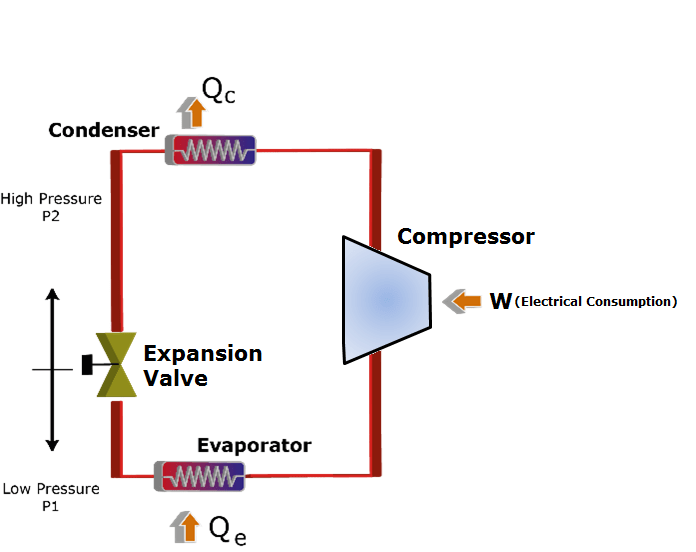
Let’s start with the basics. Our goal is to take heat from one space and transport it to another. One very common way to do this is to use a heat exchanger. But to ensure continuous cooling, we must ensure that we have a constant supply of fluid at a temperature we desire. To build this system, let’s start with four components: a compressor, a condenser, an expansion valve, and an evaporator. Then, let’s have a refrigerant enter the compressor at a low temperature in a gaseous state, and do work on it to increase its temperature and pressure. Then, let’s have it enter the condenser, where heat is transferred into a nearby medium. Afterwards, let’s run it through an expansion valve to cool it and release pressure while turning some of the gas into a liquid. Finally, let’s pull it through an evaporator, which is basically a heat exchanger that allows the cold fluid to absorb heat from the surrounding medium (and therefore cool it) and gasify it. Once the fluid leaves the evaporator, it enters the compressor and the process (known as the vapor compression cycle) will start again.

Absorption Refrigeration

Absorption Refrigeration

Absorption Refrigeration

11/25/17

“How do can we apply the laws of physics and chemistry to make a refrigerator?”


Refrigerators allow us to survive in the modern world, whether it be in keeping our buildings cool or our food fresh. However, how exactly do these systems work? Well, let’s look at one such approach.


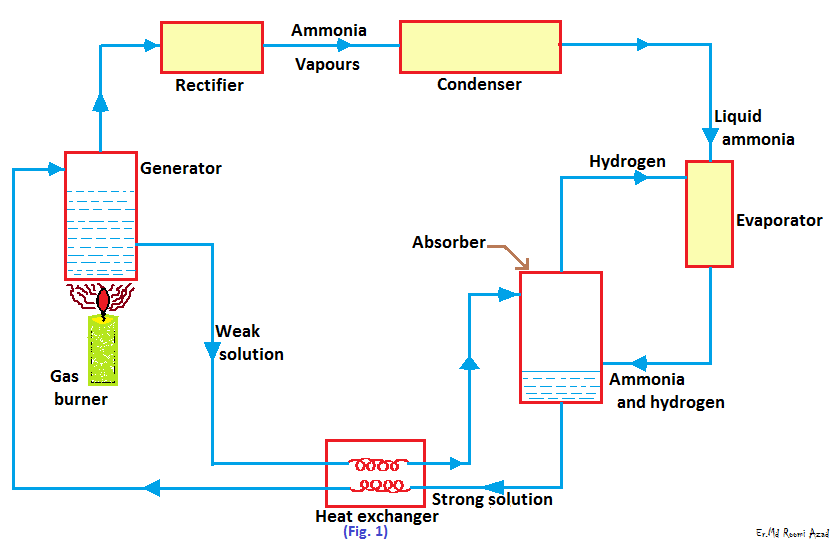
First, let’s start with a solution of hydrogen and ammonia in a boiler. Then, let’s apply heat to separate out these two substances, leading the ammonia gas to a higher pipe and the hydrogen to a lower pipe to be mixed later. Once this is complete, let’s send the ammonia gas through a heat exchanger to condense it into a liquid. Afterwards, let’s shove this new liquid with the hydrogen gas in a freezer (evaporator). The highly reactive chemical reaction will absorb a large amount of heat from the surroundings. The ammonia gas will then be evaporated with a second heat exchanger and sent back to the original boiler, starting the process all over again!

Absorption Refrigeration is commonly implemented in food storage in commercial vehicles and in buildings for waste heat recovery.

Psychrometric Charts

Psychrometric Charts

Psychrometric Charts

11/20/17

“How can we create a chart of a temperature comfort range?”


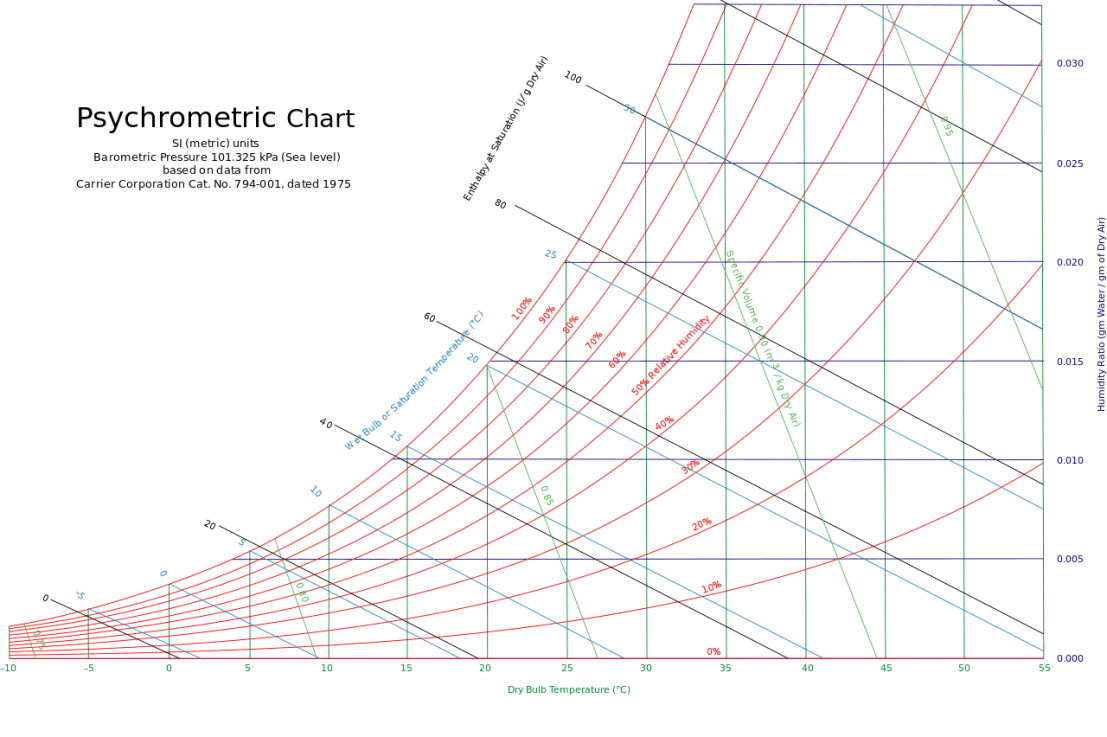
We all know that many different external factors can affect one’s temperature comfort zone. For example, 28 degrees centigrade can feel either pleasant or horrific depending on the relative humidity. So how can we relate all of these complex variables together in a coherent way? Well, many good Engineers, Architects, and Scientists took on this challenge, and decided to create a chart that takes in Dry-bulb (or absolute) temperature, Wet-bulb, Dew Point, Relative Humidity, Humidity Ratio, Specific Enthalpy, and Specific Volume of the local atmosphere to produce a visualization of a temperature comfort range. This is known as a psychometric chart and is one of the most important foundations of modern HVAC engineering.

The Dew Point

The Dew Point

The Dew Point

11/19/17

“How can we measure the point in which saturation occurs?”


When it gets humid outside, it’s very easy for moisture to appear on surfaces. However, why does that happen? Well, the answer lies in a most interesting property called the Dew Point. The dew point is the temperature at which the gas in a given area will condense into a liquid. If an object cooler than this point comes in contact with air, then it is possible for dew to form. HVAC system engineers must keep this value in mind when designing dehumidifier equipment.

The Heat Index

The Heat Index

The Heat Index

Isaac Gendler

11/18/17

“How can we measure how a temperature really feels?”


We all know how to read a normal thermometer. However, when it gets really humid, then oftentimes it will feel much hotter than it really is. So how can we use our scientific mindset to quantify this phenomenon? Well, what if we were to create a formula that combines both the absolute temperature and the relative humidity to produce a value? Well, this is the idea behind the heat index and is used by weather forecasters and HVAC systems analysts all over the world.