Tag: Thermodynamics

Building Heating Loads

Building Heating Loads

Building Heating Loads

01/06/18

“What are the heating requirements of buildings?”


We know that the electricity needed by the building represents its energy load, but electricity is often not the only thing that a building requires. Furthermore, said building will also need heating and cooling. So how can we represent this in a quantitative fashion? Well, taking inspiration from energy loads, we can use a building energy load to show the information for heating or cooling in a building. The building energy load can be regulated through the use of an HVAC system.

Thermal Efficiency

Thermal Efficiency

Thermal Efficiency

12/28/17

“How can we calculate the efficiency of a heat engine?”


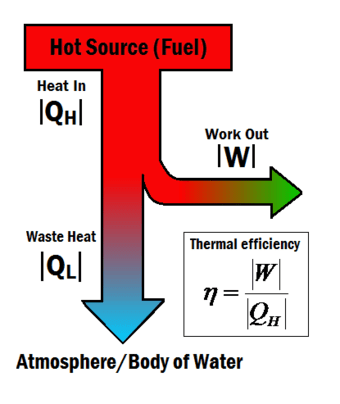
Heat Engines are one of the most widely used technologies today, being used in applications from automobiles to trains. However, our purchase of any model will be guided by the efficiency we want. So how can we measure this quantity? Well, we know that a heat engine works by taking in and putting out heat. And we also know that because of the second law of thermodynamics, some of this input heat will be converted to useful work. So what if we were to simply take the ratio of the output work and input heat (w_out/q_in) and use this as a quantifier? Well, this value is known as the Thermal Efficiency and is one of the most vital concepts of thermodynamics.

Absorption Heat Pumps

Absorption Heat Pumps

Absorption Heat Pumps

12/24/17

“How can we make a heat pump without using electricity?”


Heat pumps usually operate because of electrical energy. However, sometimes we may not have a constant supply of it. So how can we design heat pumps to compensate for this? Well, let’s think about it using our engineering mindset. Normal heat pumps work by taking a refrigerant (commonly ammonia), pumping condensing and depressurizing it, and exposing it to outside air to increase its temperature and evaporate it and then returning to its original state through the use of a mechanical pump. Our non-electricity driven Absorption Heat Pumps diverge by stuffing the ammonia directly into water after evaporation and pumping up the pressure through a low power compressor. Absorption heat pumps require a gaseous form of energy such as solar fuels and can be commonly found in industrial and commercial edifices.

Thermal Power Stations

Thermal Power Stations

Thermal Power Stations

12/21/17

“What type of facility can convert thermal energy to electrical?”


Energy can be generated in a wide multitude of methods. However, (and perhaps unfortunately) the most popular method is to heat an energy dense material to boil water into steam to drive a turbine. This facility known as a Thermal Power Station. Thermal Power Stations usually operate under a Rankine Cycle and can run on multiple types of input such as coal, petroleum, and municipal waste.

Isobaric processes

Isobaric processes

Isobaric process

12/17/17

“What is a thermodynamic process in which pressure remains constant?”


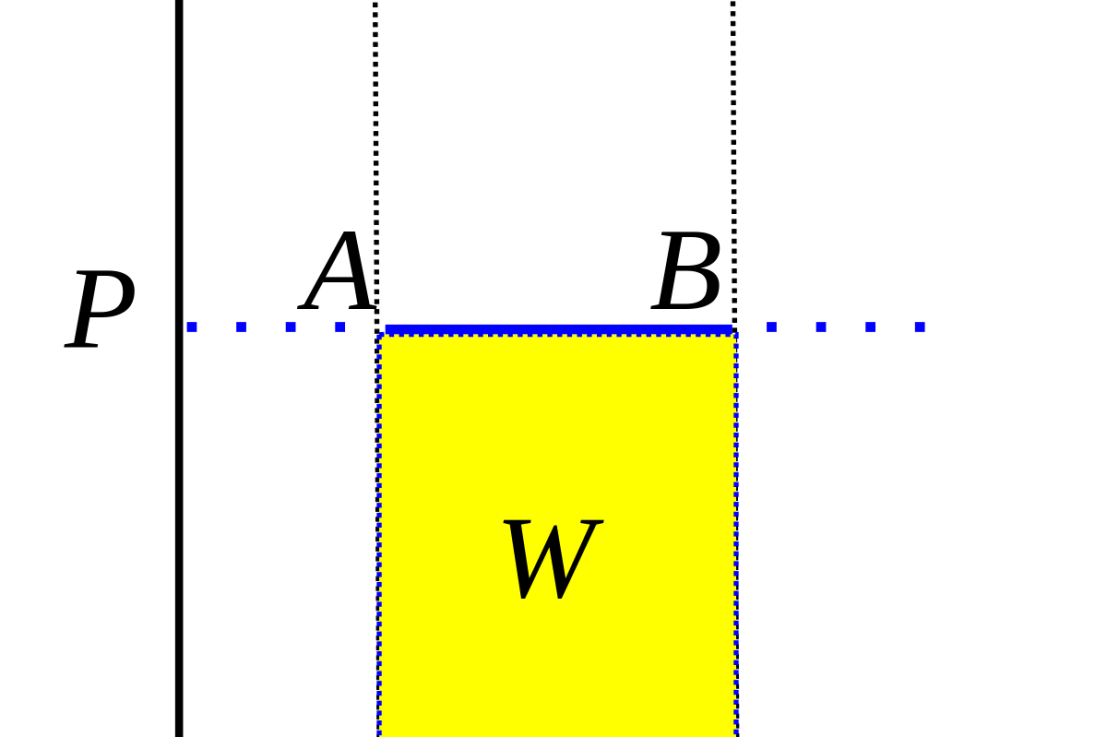
One of the defining features of a thermodynamic process is that the state of the system will change with time. However, in some of these processes, not all of the properties of a state will change. An example is Isobaric Processes, in which the pressure of a system will stay constant throughout the process. The work done under an isobaric process can be very simple to compute, being proportional to the change of volume W = P(v2-v1).

Stirling Cycle

Stirling Cycle

Stirling Cycle

12/09/17

“How can we describe the operation of a Stirling Engine?”


Stirling Engines are very interesting machines. However, how exactly can we describe how they operate? Well, let’s use our engineering mindset to find out. First, let’s start with an isothermal expansion in which the working fluid is heated by an external source in Phase 1. Then, let’s go through a constant volume heat removal by passing the working fluid through a regenerator in Phase 2. Afterwards, the system should undergo an isothermal compression in Phase 3. This will lead up to Phase 4, a constant volume heat addition bringing the working fluid back to the beginning of the Stirling Cycle. Stirling cycles operate much like Carnot cycles except that their heat addition/removal process is constant volume.

The Brayton Cycle

The Brayton Cycle

The Brayton Cycle

12/08/17

“What is the fundamental process for jet engines?”


Jet engines are some of the most advanced pieces of technology in the world. However, how exactly do they work? Well, let’s use our engineering mindset to find out. First, let’s start with a working fluid, and compress it in an adiabatic manner for Part 1. Afterwards, let’s inject some fuel to induce a constant pressure explosion in Part 2. This should cause an adiabatic expansion for Part 3. To finish everything off, let’s go through with a constant pressure heat rejection in Part 4. This cycle is known as The Brayton Cycle and the efficiency can be given by the equation Nu = 1 – t1/t2 = 1 – (p1/p2)^((k-1)/k).

The Rankine Cycle

The Rankine Cycle

The Rankine Cycle

12/07/17

“How can we predict the performance of steam turbines?”


Steam turbines are some of the most used energy systems in the world. As such, it would be very practical to analyze how they consume energy. However, because of intricacies in internal operations, the Carnot Cycle will not work. So how can we use our engineering mindset to model steam turbines? Well, let’s use our engineering mindset to find out. To begin, let’s pump our working fluid from a lower pressure to a higher one in Process 1-2. Then, this high-pressure liquid will enter a boiler to be heated by an external source at a constant pressure until it becomes a dry, saturated vapour in Process 2-3. Afterwards, let’s put this through a turbine, generating power. This Process 3-4 will decreases the temperature and pressure of the vapour, and some condensation may occur. Finally, let’s end this by putting the water through a condenser and condensing it to a liquid at constant pressure until it becomes a saturated liquid in Process 4-1. This cycle is known as a Rankine Cycle and has become the foundation for all steam turbine energy systems.

Air Standard Assumptions

Air Standard Assumptions

Air Standard Assumptions

12/06/17

“What are the common assumptions for analyzing Power engines?”


Power engines are very complex machines. As such, we will have to simplify them a bit when performing analysis. So how can we use our engineering mindset to solve this problem? Well, let’s make some assumptions. First Since these systems are fluid based, and the air is the simplest fluid to analyze, let’s say that air is the primary working fluid. Second, let’s say that all processes are ideal and reversible. Third, have combustion is modelled by a heat addition process. Fourth finally, let the exhaust process is a heat rejection process. These are known as the Air Standard Assumptions and are some of the most fundamental aspects of thermodynamics