Tag: Thermodynamics

Plate Heat Exchangers

Plate Heat Exchangers

Plate Heat Exchangers

10/09/18

“What is a more efficient heat exchanger design?”


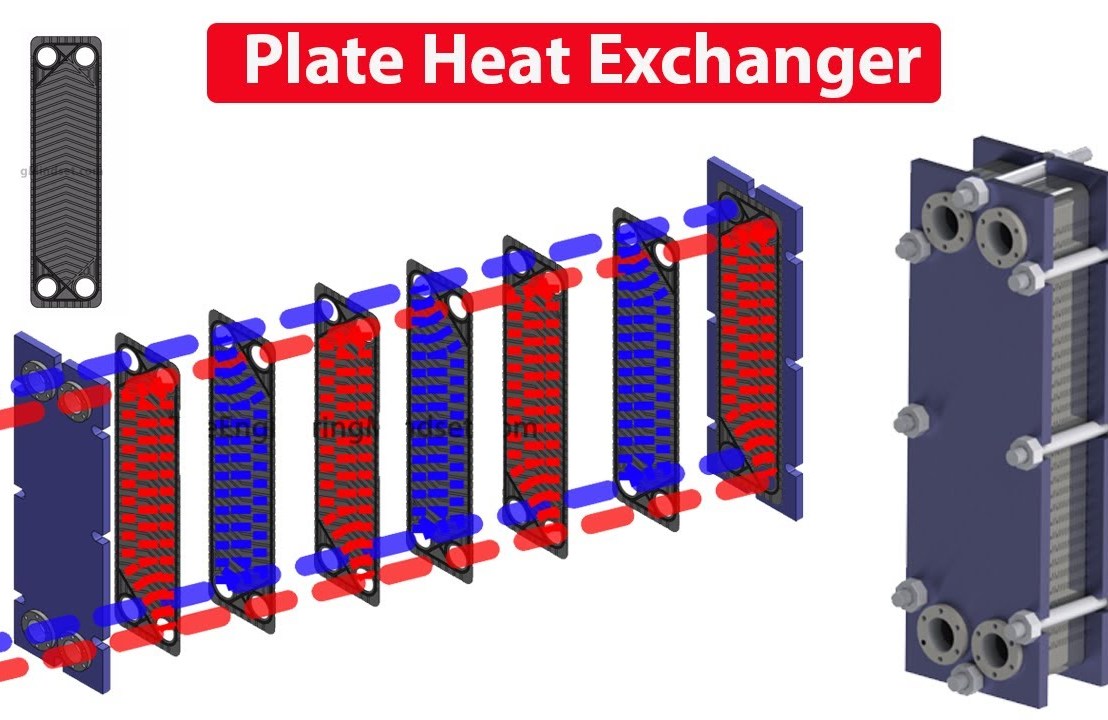
Heat exchangers come in all shapes and sizes. But how could we make a more efficient design? Well, what if we were to have a series of long metal plates with holes on their four corners, with one pipe carrying a hot fluid moving through one and another one carrying cold fluid moving through the other. Let’s allow for the heat to transfer between these two plates also. By allowing this to occur, we can warm up one fluid while cooling the other one very efficiently. These are known as Plate Heat Exchangers and are commonly applied in building HVAC.


Image credit youtube.

Surface Temperature Probes

Surface Temperature Probes

Surface Temperature Probes

09/26/18

“How can we measure an object’s surface temperature?”


Engineers and Scientists love to measure things. And one of the most important things to measure is often the surface temperature of objects. So how can we accomplish this? Well, we can use a thermistor with a specialized shape for surface monitoring called a Surface Temperature Probe to accomplish this.

How Adding Fins can Achieve Better Thermal Management

How Adding Fins can Achieve Better Thermal Management

How Adding Fins can Achieve Better Thermal Management

09/17/18

“How can adding fins help thermal management?”


In engineering, objects can overheat from a variety of operations. As a result, they will need some form of thermal dissipation. But how can we do this? Well, let’s use our engineering mindsets to find out. We know that if we add more surface area to an object, then it will be more exposed to the surrounding atmosphere. And if it is more exposed, then more heat transfer will take place. So what if we were to make our system more conductive by adding fins? This is the fundamental idea of How Adding Fins can Achieve Better Thermal Management.

Containment Structures for Phase-Changing Materials

Containment Structures for Phase-Changing Materials

Containment Structures for Phase Changing Materials

09/10/18

“How can we make contain phase-changing materials in building integrated solar PV?”


While building integrated PV holds so much promise for distributed energy generation, inefficiency from overheating can be a terrible bottleneck. This is commonly solved by integrating the structure with some phase-changing materials. But how can we actually mount it onto the system? Well, what if we were to build a containment structure with adiabatic materials at the top and bottom to ensure temperature stability? This is an example of Containment Structures for Phase Changing Materials. An air gap is usually provided at the back to ensure proper cooling. The extra thermal energy from the PCM can also be used to heat vital building components such as water.


Photo credit ClimateTechWiki

Heat Pipes

Heat Pipes

Heat Pipes

08/31/18

“How can we have a completely passive thermal cooling mechanism?”


Thermal cooling is often required in many cases. But sometimes an active cooling solution may not be appropriate. So how can we have truly passive cooling? Well, what if we were to have a pipe with a working fluid, and have it constructed such that the heat source will heat up the medium to evaporation, which then moves along the pipe until it cools down and condensates, turning back into its original form and repeating the process? These are known as Heat Pipes and are an interesting application of passive cooling.


Photo credit www.myheatsinks.com

Thermal Mass

Thermal Mass

Thermal Mass

08/29/18

“How do buildings react to temperature changes?”


We have a conundrum. Temperatures change throughout the day, but inside a building it’s supposed to stay constant. And since some buildings are better about it than others, how can we quantify this phenomenon? Well, since this concept is a lot like inertia, Architectural Engineers have decided to call this Thermal Mass.  

Phase-Change Materials for Solar PV Cooling

Phase-Change Materials for Solar PV Cooling

Phase-Change Materials for Solar PV Cooling

08/14/18

“What is an innovative way to cool solar PV?”


Solar PV has the highest growth rate amongst all forms of energy. However, in order to operate effectively, it must be at a stable temperature. One way to do this is to use something known as Phase-Change Materials. Phase-Change Materials are high heat coefficient materials at their phase-change temperature. Because they have a high heat coefficient, they can absorb a large amount of heat without fully changing their state. Phase-Change Materials are employed in Building-Integrated Solar PV Systems to keep them at optimal temperatures.

Transformer Oil

Transformer Oil

Transformer Oil

08/07/18

“Is oil used to insulate transformers?”


Transformers are an inseparable part of Critical Grid Infrastructure. And part of their day-to-day functioning requires insulation material. However, such material will have to be able to withstand high temperatures and sudden electric discharges. This is commonly solved using Transformer Oil, a substance employed all around the world.

Sigma Heat

Sigma Heat

Sigma Heat

07/28/18

“How can we calculate the specific energy for humid air?”


Air can vary a lot in both temperature and humidity. And sometimes, we would like to know the specific energy for humid air under constant pressure at a reference temperature ignoring the effects of condensation. To do this, we can calculate by the Sigma Heat S = 17.86 (kj/kg) + 1.05 (kj/kg)*t + W(2501 (kj/kg) + 1.884(kj/kg)*t), where t is the dry-bulb temperature of the air (in °C), and W is the specific humidity of the air (no unit). The Sigma Heat equation is commonly used in mining engineering to calculate the temperature regulation of mine air.