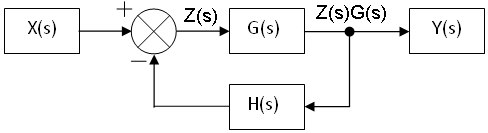
“What causes controls systems to change input to output?” All controls systems have an input (usually some sinusoidal wave) and an output (the wave modified either through addition, multiplication, differentiation, or integration). However, what exactly causes this mathematical change? Well, the key behind this is something known as the transfer function. The transfer function H(s) is defined as the ratio of the output function Y(s) over the input function X(s) (H(s) = Y(s)/X(s)). If we rearrange this formula, then we can see that the input function multiplied by the transfer function is equal to the output function (H(s)*X(s) = Y(s)).
“When does a transfer function go to zero or infinity?”
Transfer functions are usually made up of two polynomials, one in the numerator and one in the denominator. When the polynomial in the denominator (known as the pole) goes to zero, the transfer function will become infinitely large, while when the ones in the numerator go to zero, the function becomes a zero (hence the term zero for such functions). If a transfer function has more poles, then it becomes more unstable, while more zeros will make it more stable. Because of this, controls engineers try to maximize the pole-to-zero ratio.
A visualization of reversible vs nonreversible processes
08/08/17
“What exactly is the difference between reversible and non-reversible systems?”
Reversible and non-reversible systems are two of the most fundamental and confusing concepts in thermodynamics. But this visualization should help clarify them. Let’s take a ping pong game. If we are playing without score, then after a round is over, everything goes back to normal with no change in the system, making it reversible. However, if we are keeping score, then after every round the number of points change forever, making this process non-reversible!
“What do we call it when a system’s state changes?”
Thermodynamic systems have a variety of properties, ranging from temperature to pressure to volume, which all make up its state. However, these properties are subject to change if the system is not in equilibrium. So what do we call this change in properties? Well, after much investigation, thermodynamicist have come up with the term process to describe this change. Processes can be of many types, such as changes in volume or pressure.
“How can we predict how a system will react based on how it reacts right now?” When working with control systems, we often have some desired output in our mind. However, frequently the actual performance of our systems diverges greatly from what we want. So how can we use our engineering mindset to correct this problem? Well, let’s think about it. We can tell a computer how we want a certain system to behave. And we can also create a log of its outputs. So what if every time we gave an output, we took its data, compare it to our desired, and try to minimize the difference with the next iteration? Well, this is the fundamental idea behind model predictive control and is used in industries spanning from building controls to renewable energy to intelligent transportation systems!
“How can we prevent a grid overload using a simple technique?”
We have a problem. We would like the demand usage for the electric grid to be as equalized as possible, such that the electricity drawn in at one time would look the same as the electricity drawn in at another. But this is almost never the case. Instead, the demand for the grid varies greatly throughout the day. And sometimes these demand peaks are so high that they destabilize the grid! So how can we use our engineering mindset to solve this problem? Well, what if we were to just shift electricity usage from times of peak load to times of less intensive load? This is the fundamental idea behind demand response and can be accomplished with economic incentives and through smart electricity control.
“What is the most popular type of heat exchanger?”
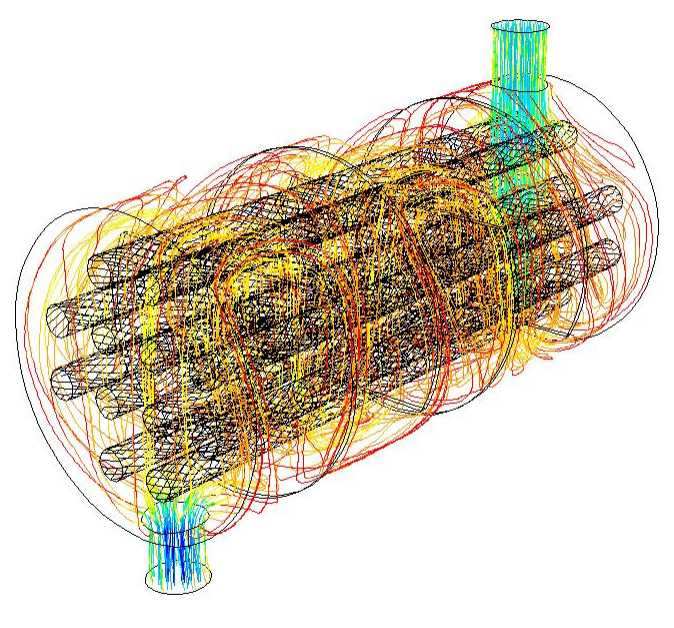
Let’s think of a design for a simple heat exchanger. First, let’s take a bundle of tubes and put it into a shell. Then, let’s run one fluid through the tubes and another around the tubes, both at different temperatures. Over time, the heat from the hotter one to the colder one. This setup is known as a shell and tube heat exchanger. Shell and tube heat exchangers come in two varieties, single phase (which have the fluids in only one phase) and multiphase (which uses both gases and liquids simultaneously).Because of their simple construction, shell and tube heat exchanger have become the most popular in the world.
“What houses the controls for cyber-physical systems?”
Mechatronic systems require controls software in order to function correctly. However, how is this implemented physically into the system? Well, let’s use our engineering mindset to find out. We know that microcontrollers can perform simple controls tasks. So what if we were to hook a number of them together and program them with software to make a controls unit focused on one task? Well, this piece of technology is known as an embedded system and can be found in electro-mechanical operations worldwide. Examples of embedded systems include braking systems in vehicles, thermostats, and the motors on NASA’s Mars Curiosity Rover!
“How can we carry waste heat to an end user?” We have a problem. Residential communities often require heat for their everyday needs. But for each building to have their own heating unit would be very difficult, costly, and inefficient. So how could we use our engineering mindset to solve this problem? Well, what if we were to have a central energy generation location that would heat up fluids which would be transferred throughout a network using insulated pipes? Well, this is the idea behind district heating and is used to warm homes everywhere.




 Isaac's Science Blog