“What if we quantified all of the energy used to create an item?”
In order to create a product, energy is required whether it be in the manufacturing process or in transportation logistics. One commonly used way to quantify this is through Life-cycle assessment. But what if we simply want to obtain a direct measurement of all of the energy used in a product? Well, this would simply entail summing up each part to create what engineers call the total embodied energy!
One of the most fascinating facets of the human body is the tongue. Its ability to move food around in one’s mouth without any bone structure is quite marvelous. However, how exactly can it do this? Well, let’s use our scientific mindsets to find out. If we analyze our tongues further, we should see that these appendages are in fact in fact constructed of muscular material. Because of this, they have an inherent flexibility where any region of the tongue can lengthen, shorten, twist, or bend at any time, allowing for a wide arrange of movement. These Muscular Hydrostats can be found in many other animals, such as the tentacles of octopi and the Trunks of elephants. Because of their diverse applications in the animal world, engineers are researching how to implement similar materials into robotics systems
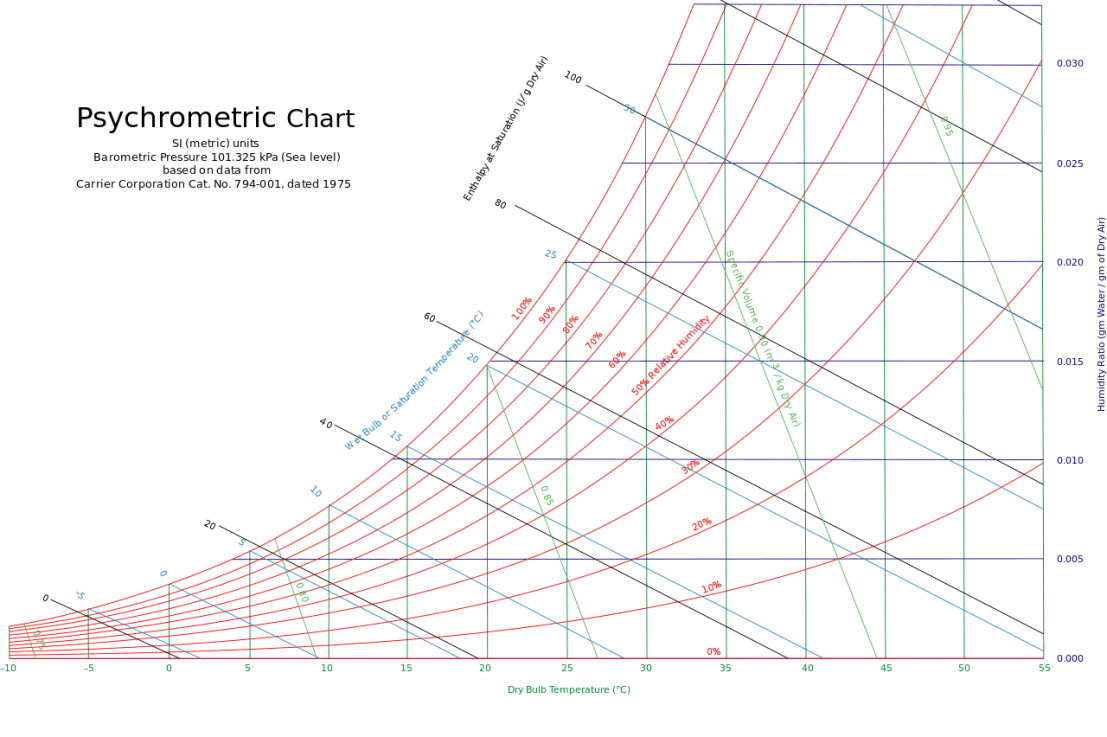
“How can we create a chart of a temperature comfort range?”
We all know that many different external factors can affect one’s temperature comfort zone. For example, 28 degrees centigrade can feel either pleasant or horrific depending on the relative humidity. So how can we relate all of these complex variables together in a coherent way? Well, many good Engineers, Architects, and Scientists took on this challenge, and decided to create a chart that takes in Dry-bulb (or absolute) temperature, Wet-bulb, Dew Point, Relative Humidity, Humidity Ratio, Specific Enthalpy, and Specific Volume of the local atmosphere to produce a visualization of a temperature comfort range. This is known as a psychometric chart and is one of the most important foundations of modern HVAC engineering.
“How can we measure the amount of humidity in a system?”
If you have ever traveled to moist locations such as India or the East Coast of the United States, then you will learn very quickly of something called humidity. This feature of air can make it feel like you are swimming in a sauna. However, have you ever wondered how can we measure this phenomenon? Well, we know that the more water is contained within a local atmosphere, the more humidity is experienced. And we also know that the total amount of pressure within water vapor at this temperature will be unable to exceed the equilibrium vapor pressure of the water (because if it did, it would just sink right back into the water!). So what if we were to take the ratios of these values for an area? Well, this value is known as the relative humidity and is used in vital for weather forecasts and HVAC system control.
“How can we analyze how objects fly without flying?”
Whether it be the drones used to deliver boxes, planes to fly across the world, or satellites launched into space, flight has revolutionized human society. As such, these systems need to be tested rigorously before operation. But doing in-flight analysis is not only difficult but expensive. So how could we use our engineering mindset to solve this problem? To begin, let’s think about what makes in-flight analysis so improbable. After searching, we should find that it’s controlling the and maintaining the vehicle while in flight moving with respect to the wind. But we also know from basic physics that one object moving against another object in a frame of reference in respect to a stationary object is the same as the latter moving while the former is static. So logically, if we can control the wind and keep the machine stationary, the analysis should be the same or similar. And if we can take from our HVAC systems knowledge then we know that we can control airflow using a VAV setup. So how about we construct a facility that can hold an object in a steady position while the air blows on it? Well, this is known as a wind tunnel, and is employed by NASA to simulate drag on their aircraft!
“How can we remove solid particles from the incoming air?”
When working with ventilation based applications, we often have to deal with particulates such as bacteria and dust coming into the mixture. An influx of these materials at the wrong time can prove hazardous and even disastrous for the system. So how can we use our engineering mindset to solve this problem? Well, what if we were to simply apply a layer of fibrous materials that could absorb such materials? Well, this is the idea behind a technology known as air filters, and are used in applications ranging from wind tunnels to internal combustion engines.
“How can we analyze the portion of the lifecycle of a product?”
Life-cycle assessments are done on projects to determine their total impact upon the environment. However, sometimes we may only want to know the impact of a portion of their life, specifically from resource extraction up until it leaves the factory. One way to accomplish this is to use something known as a cradle to gate life-cycle assessment. This process is very useful for manufacturers to determine what their contribution to climate change is.
“How can we regulate the flow of air in a building’s ductwork?”
Air in a building ductwork needs to be regulated and circulated in order for our HVAC systems to work. However, this can not be done automatically and requires a machine to do so. So how can we use our engineering mindsets to solve this problem? Well, what if we were to simply construct a machine that can take in air, heat or cool it with a coil, and then return it as circulated air? Well, this is the fundamental idea behind an air handling unit and has become a staple of buildings worldwide. Air handling units often have integrated control systems to assist in dealing with complex environments
“How can we design humidifiers for industrial needs?”
Humidifiers are widely used to make personal spaces much more habitable. However, can this technology be utilized for industrial applications as well? Well, it turns out that many processes actually need to be undertaken in less dry conditions because static air friction becomes more prevalent. To illustrate, the this buildup of dry air in data centers and manufacturing facilities could cause static electricity to discharge. Art museums also need to keep paintings at a certain humidity to protect works of art. As you can see, there are in fact many many industrial applications of humidifiers!





 Isaac's Science Blog