“Is it possible to use solar power to power artificial skin?” Many individuals on this planet suffer from skin related wounds, whether it originates from combat, accidents, or sustenance abuse. But with the advance of prosthetic engineering, artificial skin capable of intercommunicating with the human brain is coming out of the realm of science fiction and into science fact. However, since these machines are contingent upon electrical signals, power is needed to be provided for operation. So how can we use our engineering mindsets to solve this problem? Well, luckily for us, Dr. Ravinder Dahiya of the University of Glasgow school of Engineering has developed a solution using one of my favorite technologies, solar energy. In a recent paper published in the journal Advanced Functional Materials, Dahiya and his team illuminate us on how a graphene-based artificial skin can be underlaid with thin-film solar photovoltaics to provide all necessary power! This is an astounding discovery and one that is sure to assist the lives of many individuals in a most benevolent way. Dahiya states that further work needs to be done on creating an energy storage system to capture all energy generated by his system, which could then be used to power external electrical systems.
“What structures are put in place to transmit electricity along long distances?” Human civilization in its present form has a tremendous energy requirement to sustain itself, which is provided through the use of complex energy generation systems. However, such infrastructure tends to be placed a large distance away from inhabitation, so how can we transfer the generated energy safely into where humans need them? Well, we can accomplish such a task through the use of overhead power lines. Overhead power lines are constructed by using one or more conducting lines being suspended through strong mechanical beams. These conducting lines will be able to safely insulate from the external world and transfer it to other locations, while the beams will be able to support the weight. Overhead power lines are a cost effective way to distribute energy and are used around the world from the mountains of California to the streets of Istanbul.
“How can we apply our knowledge of semiconductors to create electronic switches?”
P and N type semiconductors are highly useful devices for creating a controlled electric current. However, how could we apply this technology to create something incredibly useful? Well, let’s use our technical mindset to figure this out. We know that if an N type and a P type were hooked up together and the P type had a higher voltage than the N type,, then a flow of extra electrons from the N type (called the “emitter” would come in to fill the P type (called the “base”). Furthermore, if there was an another N-type (called the “receiver”) electron on the other side of the P-type that was even more positively charged, then we would be able to not only have an electron flow but be able to control the amount of current flowing. However, our only problem is that this operation can only take place if both the base and the receiver had a positive voltage. This can be easily fixed through applying a positive voltage to the base, allowing not only for a current to take place but control of the current and voltage to happen as well, effectively making a switch with no moving parts! This is the foundation of an electronic component known as the transistor, and is what allowed for the modern computer revolution to have taken place!
“What are the fundamentals of the fundamentals of solar cells?” Solar cells are one of the most magnificent devices that humanity has conjured. However, what exactly makes them tick? To find out, let’s go take a look. If one were to analyze a solar cell with a magnifying glass so powerful that it could see in the microscopic level then we would find a multitude of small, three terminal devices. These devices are known as Transistors and have very special properties. Specifically, it can work as a switch without moving parts! However, before we understand transistors, we must understand what cause them to work. Half of the composition of transistors are composed of objects known as P-type and N-type semiconductors. P-type semiconductors hold an impurity of boron[B], which holds one less electron than silicon, while N-type semiconductors are have a small impurity of phosphorous [P], which holds an extra electron than silicon. When combined, these semiconductors will have more mobile charges and can conduct current better.
“Could we use the batteries of electric vehicles to power our homes?”
Renewable energy has a problem. The peak times for generating such power (mid-day) is often not in sync with the peak stress on the grid (sunset, when solar energy is no longer available), and local battery storage can be quite expensive. So how can we circumvent this issue? Well, let’s use our engineering mindsets to solves this problem. One of the main problems stems from the lack of affordable energy storage. However, many sustainability conscious individuals also own electric vehicles. And in these electric vehicles are electric batteries which often times have excess energy. So what if when these cars were parked at night, they would feed energy back into the local smart grid to power homes? Well, this is the main idea behind a system which researchers refer to as vehicle to grid technology, which is not only environmentally friendly but economically with the use of net-metering.
“What exactly makes the type of batteries in your phone so special?”
You are probably hearing about special “lithium ion batteries” being featured in devices everywhere. But have you ever wondered what exactly makes them so special? Well, let’s take action and use our engineering mindset to figure this out. In contrast to traditional batteries, lithium ion batteries are constructed out of lithium and carbon. These elements are fairly light in nature, and lithium is also highly reactive, allowing these batteries to have a very high energy density. Quantitatively speaking, lithium-ion batteries can hold 150 watt hours in a single kilogram, only 1/6th of what is required for older lead acid batteries! Furthermore, Lithium Ion batteries lose their charge during storage at 1/4th of the rate other batteries do, can be recharged before being completely discharged, and can handle hundreds of charge/discharge cycles. This combination of high energy density and rechargeability makes lithium ion batteries terrific options to outfit mobile machines such as phones and cars. However, the same highly reactive property that makes them so effective with energy storage also causes structural instability, since they start degrading once they begin degrading once they leave the factory and can be very prone to unintended and dangerous heat-induced chemical reactions such as explosions.
“How can we make a convenient way to store energy harvested from the sun?”
Solar power is a most fascinating and practical way to capture energy. Just by taking in natural energy from the sun, it can power homes, buildings, and even entire towns! However, all of this comes with one drawback; Solar energy can only operate when the sun is out. This means that if machines want to operate during the dark, there will need to be some way to store this energy. Well, instead of giving up, let’s use our engineering mindset to solve this problem. We know that one method to store energy is one that is found every day, batteries. Batteries can have a high energy and also discharge with ease. So what if we were to hook up a solar panel system to a battery to create a solar battery? This setup is the exact working principle behind a multitude of innovative projects such as Tesla Motor’s powerwall system and grid islanding infrastructure.
“What happens when renewable energy becomes cheaper than it’s more corrosive counterparts?” One of the major slanders against renewable energy is that it is too expensive to compete with traditional sources such as coal and petroleum. However thanks to the efforts of generations of scientists and engineers, the upfront cost for cleaner systems has dropped exponentially in the past few years, so much so that countries and states such as California and Germany have reached something called grid parity, or when renewable prices actually become cheaper than their corrosive counterparts with no subsidies! In fact, solar energy prices are falling so fast against rising electric utilities that according to a recent report by Deutsche Bank, 80% of the world market will have achieved grid parity by 2017!
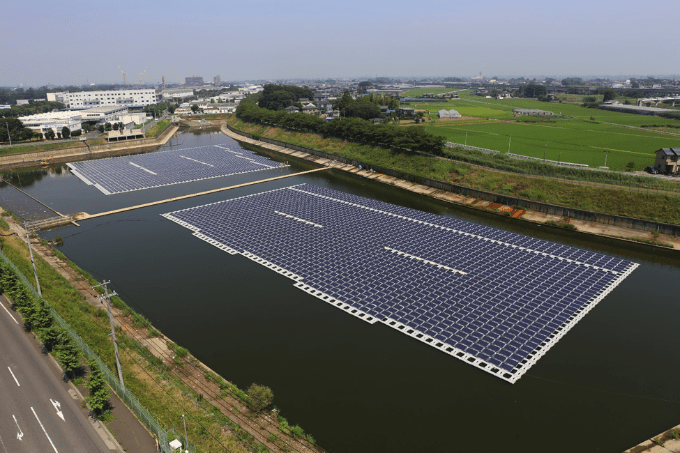
“How can we achieve greater efficiency of solar arrays using water?”
Solar panel arrays are some of the most benevolent technologies in existence. However, they can often require large parcels of land, which could be expensive and take away from the possibility of being used for other activities. So how can we use our engineering mindset to circumvent this issue? Well, if our main quandary is that solar panels take up a large amount of land, why not take them off land? Specifically, what if we were to create solar panels designed to float on water? This is the operating principle behind floating photovoltaics (also known as “floatovoltaics”), which use a specialized form of solar panels placed in water reservoirs to generate clean electricity for the local area. Floating solar arrays are more efficient than traditional models and can be hidden from the public view, but designers of such systems must take into consideration the effects of increased wind speeds over water and the local habitat. Companies around the world are already suiting to take up the challenge of implementing these systems, with Kyocera of Japan, Sonomoa clean power of California, and Infratech industries of Australia investing money to build these models.


 Isaac's Science Blog