Tag: Controls

Controls gain

Controls gain

Controls gain

08/18/17

“What is the amplification of a controls system?”


When a signal passes through a transfer function, its output will be modified in an according way depending on its frequency. So what do we call the change of magnitude of the signal? Well, after much debate, controls researchers have settled on the idea of gain to describe this. Gain is defined as the ratio of the new magnitude to the old magnitude, such that a system that is twice as large will have a magnitude of 2 and half the size would be 1/2

Dead Reckoning

Dead Reckoning

Dead Reckoning

08/17/17

“How can we make a location history using past velocities?”


Making a location history can be very difficult. Having to make active GPS measurements for a cycle of intervals is very taxing on resources. However, is there a way that we could circumvent this and make a new less resource intense system? Well, let’s start off by thinking back to basic physics. We know that velocity multiplied by time equals a change in distance. So what if were to start off with an initial GPS location and then build an array of all of the measured velocities after that? Well, this is the fundamental ideas behind a technique known as Dead Reckoning and is commonly implemented in control systems and machines that are equipped to go into no-GPS locations.

Integral Control

Integral Control

Integral Control

08/17/17

“How can control systems be based on the summation of error levels over time?”


Control systems respond to an error between feedback and setpoints by making changes to the next output. However, sometimes the error does not change fast enough or it changes too quickly. So how could we devise a mechanism to solve this issue? Well, let’s start with a simple idea. We know that if an error value were to persist over time it would show easily on a graph. So what if we were to just take the area of the error under this graph and modify our outputs accordingly? This is the fundamental idea behind integral control and is one of the prime factors in the ever so often used PID control system.

Derivative Control

Derivative Control

Derivative Control

08/16/17

“How can control the rate of change of our control system?”


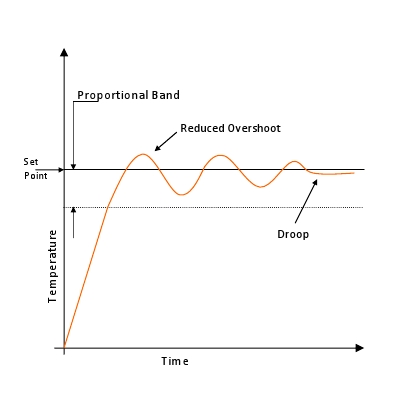
Proportional control systems are great for correcting the error of simple applications. However, one major drawback is that this method does not control the rate of change of the control system. For example, let’s say that we have a self-driving car that needs to accelerate to the speed limit of a roadway. Proportional Control might accelerate so fast that it actually overshoots the speed limit and causes an accident! To solve this, we can introduce a factor called a derivative control which modulates the rate of change of the system. If we were to introduce it to the self-driving car, then its rate of change would be held in a sustainable manner and decrease to zero as it becomes closer to the setpoint.


Proportional Control

Proportional Control

Proportional Control

08/16/17

“How can we have a control method proportional to the error?”


Closed loop control systems respond to external stimuli with the use of an error compared to a setpoint. So how can we use this information to make an easy to use control system? Well, what if we were to base our adjustment to be proportional to the error, such that the higher the error the higher the restoring force? Well, engineers have implemented exactly this in a form known as proportional control and are used in applications such as self-driving vehicles and valve systems.

Routh–Hurwitz stability criterion

Routh–Hurwitz stability criterion

Routh–Hurwitz stability criterion

08/15/17

“How can we analytically estimate the stability of a transfer function?”


We know that transfer functions have a certain level of stability afforded to them. However, sometimes the functions can be quite complicated. So how can we analytically analyze their stability? Well, let’s think about it. First, let’s take our polynomial. Then, let’s take the coefficients for all of our functions. Then, let’s make a graph with the number of rows equal to the highest exponent and number of columns equal to half rounded up of that. Afterward, let’s place the coefficients on the first two columns such that the greatest coefficient goes on the top left, the next one goes beneath, the next one goes to the right of the first one, the next one goes below, and so on. Now let’s fill in the rest of the table by taking the difference between the coefficient in the first column two rows up multiplied by the coefficient up and right one, and then let’s subtract it from the value directly up two and right one minus the one at the first column one row up while dividing everything by the number directly up one row and put the result in place of the column . Let’s now repeat this pattern until we have the entire table filled out. If any coefficients in the first column are of a different sign, then the system will be unstable. This mathematical tool is known as the Routh–Hurwitz stability criterion and is used in designing all sorts of control systems.

Duty Cycles

Duty Cycles

Duty Cycles

08/15/17

“What described the on and off period for a digital signal?”


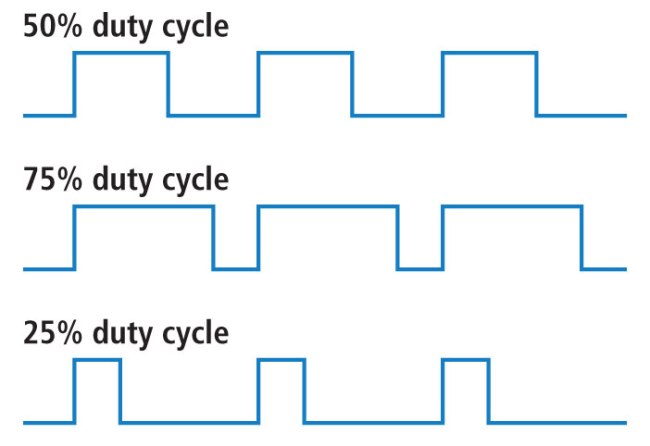
Digital signals have only two modes: on and off. And sometimes they cycle through each at a constant period. So how can we describe this phenomenon? Well, after much research, engineers have come up with the concept of a duty cycle. A duty cycle determines for what time periods the signal is on duty and can be quantified by the percentage on vs off (for example, a signal that is active for 3/4ths of the time has a duty cycle of 75%)

Control System Stability

Control System Stability

Control System Stability

08/14/17

“How can we measure the stability of a control system?”


Control systems are necessary for the function of society. However, if our system proves to be unstable, then it can cause serious harm to its operation. So how can we measure the control system stability? Well if we take the Laplace transform of the transfer function and observe that there are poles in the right-hand plane, then the exponential part of the function will grow to infinity over time, thereby causing a system malfunction. Control system stability is used to analyze a diverse range of fields ranging from aerospace controls to robotics and even building energy management.

Open loop control

Open loop control

Open loop control

08/13/17

“How can we make a simple control system?”


Control systems can be very complicated in nature due to their reliance on feedback systems. However, if we want, we can make our systems much more flexible if we take away such a mechanism. This is known as an open loop control. An example of an open loop control is a movement mechanism that pushes an object towards a destination regardless of what is in the way. If we were to model this on a control diagram, then the input would go straight to the output and never come back (hence the name open loop)