Tag: Controls

Thermostatically Controlled Loads

Thermostatically Controlled Loads

Thermostatically Controlled Loads

09/06/17

“How exactly can we model loads that are controlled by thermostats?”


Machines take energy from the grid under many parameters. And some of them are controlled by environmental temperatures, such as temperature. And a portion of these units (such as HVAC systems, water boilers, and refrigerators) try to match their setpoints to a value on a thermostat. These machines are known as thermostatically controlled loads and are used in grid-building system modeling to generate predictions about demand side energy usage.
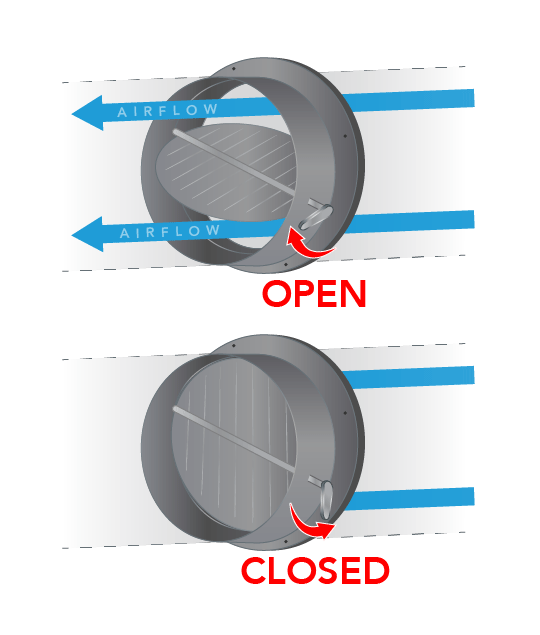
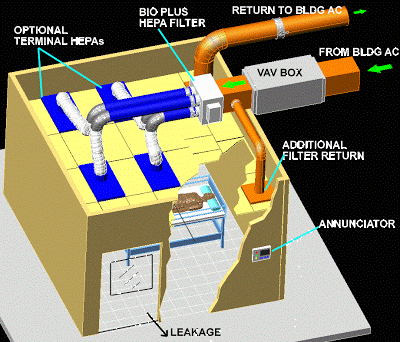
HVAC Dampers

HVAC Dampers

HVAC Dampers

09/01/17

“How can we control the flow of air in an HVAC system?”


Many HVAC air systems operate by regulating the flow of air into a space. But how can we do so? Well, what if we were to use our engineering mindset to create a duct that would control the amount of air that would be transferred? This is known as an HVAC Damper and is commonly implemented in Variable Air Control Systems.

Variable Air Volume HVAC Systems

Variable Air Volume HVAC Systems

Variable Air Volume HVAC Systems

08/31/17

“How can we make a more optimal HVAC system?”


While Constant Air Volume HVAC Systems are affordable, they are not the most optimal solution. They don’t have the most precise temperature control, their fans can be noisy, and they can consume a large amount of energy. So how can we use our engineering mindset to solve this problem? Well, what if we were to have our air temperature be constant instead of our air supply? This would allow us to change the air temperature at a specified rate, allowing us to save money, energy, noise, and wear. This system is known as a Variable Air Volume HVAC System and is used in building systems all over the world.

Constant Air Volume HVAC Systems

Constant Air Volume HVAC Systems

Constant Air Volume HVAC Systems

08/30/17

“How can we make an affordable HVAC system?”
Most buildings are heated and cooled by a supply of air from an HVAC system. But many times, we are under financial constraints. So how can we make a simple and affordable HVAC air supply system? Well, what if we were to just fill the room with a constant supply of air while varying the temperature to meet our needs. Since we don’t have to monitor the air volume entering the system, we won’t have to build an extra control system, while still achieving our temperature setpoints. These systems are called Constant Air Volume HVAC Systems and are often used in smaller building areas.

Phase margin

Phase margin

Phase margin

08/28/17

“How can we measure the difference between a control signal and a half phase shift?”


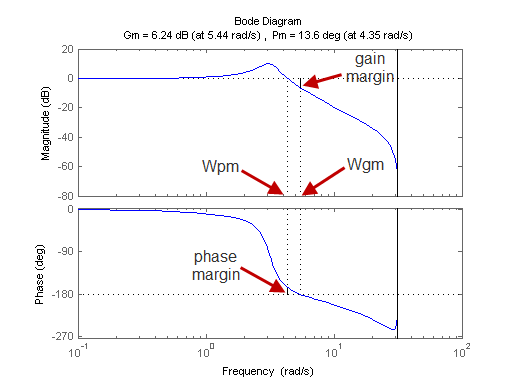
When working with electronic amplifiers, the phase of an input signal might be shifted, which might introduce instability. And if this phase shift is greater than 180 degrees, then the system will be unstable. To standardize all measurements, electronics researchers have introduced the concept of a phase margin, or how far off from a 180-degree phase shift this new phase is. The phase margin can be calculated with the simple equation P_margin = |180-phase|.

Gain Margin

Gain Margin

Gain Margin

08/27/17

“What is the margin of stability for a gain Bode Plot?”


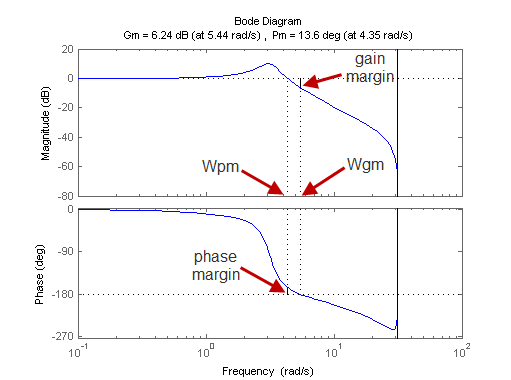
One of the most useful features of a Bode Plot is the ability to find the stability of a system. One way to do that is to find the frequency at which the phase shift becomes 180 degrees, get the amplitude of the gain at the point, and then make a gain margin extending out to both sides equal to the magnitude of 1/|Amplitude value|, such that anything within that range will be stable.

Control Time Shifts

Control Time Shifts

Control Time Shifts

08/22/17

“Can we have built-in time delays into control systems?”


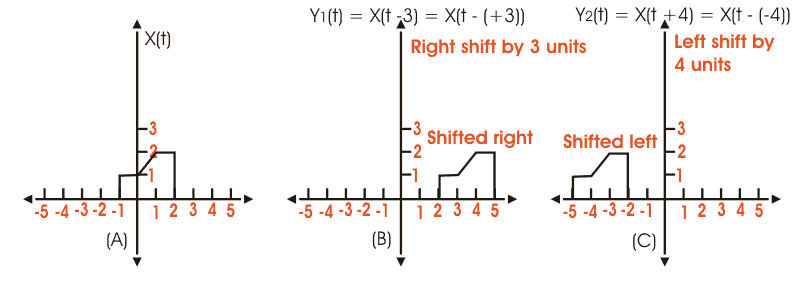
When working with control systems, sometimes we don’t want all actions to occur instantaneously. For example, we might want to have an elevator door wait to close a few seconds after everyone has entered. This can be modeled as a time shift within the system. A time shift for a function in the time domain can be represented by f(t) = x(t-tau) where tau is the time constant and in the Laplace domain by the equation f(s) = e^(-tau*s) *X(s).

Resonance

Resonance

Resonance

08/22/17

“What is the maximum amplitude of an oscillating system?”


In the physical world, systems can vibrate at different frequencies with different outputs. But when the system achieves maximum vibration at a certain frequency, it is called a resonance. Resonance has large impacts on the design of systems, from constructing electrical circuits to achieve certain characteristics to analyzing vibrational characteristics of bridges

Robust Control

Robust Control

Robust Control

08/22/17

“How can we make controllers that deal with uncertainty?”
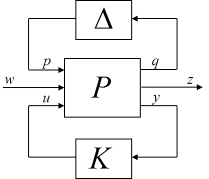
In an ideal implementation, controllers will have to deal with no uncertainty. However, reality is not always as nice as we would like it to be, and often times things happen that we can not prepare for. Because of this, controls engineers have invented something known as robust control to deal with such events. Robust control works by having an internal operation error boundary such that any system can handle any stimulus within the zone of error.