Category: Physics

Carnot cycle

Carnot cycle

Carnot cycle

04/29/17

“What is the most efficient possible heat engine?”
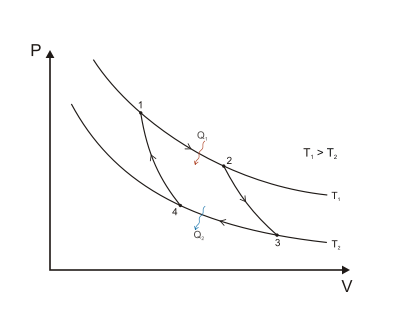
The Heat engine is one of the most productive inventions of humanity, allowing our civilization to take in exterior heat and channel it into useful energy. However, since there are so many different processes to choose from, which one is the most efficient? Well, let’s think about it. A heat engine cycle can be boiled down (pun definitely intended) to one core principle, an oscillation between a hot temperature and a cold temperature. One very efficient way to accomplish this is to have an isothermal process to expand the gas for a given amount and then use an adiabatic one to cool it down while further expansion takes place. Then, one can reverse this process by using an isothermal compression combined with an adiabatic one to raise the temperature and pressure back up to the original value, therefore completing the process known as a carnot cycle.

Carnot efficiency

Carnot efficiency

Carnot efficiency

04/28/17

“How can we calculate the maximum efficiency of a heat engine?”


Due to the second law of thermodynamics, physics proves that there is a limit to the efficiency of all heat engines. However, we know that from practical experience that some heat engines are more efficient than others. So how can we predict what the maximum efficiency of a heat engine can be? Well, engineers and physicists have thought about this same problem for many long years, and after deep exploration into the subject an equation known as the carnot efficiency has been fabricated. This equation states that the maximum efficiency of an engine is the difference between the maximum temperature and the minimum temperature divided by the max temperature, or that (nu) = (T_max-T_min)/t_max. As a result, the efficiency can never be greater or equal to 100%, and if there is no difference in the temperature the maximum possible efficiency is 0%

Heat engine theory

Heat engine theory

Heat engine theory

04/27/17

“How can we turn heat into useful energy?”
It is a well-known fact that energy can be converted into heat. However, is it possible to accomplish the opposite? Well, let’s think about it. We know that if we connect two points with different temperatures, then a heat flow will take place. And since this means that there is a  transfer of energy, it can be redirected into useful work. A machine that accomplishes this is known as a heat engine, which is used in everyday life from jet engines to electricity generators.

Liquid fluoride thorium reactors

Liquid fluoride thorium reactors

Liquid fluoride thorium reactors

04/17/17

“How can we actually make thorium energy a reality?”
Thorium energy is definitely not like your grandparent’s form of nuclear energy. Because of this, the engineering design for its reactors must be significantly different. First, instead of using liquid water to power this system, why not use liquid fluoride? This element is chemically stable, strong against radiation damage, have a high volumetric heat capacity, and can operate at high temperatures while remaining at normal pressures. Next, let’s think about how to implement this. First, let’s feed the salt into the reactor core. The fission from the thorium/uranium decomposition will heat this salt, which can then be transferred through a pipe to heat up a gas which drives a turbine which created electricity. We can then use the excess salt to flow back into the core to be recycled, and the waste heat from the gas can then be used to desalinate water

Thorium energy

Thorium energy

Thorium energy

04/15/17

“Wait, there’s another way to make nuclear energy?”
Traditional nuclear power plants use the decomposition of uranium 235 through fission to generate energy. However, This process is unstable and dangerous. But is there another way that we can generate nuclear energy? Well, let’s use our engineering mindset to find out. If look into fundamental chemistry, we will run into a most peculiar atom known as thorium. When Thorium is hit by an extra neutron, it will begin a decay process that ends with a transformation into uranium 233, which will produce energy when the object itself is hit by a neutron.  One of the primary benefits of thorium energy is that it does not produce Uranium 238, therefore being much less pollutive on a 10,000-year scale, as well as being more plentiful. Many countries (notably India and China) are looking in to develop their own Thorium energy systems, and it might prove to be the nuclear power of the future.

Thermal resistance

Thermal resistance

Thermal resistance

04/12/17

“How can we measure how the flow of heat will be impeded in a material?”
All objects have a temperature. And this temperature can change whether by convection, conduction, or radiation. However, because of an object’s material makeup, this flow of heat may not be uniform. So how can we measure how much an object will resist a change in temperature? Well, let’s use our scientific mindset to think about it. We know that temperature consists of a measure of the random kinetic motion of particles and that a change in this value is caused by energy entering or exiting the system. Rationally speaking, it would follow that materials with different forms of internal properties have more or less impediments in the way of this heat flow. After years of research, scientists have quantified this property as thermal resistance and is one of the bedrocks of thermodynamic physics.

Virtual images

Virtual images

Virtual images

04/05/17

“What happens when light rays from a reflective or refractive material do not converge?”
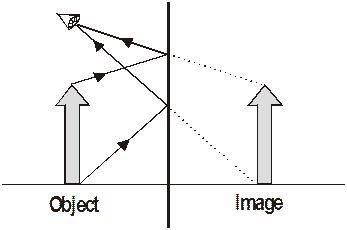
When light bounces from some materials, sometimes it does not completely converge. An example can be light incident on planar mirrors or negative lenses. However, an image still forms, contradicting the theory of real images. How can this be? Well, let’s use our scientific mindset to find out. We know when non-parallel light rays do not converge in real space, they are at an angle with each other. However, if we are to think “outside of the box” and move into the virtual world, we can observe that such rays originate from a common point. And since our brains are not advanced enough to distinguish between optical illusions and reality, we will see what scientists call a virtual image at that point. Since virtual images do not exist in reality, they can not be projected onto a screen like real images.

How to make a hologram

How to make a hologram

How to make a hologram

03/30/17

“How can we use physics to make a hologram?”


Most photographs are composed in two dimensions. However, wouldn’t it be really cool if we could have three-dimensional photographs? Well, instead of just imagining it, let’s apply our engineering mindset to build it. To begin, let’s start off with  a few tools, a laser, some lenses, a beam splitter, mirrors, and holographic film. Next, let’s point the laser to the beam splitter to divide the beam into two separate parts. Next, let’s direct both of these beams through diverging beams so they begin to “spread out”. Let’s also make sure that one of these beams (Called the “object” beam) envelops an object of our desired choice. The light impinging on this object will then be reflected, and let’s make sure that this light is directed onto a piece of holographic film. Let’s then use mirrors to guide the second beam of light (Called the “reference” beam) onto the mirror as well. The holographic film will capture the phase difference between the two beams, as well as the levels of darkness and light resulting from the reflection of the object. After all of this work, we would have just created our very own hologram! This process must be so precise that even vibration on the order of a ninth of the wavelength of the laser would destroy the image!

Real images

Real images

Real images

03/26/17

“How can we create an artificial image of an object using light?”
As human beings, we are very visual creatures. We like to watch movies on big screens, take photographs of memorable events, and look at the stars of our universe using telescopes. Interesting enough, all of these technologies use one vital physical phenomena for their operation, real images. When light from an object passes through a thin concave lens, it will be focused onto a single point. At that single point, an image of the object will be formed. If placed on a planar surface, then this image will be visible for everyone to see! Real images are usually inverted, and their magnification depends on the distance from the object to the focal length of the lens