Category: Physics

Entropy Changes of an Ideal Gas

Entropy Changes of an Ideal Gas

Entropy Changes of an Ideal Gas

12/05/17

“How does the entropy of an ideal gas change with time?”


When an ideal gas undergoes a nonadiabatic process, it’s entropy is bound to change. However, how can we quantify such a change? Well, let’s use our engineering mindset to figure this out. One way would be to look at a thermodynamic property table, find the specific enthalpies for different temperatures, and then take the difference in values. Another way would be to plug in the equation delta s = C_v*ln(t2/t1) + R*ln(v2/v1) or delta s = C_p*ln(t2/t1) – R*ln(p2/p1).

Corrosion

Corrosion

Corrosion

12/01/17

“How do metals waste away with time?”


Metals are some of the most widely used materials in the world. However, nothing within the realm of physics lasts forever. If a metal is immersed in an atmosphere, then it will be surrounded by chemicals alien to its own. Chemical reactions are bound to occur, and over time this metal will decay and waste away in a process known as corrosion. Corrosion is a very important engineering factor, especially for public infrastructure. So much so that in 1998 alone the total annual direct cost of corrosion in the U.S. was around. $276 billion!

The Dew Point

The Dew Point

The Dew Point

11/19/17

“How can we measure the point in which saturation occurs?”


When it gets humid outside, it’s very easy for moisture to appear on surfaces. However, why does that happen? Well, the answer lies in a most interesting property called the Dew Point. The dew point is the temperature at which the gas in a given area will condense into a liquid. If an object cooler than this point comes in contact with air, then it is possible for dew to form. HVAC system engineers must keep this value in mind when designing dehumidifier equipment.

The Heat Index

The Heat Index

The Heat Index

Isaac Gendler

11/18/17

“How can we measure how a temperature really feels?”


We all know how to read a normal thermometer. However, when it gets really humid, then oftentimes it will feel much hotter than it really is. So how can we use our scientific mindset to quantify this phenomenon? Well, what if we were to create a formula that combines both the absolute temperature and the relative humidity to produce a value? Well, this is the idea behind the heat index and is used by weather forecasters and HVAC systems analysts all over the world.

The Compressibility Factor

The Compressibility Factor

The Compressibility Factor

09/23/17

“How can we quantify how much a gas deviates from its ideal form?”


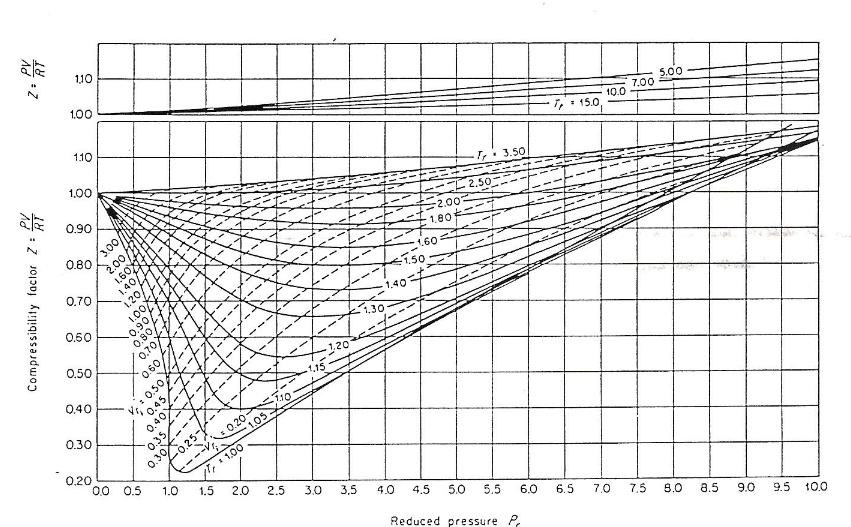
In introductory chemistry and physics classes, all gases are assumed to be completely ideal. However, in the real world gases usually are not so easy to work with. So how can we quantify a gas’ deviation from its ideal form? Well, let’s start from the basics. We know that all of the gas’s properties can be completely related to one another through the ideal gas equation p*v_specific=r*T. It would logically follow that if we were to divide the product of the pressure and the product of the specific volume by the universal gas constant times the temperature, we should end up with a ratio of 1/1.So what if we were to find out a gas’s specific volume, temperature, and volume of a gas in its non-ideal form, take their ration, and use that as a constant in a modified ideal gas equation? This is known as the compressibility factor and is commonly represented as z in the non-ideal gas equation p*v_specific=z*r*t.

Pulse-width Modulation

Pulse-width Modulation

Pulse-width Modulation

09/18/17

“How can we use a digital signal to control power appliances?”

Using sinusoidal analog signals for control applications has drawbacks. Specifically, the constantly changing signal can cause the resistors on a circuit to heat up and induce damage. However, how can we use our engineering mindset to fix this problem? Well, what if we were to replace this analog system with a discrete one operating at a duty cycle? That way we can imitate the perpetually switching signal while avoiding the issues that come along with it. This type of signaling is known as pulse-width modulation and is one of the fundamental ideas of modern control theory


The Strange Second State of Water

The Strange Second State of Water


The Strange Second State of Water

09/17/17

“Can water have a second liquid state?”


Water is a most peculiar molecular compound. Although this material composes over sixty percent of the human body and the vast majority of the Earth’s surface area, we still know very little about the chemical and physical properties and behaviors of this element. And this idea could not be better exemplified by a most recent discovery lead by a highly intelligent group of scientists.

At Oxford University, A group of physicists led by the postdoctoral research assistant Laura Martinez Maestro had decided to conduct a new experiment on water (Crew, Bec). For this, they took a sample of water at zero degrees Celsius and increased the temperature slowly until it reached one hundred degrees Celsius while measuring the thermal conductivity, refractive index, conductivity, surface tension, and the dielectric constant. Once the water hit, 40 degrees Celsius, its properties started to shift drastically, and once it had hit 60 degrees Celsius all of its properties had changed into something new. Specifically, the temperature of change was 64 degrees Celsius for thermal conductivity, 50 degrees Celsius for refractive index, about 53 degrees Celsius for conductivity, and 57 degrees Celsius for surface tension.

Why does this happen? Although everything seems murky at the moment, this phenomenon might be a consequence of the fact that water molecules only have a very weak bond with one another, and that the bond between oxygen and hydrogen is far greater than the hydrogen-hydrogen bonding. As a result, the molecular structure of  molecules is constantly changing and reforming, leading many to believe that this might be the cause for the strange second stage of matter


References

Crew, Bec. “Physicists Just Discovered a Second State of Liquid Water.” ScienceAlert, ScienceAlert, 14 Nov. 2016, http://www.sciencealert.com/physicists-just-discovered-a-second-state-of-liquid-water.

On water’s expansion with freezing

On water’s expansion with freezing

On water’s expansion with freezing

09/16/17

“Why does water expand upon freezing?”

The variation of volume with thermal energy for most liquids has a very simple characteristic. When heat is applied, the volume increases, and vice versa for cooling. This is because the added (or subtracted) energy will cause the amplitude of the vibrations of the molecules to change, thereby modifying the volume. For example, when a liquid freezes, the molecules will pack into one another, thereby shrinking the volume.

However, water exhibits a very peculiar phenomenon. When water is cooled to its freezing point, its volume will actually expand. Why does this happen? Well, let’s analyze it using our scientific mindset. Unlike most other molecules, water has a very unusual structure. Specifically, a water molecule’s primary form of bonding is based on hydrogen bonding. When temperature decreases, the strength of a hydrogen bond actually increases (since the lower thermal energy means that the hydrogen bonds will have less vibrational energy, therefore lowering the chance to shake out of position and increasing stability).

Once water is cooled into ice, the only bonding will be hydrogen bonding. Specifically, it will be bonded in a hexagonal structure, which is a much more “open” network than most structures. The tandem of hydrogen bonding and a hexagonal structure vastly decreasing the density (Levine, Scott 2013). And because density is described by the equation, with being the density,  being the mass, and being the volume, and as mass is constant, when the density decreases the volume must increase as a result. Consequentially, the volume of water increases upon freezing! This fact has multiple implications. For example, a lower density of ice means that ice will float in water, which allows for complex structures such as ice glaciers to occur naturally.


References

“Why Does Water Expand When It Freezes? .” FAQ: Water Expansion on Freezing, New York University, 3 Dec. 2013, http://www.iapws.org/faq1/freeze.html.

Liquid pressure variation with height

Liquid pressure variation with height

Liquid pressure variation with height

09/12/17

“How does the pressure of a liquid vary with height?”


Liquids are famous for their permeable structure, such that you can insert an object at any point inside it. However, depending on which part of the height you insert it, it will experience a different pressure. So how can we quantify this pressure variation with height? Well, if we investigate empirically, we will find out that this variation can be symbolically represented as P = rho*g*h, with P being the pressure, rho being the density, g being the gravitational acceleration, and h being the height.