Category: Engineering

Factor of safety

Factor of safety

Factor of safety

11/19/16

“How do engineers deal with loads near the failure point?”


When doing engineering, one has to deal with the maximum load that a system can handle. However, in the real world, it would be quite unwise to have loads even near this limit. The rationale behind this is that such a system could experience an unexpected impingement. To illustrate, let’s suppose that enough people stand in an elevator to have it at maximum capacity, if even a rat were to climb into this elevator, then this capacity would be overloaded and the elevator would experience failure. Luckily, engineers tend to be foresightful people, so when developing structures, instead of designing them just to sustain the expected loads, they are created in respect to a factor of safety. A factor of safety an extra “margin” that a structure can support (in terms of a multiple of the expected load), and can be calculated using the formula FoS =Ultimate stress/actual stress . An example of the factor of safety in use is the famous Eiffel tower, which is designed to sustain 4.5 times as much stress than it typically does. In summation, the factor of safety is an intrinsically necessary tool in modern engineering, and has saved countless of lives all over the world.  

Microbeads

Microbeads

Microbeads

11/10/16

“What component of personal care products cause a high amount of pollution?”


Cleanliness is a necessity for modern day civilization. And as human civilization advances, so does our standards and means obtaining cleanliness. And one such advancement comes in the form of microbeads. Microbeads, also known as microplastics, are solid plastics that are less than 5mm in diameter that are used as exfoliating agents (meaning that they can wipe off dead skin cells) This small size combined with the cleansing property poises microbeads to be very useful in personal care products, but they come with a most unfortunate environmental consequence. When flushed down the drain, microbeads are able to pass through filters normally designed to catch larger pollutants, allowing them to seep into a body of water. The microbeads will stay around for a long period of time due to their lack of biodegradability, and nearby fish will consume these products  (believing them to be small eggs) which in turn will cause physiological harm. In an interesting turn of events, these fish can be harvested and consumed by humans, therefore causing detriment to ourselves. In summation, microbeads are a stalwart example of how humanity impinging on the environment will cause long-term impairment on humanity. Microbead pollution has become so prevalent that the Rhine river in central Europe is thought to contain one million particles per square kilometer! Luckily, numerous governments are already taking action, and in the United States the Microbead-Free Waters Act of 2015 will phase out microbeads in rinse off cosmetics by July 2017.

Alloys

Alloys

Alloys

11/02/16

“What is special about a mixture of two elements?”

Materials are composed of elements. Some are composed of many. However, what are some special properties of mixtures that involve metal? Well, after much research into the subject, Chemists have defined these materials as alloys. Since different elements have different size, and alloys are made up of different elements, the internal structure of alloys will become fairly irregular, therefore giving alloys a much harder nature. As a result, alloys are regularly applied in industrial applications where durable materials are necessary.

What are frames?

What are frames?

11/01/16

“What are frames, why are they so commonly used, and how can we analyze them?”


Frames are some of the most utilized structures in engineering. In Fact, they are so commonly used that they are used in the name Framework. But what exactly are they, why are they so utilized, and how can we analyze them? Well, like I always say, let’s think about it. Frames are fundamentally structures that hold structures together. This allows them to hold multiple disjointed parts together to become continuous, therefore allowing for more complex structures to be built, therefore allowing for complicated urban systems to be developed! Frames can be analyzed by the fact that they provide static resistance to all parts connected to their system, allowing for loads and other members to balance each other out.

Electroluminescence wire

Electroluminescence wire

Electroluminescence wire

10/28/16

“How can we make a wire that emits light?”


Electricity is something that is plentiful and available to us on a regular basis. And we know that we can convert it into something such as light. However, is it possible to make a form of wire that emits light around it? Well, let’s think about it. We know that copper is a very good conductor. Not only that, but it is also a very ductile material, allowing it to be bent and stretched into a wire.So maybe our device could include some copper, as it would allow it to conduct electricity very efficiently. But now we need something to light up from all of this electricity. Well, luckily for us, engineers have created a material called phosphor lubricant which emits light when a current passes through it. Now that we have the basics, lets build our machine. First, we should take a solid copper core covered with phosphor lubricant to act as our electrical light emitting source. Then we should encircle it with twin strands of copper wire to allow the electricity to access it. afterwards, all we need to do is apply an alternating current, And we have just made ourselves a light-producing wire! This contraption, termed electroluminescence wire, can be commonly found in a very common object, neon lights!

Building foundations

Building foundations

Building foundations

10/26/16

“How can we transfer the loads of buildings into the ground?”

Buildings are one of the omnipresent features of human civilization. Even though they come in all different shapes and sizes, they all have one thing in common, a foundation. A foundation is what transfers all of the loads of a building into the ground for support. There are three main types of modern day supports used in structural engineering: Shallow foundations which are typically simple shapes such as rectangles or circles that run around 1 meter in to the ground, deep foundations which transfer the load even further than shallow foundations (typically all the way to the more sturdy subsoil), and monopile foundations (typically used in offshore structures) which transfer the support load all the way down into the seabed.

Material fatigue

Material fatigue

Material fatigue

10/24/16

“What happens when a material is subjected to multiple loads in a period of time?”


We all know that materials respond to loads through deformation. But what happens when a material is subjected to a heavy amount of cyclical loads? Well, let’s think about it like engineers. We know that when a material experiences a large amount of stress, microscopic cracks begin to appear in it’s structure. And we also know that if the structure continues to withstand more damage, then these cracks will be exacerbated until a rupture occurs. This effect (termed by engineers as material fatigue) can cause a structure to collapse even if the applied stress is far below the yield point.

Why do phone batteries last a short time?

Why do phone batteries last a short time?

Why do phone batteries last a short time?

10/21/16

“Well, why do they?”
Batteries are one of the most indispensable drivers of modern civilization. And smartphones are of the chief applications of this technology. However, how is it that something so pivotal to society’s function wear out it’s sole power source so rapidly? Well, let’s think about it like an Engineer would. We know that batteries are powered by releasing stored chemical energy through reactions. However, batteries have a low energy density, meaning that a large battery will hold a relatively small amount of energy compared to it’s size. And since phones need to be smaller for practical use, the battery has to be small as well, and since the only other way to increase battery capacity is to increase the efficiency (which would increase costs prohibitively), smartphone users are stuck with low battery lifetimes!

Method of sections

Method of sections

Method of sections

10/18/16

“Is there a simpler way to solve truss problems?”


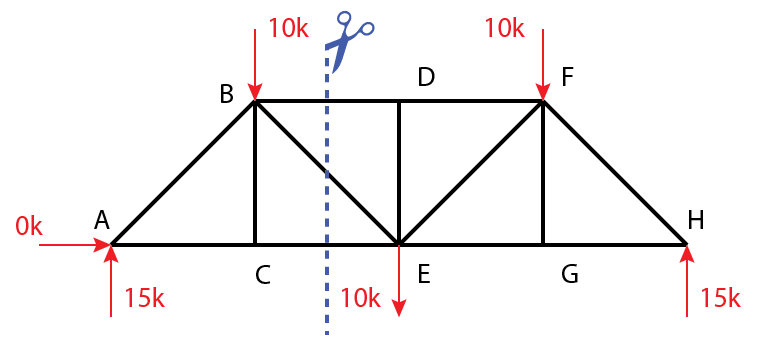
Trusses are one of the most fundamental elements in modern structural engineering. However, performing truss calculations is not only time consuming but can also be quite tiring, especially if we only desire to obtain the values for a few members. So is there a way in which we can simplify truss calculations if we are only focusing on a few parts? Well, let’s think about it. We know that when we work with external forces on trusses, we can solve for them without worrying about the internal forces, thereby allowing us to work with much less equations required. So what if we were to take the forces in the members we need and somehow turn them into external forces? This is the fundamental idea behind a technique known as the method of sections. To implement the methodm all we need to do is to find the members we desire, and then cut the truss through those members so that the internal forces will seem like net forces, and then solve for those members. This drastically reduces the time necessary to solve the problem, and prevents us from making too many absent minded mistakes