Category: Engineering

Grain size reduction

Grain size reduction

Grain size reduction

03/11/17

“Is it possible to increase the strength of a material by reducing the grain size?”
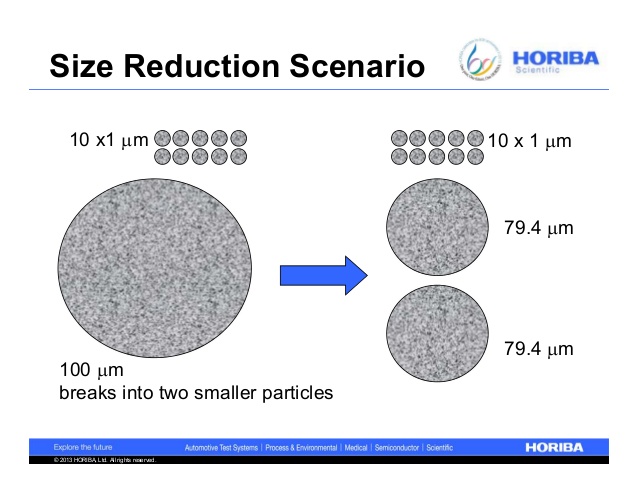
Many materials in their original form are not strong enough for practical engineering purposes. However, is there a way in which we could strengthen a material by modifying its grain structure? Well, let’s look into it. We know that the strength of a material is contingent upon its grain size. Specifically, the smaller the grain sizes are, the more of them will be able to be present within a material. So wouldn’t it logically follow that if we were to reduce the size of grains, the stronger our material would be? This is the fundamental principle behind grain size reduction, and modifies the yield strength of a material by the equation sigma =sigma_0+kdx, where sigma  is the new yield stress, sigma_0 is the original yield stress, k is a constant, and d is the grain size.
Precipitate hardening

Precipitate hardening

Precipitate hardening

03/10/17

“How can we use heat treatment to increase the strength of a material?”

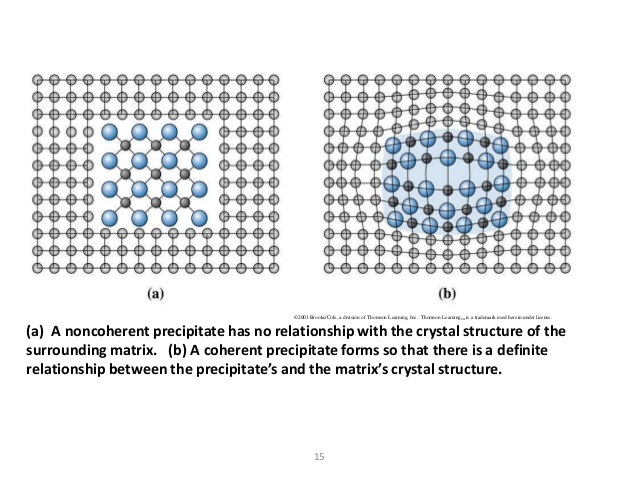
Often times, when we receive a material, it is not durable enough for our needs. So how can we use a readily available process to increase the strength of a material? Well, let’s use both of our engineering and scientific mindset to find out. Well, we know that if were to introduce an alloy into the crystal structure, then the material would be strengthened. However, if we were to increase the temperature of a material and then rapidly cool it, the material would form a highly regular crystal and the precipitates would seep into the grain boundaries, therefore greatly strengthening the material. This process is known as precipitate hardening and is used to make a variety of materials stronger ranging from everyday aluminum to the internal wing structure of a Boeing 767

Solution hardening

Solution hardening

Solution hardening

03/09/17

“What happens to a crystal structure when alloys are introduced?”
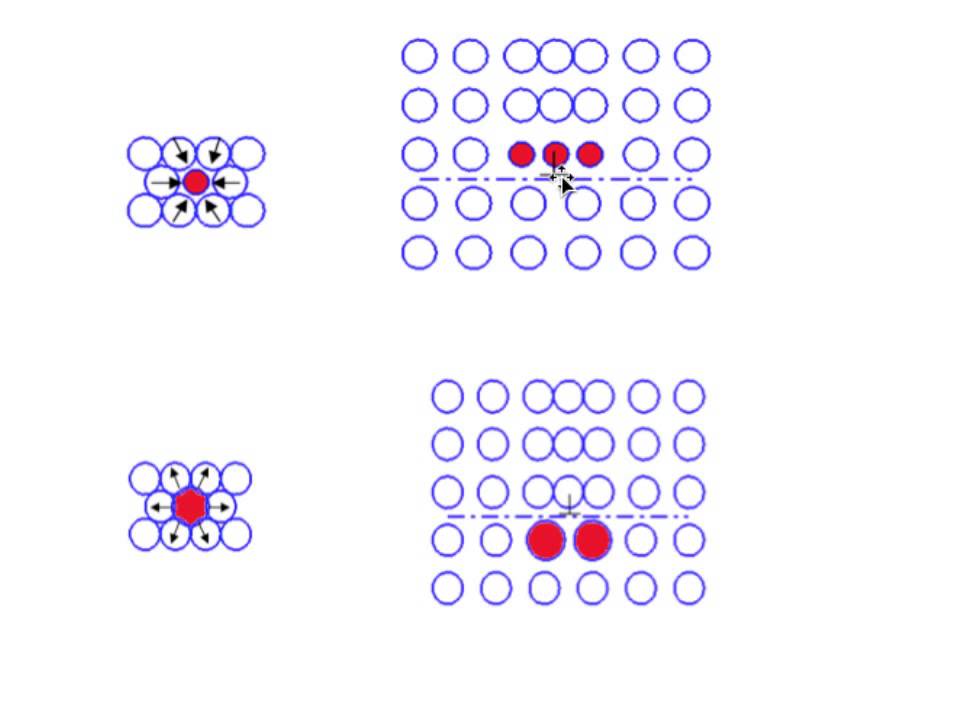
As pure elements, most crystal structures are fairly linear and homogeneous in nature. However, what happens when another element with a different atomic radius is introduced, disturbing this uniformness? Well, let’s use our scientific mindset to find out. We know that when these due to intermolecular forces that like elements will be more attracted to like elements. From this standpoint, we also can observe that this interlocking will impede further dislocations and lock the movement and slip of the atoms. This form of material hardening has been termed solution hardening my Materials Scientists and Engineers, and is dependent on the size of the inserted atoms.

Traffic barriers

Traffic barriers

Traffic barriers

03/08/17

“How can we control the flow of traffic away from dangerous road elements?”
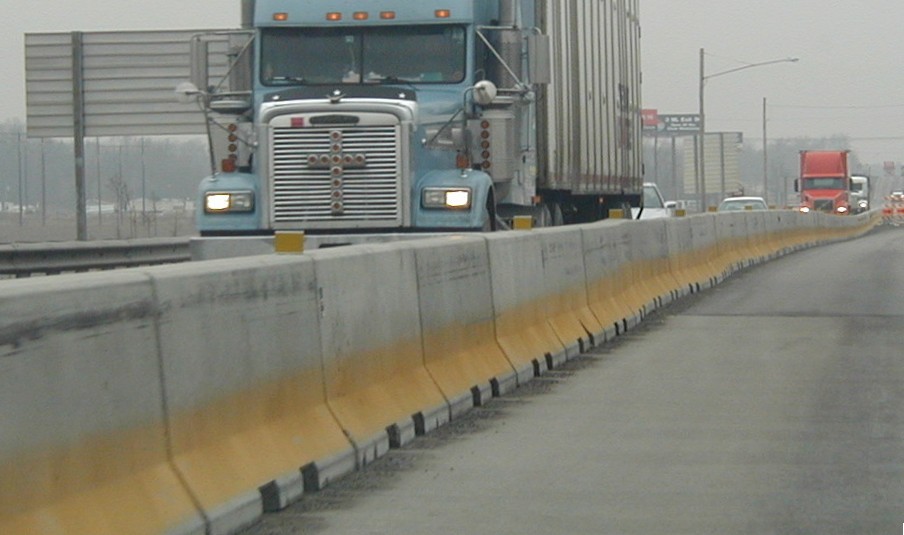
Personal vehicle transportation is one of the most used forms of transportation throughout the world. However, due to the autonomous nature of such machines, drivers can non-intentionally make collisions with errant road elements such as trees, boulders, and walls, or even the air if they run off an elevated freeway! So how could we change roads to make them much safer for general use? Well, let’s use our engineering mindset to figure this problem out. Well, we know that one way to stop an object from moving is to have it collide with a rigid object that will absorb all of its kinetic energy. So what if we were to take this idea and put it into reality? This is the exact type of thinking behind something known as a traffic barrier, which can be seen omnipresently around roads throughout the road. Examples of traffic barriers range from the exotic guard rail to the tiny traffic cone!

Interferometers

Interferometers

Interferometers

03/06/17

“How can we produce a controlled chromatic aberration for study?”


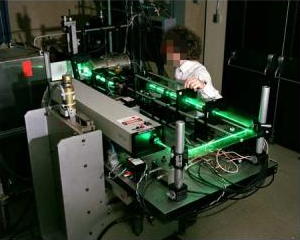
Chromatic aberration is one of the most perplexing phenomena in the study of optics. However, creating controllable versions for laboratory study are extremely difficult to accomplish. So how can we make a machine that will be able to make adjustable chromatic aberrations at our will? Well, let’s use our engineering mindset to solve this scientific problem. Well, we know that if we were to pass monochromatic light into transparent glass at an angle then some will be reflected and some will be refracted. This creates two beams of light of identical wavelength for us to study. Now, let’s take this a step further. We need to pass these beams of light back to each other so that they interfere, which can be accomplished by placing mirrors in the path of beams. So what if were to take this system and bring it into a reality? This machine is known as an interferometer, and is used in physics labs all over the world to study the intricacies of chromatic aberration.

Track gauge

Track gauge

Track gauge

03/05/17

“How does the width of railroad tracks affect transportation?”
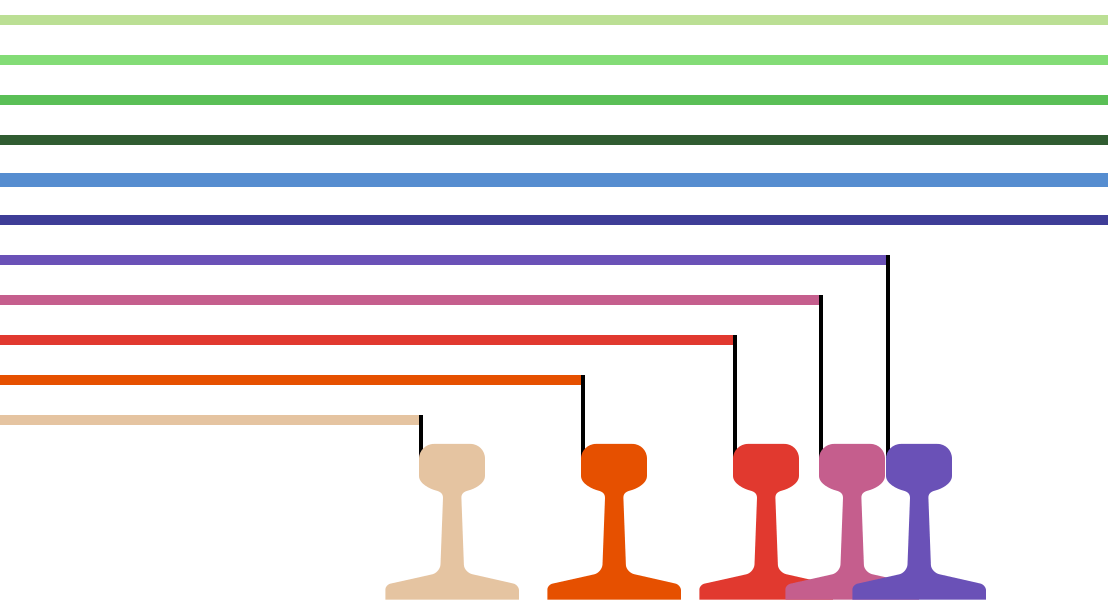
Trains of all shapes and sizes have made affordable and efficient transportation a modern day reality. However, as mechanical devices, these machines are contingent upon multiple components, such as track. So how can we classify the different types of track spacing and their resulting physical effects? Well, let’s use our engineering mindset to figure this out. We know that the geometry of railroad tracks are primarily composed of one flat path and two vertical blocks to encase the wheels. And since the flat paths are variable in nature, the length of them can be different depending on the system being used, therefore a standard measurement system known as a track gauge must be used to distinguish the different types of tracks. The larger the track gauge is, the faster the maximum speed and the easier it is to control at the expense of cost and ease of turn. The standard track gauge is known as standard gauge in the U.S and is measured at 1,435.1 mm (4 feet 8 1⁄2 inches)

Screw dislocation

Screw dislocation

Screw dislocation

03/03/17

“What happens when a shear stress acts upon a crystal lattice?”
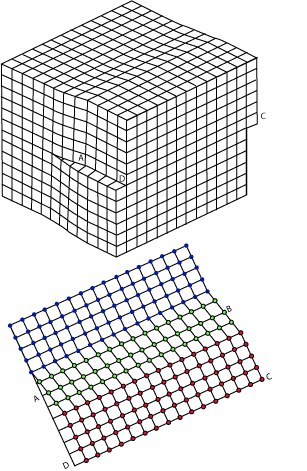
Crystal lattices are prone to imperfections, such as line defects. However, what happens when the crystal pattern experiences a shearing effect? Well, let’s use our scientific mindset to investigate this issue. Well, this will cause a rupture in the geometry which will result in a phenomenon known as a screw defect. Screw defects are so named due to the fact that if one were to walk from one edge of the dislocation to the other without jumping or falling, a screw like path would be formed.

True Stress-Strain diagrams

True Stress-Strain diagrams

True stress-strain diagrams

03/01/17

“Why is there a negative slope on a stress-strain diagram and how can we fix it?”
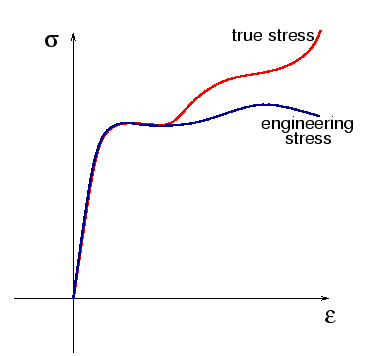
The stress-strain diagram is probably one of the most used concepts in all of engineering. However, there seems to be one counterintuitive aspect to it. Specifically, after the ultimate strength is reached, the stress-strain slope seems to become negative. This can’t be, since the stress can only increase with strain, not the other way around. So what exactly is behind this incongruity? Well, it all comes down to one simple fact. When constructing an engineering stress-strain curve, the cross-sectional area of the object is assumed to be static. However, due to the law’s of Poisson’s ratio, an elongation in length must be countered by a decrease in the associated cross-sectional area. And since this cross-sectional area will have s smaller capacity to carry force, the force distribution will go down. Therefore, if we do not include an updated area with the force, the stress will decrease with strain. Structural Engineers and Materials Scientists have recognized this flaw and have created true stress-strain diagram in response, which uses an ever-changing cross-sectional area. True stress-strain diagrams never have negative slopes, and are commonly used for research purposes.

Active solar water heater

Active solar water heater

Active solar water heater

02/27/17

“How can we create another iteration of an active solar water heater?”
Batch-collector solar water heaters are one way of heating water using solar power, but as engineers, we are never satisfied with just one way of doing things! So, how can we innovate on this design to create a new system? Well, let’s think about it. We know that using a cylinder to store heated water is a well thought out design choice. But how about we were to modify how it is heated up? Instead of just having a passive system where the cylinder is warmed by the sun, let’s instead extract it using a solar powered pump, push it through a solar panel, and let it come out back into an isolated part of the cylinder as heated water, which has a pump to escort it to the user’s house. These pumps will come equipped with two ball valves to stop the pumps in case the solar panel is no longer in use.