Category: Engineering

Diffusion couples

Diffusion couples

Diffusion couples

02/26/17

“Why does diffusion happen between two solid materials?”
Diffusion is a most fascinating chemical and physical phenomenon, allowing a dense collection of an element to expand and suffuse itself into another. However, What is required for such an effect to occur between two solid items? Well, after many years of research, Materials Scientists and Engineers have discovered a little thing called diffusion couples. Diffusion couples are two items with point defects that are in close contact. When the temperature is elevated, then the atoms of these materials are more likely to moves around, and can “jump” into the holes of its neighboring material. As time approaches infinity, these two materials will become homogeneous with one another, therefore stopping the diffusion process.

Shear Stress

Shear Stress

Shear Stress

02/24/17

“What happens when stress is applied parallel to the surface area of a material?”
Any force acting upon a three-dimensional object will produce an internal stress. However, how do engineers classify the types of stress that are parallel to the material’s surface area? Well, after many years of research, this phenomenon has been classified as a shear stress. A shear stress will produce a shear strain in the object proportional to the object’s modulus of rigidity, which can be symbolically represented with the equation (Tau = G*(Gamma), with (Tau) being the shear stress (Gamma) being the shear deformation and g being the modulus of rigidity. The higher a material’s shear strength is, the more it will be able to resist shear strength.

Microscope optics

Microscope optics

Microscope optics

02/23/17

“How exactly do microscopes work?”
Microscopes are one of the most important inventions that humanity has ever created. With these devices, we can view the microscopic world in unparalleled detail, enabling accurate observations for a myriad of scientific fields. However, have you ever wondered how they worked in the first place? Well, let’s use our engineering mindset to think about it. Before we begin to work on this problem, let’s see if a similar problem has been solved before. If you research hard enough, then you will probably realize that our fundamental problem, taking a small image and magnifying it to a larger one, has been solved by refracting telescopes already. Believe it or not, optical microscopes use the exact same setup as these telescopes! This shows how discoveries in one field of science can be applied to a completely different one as well, and through intercommunication can both field benefit.

Refracting telescope

Refracting telescope

Refracting telescope

02/22/17

“How do old-school telescopes work?”
Telescopes are one of the most amazing machines that humanity has constructed. Not only have they become a symbol for scientific endeavor but a cultural landmark as well. However, have you ever wonder how they worked (specifically the old-school ones)? Well, let’s use our engineering mindset to figure out this scientific device. If we were to uncover the case of these machines, we would find two convex lenses. Now, if we were to trace a ray diagram through the lenses, we would find something very interesting. First, the incoming light from the object would converge onto a real image on the opposite side of the first lens. The light from this image would then be received by the second lens, which shifts the light’s direction in such a way that their paths would converge on the receiving side of the lens, forming a magnified virtual image, therefore creating an enlarged image that the human eye can see. This form of a telescope is called a refracting telescope, and has been used since the days of Galileo!

Polycrystals

Polycrystals

Polycrystals

02/20/17

“How do we classify crystals that have their periodicity disrupted?”
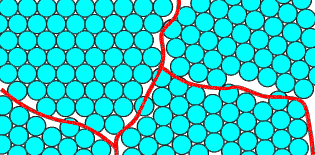
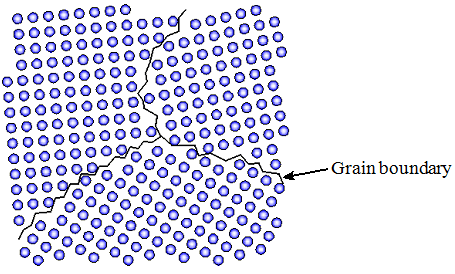
One of the most fundamental properties of crystals is their periodic structure. However, because of the sheer complexity of the physical universe, a perfect specimen is very rare to obtain. Specifically, the smooth periodicity is often disrupted, and the molecules of crystals will be forced into different grains going in different directions. Because these objects are so common, materials scientists and engineers have decided to term these crystals polycrystals. This interlocking nature makes polycrystals stronger than their monocrystalline counterparts as well as more heat resistant.

Crystal defects

Crystal defects

Crystal defects

02/18/17

“How do we classify imperfections in crystals?”


Ideal crystals never exist. For every material arrangement out there, there exists some form of a defect within its structure. Specifically, there will be some form of irregularity through its patterned nature called a crystal defect.These defects can be classified into three distinct types: Point defects (when a single atom in the crystalline lattice is placed out of order), Linear defects (when atom groups are found to be erroneous), and planar defects (two-dimensional errors which include grain boundaries and other mishaps that occur between boundaries in a material). The word defect is actually a misnomer since these phenomena can actually strengthen the properties of a material

Grain boundaries

Grain boundaries

Grain boundaries

02/17/17

“What happens when multiple grains in a crystal collide?”
Polycrystalline materials have grains that flow in numerous different directions. However, to make a continuous object, these grains must coalesce with one another. So what exactly happens at this grain boundary? Well, believe it or not, these grain boundaries actually cause the strength of the material to increase! The reasoning for this is that fragmentation along a material occurs across a row in a crystalline grain, so anything that limits this row will act as a dampener to the system.

Crystal grain

Crystal grain

Crystal grain

02/16/17

“How do we describe when crystals have arrangements in different directions?”
Crystals are fantastic structures, with millions of different molecules being chained together in a uniform pattern. However, sometimes these chains will be in different directions from one another. Because these patterns are so prevalent, Materials scientists and engineers have decided to term this feature in crystals a grain. Grains are a very important property in materials and can have a large influence on the macroscopic behavior of a material

Body centered cubic structure

Body centered cubic structure

Body centered cubic structure

02/15/17

“How are materials such as Tungsten arranged on the molecular level?”
There are countless forms of materials that can be found in the universe. And the reason why these materials are different rests on the geometry of their subatomic arrangement. So let’s take a look at an arrangement called the body centered cubic structure. The atomic arrangement of the body centered cubic structure (commonly referred to as the BCC structure) can be discretized into a chain of cubic divisions. Each cube will contain two atoms, one in the center and ⅛ of another at each corner, giving this a packaging factor of 0.68. Because of this arrangement, materials that use a BCC structure such as tungsten and chromium are typically harder and less malleable than the average atomic arrangement.