Category: Engineering

Atomic packing factor

Atomic packing factor

Atomic packing factor

02/14/17

“How can we quantify how much of a crystal structure is occupied by its particles?”
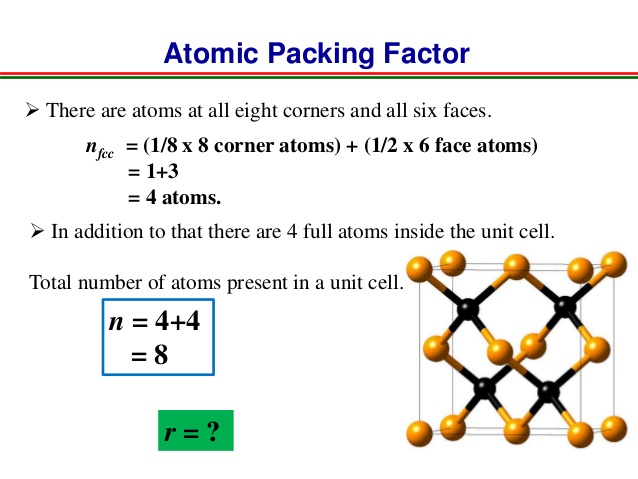
When working with crystals, it can be easy to forget that the entire volume of the structure is not occupied by its constituent particle. Because of this, it can be useful to quantify how much space is actually filled with material. After years and years of hard work and careful research, Materials Scientists have come up with a conceptual tool called an atomic packing factor. The atomic packing factor is calculated by taking the total number of particles in a crystal volume, multiplying it by their volumes and then dividing it by the total volume. This relationship can be quantitatively organized using the equation APF = (Number of atoms *Volume of atoms )/Volume of crystal. This procedure is useful for research in sustainable energy, as one would be able to analyze the properties of different types of photovoltaic crystals for solar panels.
Radius of gyration

Radius of gyration

Radius of gyration

02/13/17

“What would happen if we were to take the entirety of the object’s mass and concentrate it at a point?”
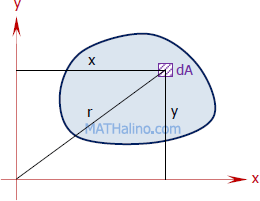
During one’s study of statics, one will have to work with the mass and moment of inertia for objects. However, could there be any ways in which we could simplify our calculations just a tad bit? Well, let’s think about it. Everything could be much simpler if we were to take the mass of the object and concentrate it at a single point away from the axis so that the resultant moment of inertia would be equivalent to original moment of inertia? This is the fundamental idea behind a concept known as the radius of gyration, and can be found with the equation k=Im, with k being the radius, I being the moment of inertia, and m being the mass.

Nuclear power generation

Nuclear power generation

Nuclear power generation

02/12/17

“How exactly is Nuclear power generated?”
We hear about nuclear power very frequently in our lives. However, how exactly does it work? Well, to start let’s look at the process. The fundamentals of nuclear power start with two elements, uranium-238 and uranium 235. U238 composes the majority of uranium in a nuclear power plant, but perhaps the most important of the two is u235. Uranium 235 is very unstable and will decompose rapidly through nuclear fission. When U235 decomposes, it’s neutrons will be thrust throughout space. When these neutrons collide with U238, the element will be shattered into a stream of different particles, which will hit other elements. This quickly sets up a chain reaction which produces a large amount of heat. This heat is then used to boil water to generate steam to move a turbine which generates electricity.

A new way to power rural communities

A new way to power rural communities

A new way to power rural communities

02/10/17

“How is Nigeria combating climate change and rural poverty in a most ingenious way?”
Nigeria is a country in western Africa which is home to nearly one hundred million people without electricity. In addition, because of it’s geographic location, it will be disproportionately affected by climate change. Luckily, this country is not a complacent one, and has already begun fighting back. A company called Lumos based in the Netherlands has developed a “micro micro grid” for the Nigerian market in which a single 80W solar panel will be attached to a housing unit which provides energy to a suitcase size battery which will power a home. These units have an upfront cost of only $75.00, and the electricity can be paid for using simple mobile phone text. after four years of using a model, the users will no longer have to pay for ongoing electricity use! This technology has the potential to electrify millions of rural homes in a safe and sustainable manner.

The wind turbines on the Eiffel tower

The wind turbines on the Eiffel tower

The wind turbines on the Eiffel tower

02/09/17

“Is renewable energy becoming so popular that even the Eiffel tower is starting to use it?”
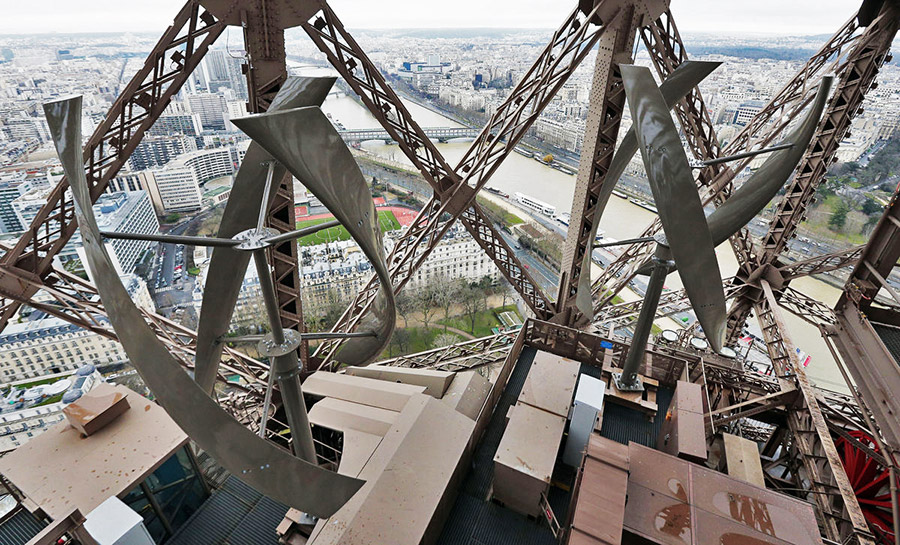
Interest in renewable energy is skyrocketing around the world. Investors have taken note that prices have fallen so low in many areas that renewables are now cheaper than their pollutive non-renewable counterparts. In fact, renewable energy is becoming so popular that even national monuments are starting to use them. As of 2015, The Eiffel tower in Paris, France has become outfitted with two wind turbines to increase power generation. These turbines utilize a vertical axis design that is 5.2 meters in height and 3.2 meters in width which can be expected to produce 10,000 kilowatt-hours of electricity per year!

Overhead power lines

Overhead power lines

Overhead power lines

02/08/17

“What structures are put in place to transmit electricity along long distances?”
Human civilization in its present form has a tremendous energy requirement to sustain itself, which is provided through the use of complex energy generation systems. However, such infrastructure tends to be placed a large distance away from inhabitation, so how can we transfer the generated energy safely into where humans need them? Well, we can accomplish such a task through the use of overhead power lines. Overhead power lines are constructed by using one or more conducting lines being suspended through strong mechanical beams. These conducting lines will be able to safely insulate from the external world and transfer it to other locations, while the beams will be able to support the weight. Overhead power lines are a cost effective way to distribute energy and are used around the world from the mountains of California to the streets of Istanbul.

Concentrated solar power

Concentrated solar power

Concentrated solar power

02/06/17

“Is there a way to generate solar power without using photovoltaics?”


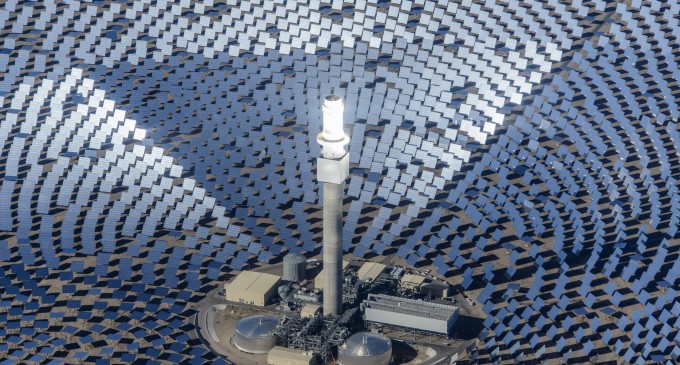
Solar PV systems are one of the most ingenious gifts that technologists have bestowed upon humanity. However, engineers are a rather creative people and like to do the same thing in multiple ways. So how can we “re-invent the wheel” when it comes to solar power? Well, we know that the sun produces sun rays. And if we focus these sun rays onto a focal point, then a large amount of energy can be transferred to an object that point. So what if we were to take a large array of concave lenses, focus all of the sunlight onto a source of water, and use the resulting energy to turn said water into steam to drive a turbine that generates electricity? This is the operating principle behind a system known as concentrated solar power and is commonly used in highly irradiated areas such as California, Spain, and South Africa.

Dual rotor wind turbines

Dual rotor wind turbines

Dual rotor wind turbines

02/04/17

“Could we make wind turbines more efficient by adding a second rotor?”
       The wind turbine is one of the finest inventions that humanity has conjured. It is simply amazing how these machines can take in the kinetic energy of the wind and transfer it into power to be used by humans. However, the designs of these machines often come with a problem. The rotor of the turbine, one of the most important components of the device, disrupts the surrounding wind, inducing turbulence and lowering the amount of energy to be obtained. So how could we use our engineering mindsets to solves this problem? Well, Aerospace Engineers Anupam Sharma and Hui Hu of Iowa State University made a thorough investigation on this problem, and discovered that one way to solve this problem is actually to add a second rotor to the turbine! This would not only increase the amount of energy absorbed, but also prevent much of the unwanted turbulence. This team is currently working on optimizing the design, such as the location of the turbine, the direction it should take, the size, and what kind of airfoil the dual rotor wind turbine should have.

Transistors

Transistors

Transistors

02/03/17

“How can we apply our knowledge of semiconductors to create electronic switches?”


P and N type semiconductors are highly useful devices for creating a controlled electric current. However, how could we apply this technology to create something incredibly useful? Well, let’s use our technical mindset to figure this out. We know that if an N type and a P type were hooked up together and the P type had a higher voltage than the N type,, then a flow of extra electrons from the N type (called the “emitter” would come in to fill the P type (called the “base”). Furthermore, if there was an another N-type (called the “receiver”) electron on the other side of the P-type that was even more positively charged, then we would be able to not only have an electron flow but be able to control the amount of current flowing. However, our only problem is that this operation can only take place if both the base and the receiver had a positive voltage. This can be easily fixed through applying a positive voltage to the base, allowing not only for a current to take place but control of the current and voltage to happen as well, effectively making a switch with no moving parts! This is the foundation of an electronic component known as the transistor, and is what allowed for the modern computer revolution to have taken place!