Category: Engineering

Remote Terminal Units

Remote Terminal Units

Remote Terminal Units

01/04/17

“How can we implement a distributed control system?”


Distributed Control Systems are famous for their ability to transmit data and control the physical world over distant ranges. However, how exactly can we implement these systems in real life, without making the components too expensive? Well, let’s use our scientific mindset to find out. We know that microcontrollers can send and receive information on a rapid basis. And these microcontrollers can then connect to one another to form a greater network. So what if we were to simply use these microcontrollers as the interface for distributed control systems? Well, these special microcontrollers are called Remote Terminal Units.  Remote Terminal Units can be likened to the tentacles of an octopus, each a separate part of a grander control system.

How Local Wildlife Can Affect a Building’s Power

How Local Wildlife Can Affect a Building’s Power

How Local Wildlife Can Affect a Building’s Power

01/03/18

“How can a building’s energy be shut down by a little critter?”


Something very interesting happened at my school today. A little squirrel found its way into the central power line and decided to have a nibble on the insulation cord. Soon enough, (s)he had destroyed the connection, knocking out power to the entire university, even the cogeneration facilities! I think that this little event illustrates how local wildlife can affect a building’s power systems. To guard against such an event, construction managers add further insulation from the external world or apply animal repellent in the wires. If such an event does happen, then local generators, batteries, or solar panels can be placed to allow for backup power

BACnet

BACnet

BACnet

01/02/17

“What is the communications protocol for building automation systems?”


Building automation systems are amazing for optimizing building energy systems. However, in order to operate, they need their own communications protocol. So how can we use our engineering mindset to solve this problem? Well, after many years of research, the good engineers of ASHRAE have been able to develop a protocol known as BACnet. BACnet stands for Building Automation and Control network and is the standard for all BAS systems.

Zone Valves

Zone Valves

Zone Valves

01/01/18

“How can we control fluid flow in a hydronic heating system?”


Hydronic heating systems are famous for their use of liquids to control heating. And many of these systems are taken further by dividing the volumes they cool into multiple zones to keep multiple areas at different temperatures. However, how can we actually implement this? Well, we can accomplish this using a little piece of technology known as a zone valve. Zone valves can regulate the flow of water into multiple areas, allowing for a truly zoned system.

Night-Sky Cooling Systems

Night-Sky Cooling Systems

Night-Sky Cooling Systems

12/31/17

“How can we use the nighttime chill to cool a building?”


Traditional HVAC systems have brought wonders to human civilization, but sometimes as engineers we would like to reinvent the wheel. To begin, everyone knows that the nighttime has its own coolness. So what if we were to take advantage of this by applying a liquid coating to the roof of a building, let the night chill cool it down, funnel it through gutters to a thermal storage, and then use it through the day? Well, this is the fundamental idea behind Night-Sky Cooling Systems. This method offers a low infrastructure low-cost, and low-energy alternative to traditional HVAC systems. That being said, Night-Sky Cooling Systems also consume large amounts of water and are heavily dependent on a cool night sky to keep them running.

Cams

Cams

Cams

12/30/17

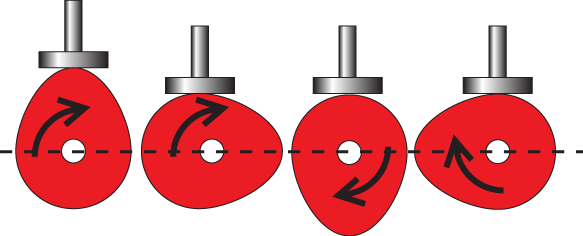
“How can we transform rotary motion into linear motion?”


Generating rotary motion from something like an engine can be very simple. However, what if want to have periodic linear motion? Well, let’s use our engineering mindset to figure this out. What if, we were to make a simple linkage that would allow for a connection between rotary and linear motion? Well, this machine is known as a cam and can be found in all sorts of devices, one of the most famous being the internal combustion engine.

Ventilation

Ventilation

Ventilation

12/29/17

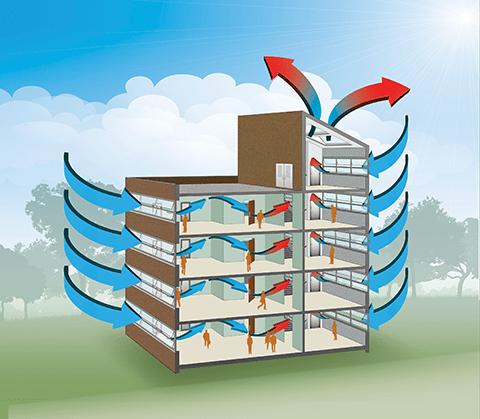
“How can we keep a building’s air fresh?”


Buildings are great for enclosing an interior space. However, if there is no contact with the outside, then the air inside will become trapped and polluted. So how can we make sure that fresh air is continually supplied without overcooling the building? Well, we can use something known as ventilation, that allows some air to pass in and some to pass out, creating a continuous cycling of air. Ventilation is a fundamental part of the built environment and has become of the most important standards.

Thermal Efficiency

Thermal Efficiency

Thermal Efficiency

12/28/17

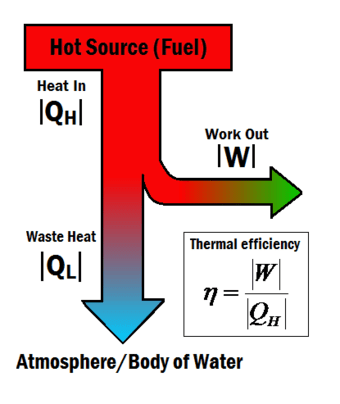
“How can we calculate the efficiency of a heat engine?”


Heat Engines are one of the most widely used technologies today, being used in applications from automobiles to trains. However, our purchase of any model will be guided by the efficiency we want. So how can we measure this quantity? Well, we know that a heat engine works by taking in and putting out heat. And we also know that because of the second law of thermodynamics, some of this input heat will be converted to useful work. So what if we were to simply take the ratio of the output work and input heat (w_out/q_in) and use this as a quantifier? Well, this value is known as the Thermal Efficiency and is one of the most vital concepts of thermodynamics.

Building Automation Systems

Building Automation Systems

Building Automation Systems

12/27/17

“How can we make an intelligent building?”


With the advent of the internet of things, automation has become a very trendy topic. Due to its generalized nature, it can be applied to almost anything. And buildings are no exception. Building Automation Systems are computerized networks that take input from temperature, pressure, and humidity sensors to actualize adjust internal settings in the building,. This includes adjusting the HVAC setpoints and air handler settings. Building Automation Systems are often referred to as smart buildings and can pave the way to the future in energy efficiency.