Category: Chemistry

Crystal defects

Crystal defects

Crystal defects

02/18/17

“How do we classify imperfections in crystals?”


Ideal crystals never exist. For every material arrangement out there, there exists some form of a defect within its structure. Specifically, there will be some form of irregularity through its patterned nature called a crystal defect.These defects can be classified into three distinct types: Point defects (when a single atom in the crystalline lattice is placed out of order), Linear defects (when atom groups are found to be erroneous), and planar defects (two-dimensional errors which include grain boundaries and other mishaps that occur between boundaries in a material). The word defect is actually a misnomer since these phenomena can actually strengthen the properties of a material

Grain boundaries

Grain boundaries

Grain boundaries

02/17/17

“What happens when multiple grains in a crystal collide?”
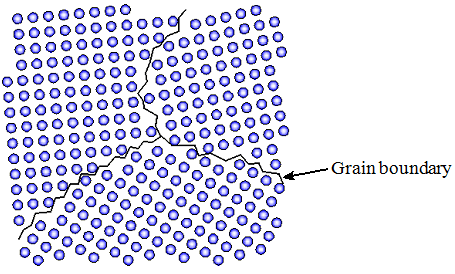
Polycrystalline materials have grains that flow in numerous different directions. However, to make a continuous object, these grains must coalesce with one another. So what exactly happens at this grain boundary? Well, believe it or not, these grain boundaries actually cause the strength of the material to increase! The reasoning for this is that fragmentation along a material occurs across a row in a crystalline grain, so anything that limits this row will act as a dampener to the system.

Crystal grain

Crystal grain

Crystal grain

02/16/17

“How do we describe when crystals have arrangements in different directions?”
Crystals are fantastic structures, with millions of different molecules being chained together in a uniform pattern. However, sometimes these chains will be in different directions from one another. Because these patterns are so prevalent, Materials scientists and engineers have decided to term this feature in crystals a grain. Grains are a very important property in materials and can have a large influence on the macroscopic behavior of a material

Body centered cubic structure

Body centered cubic structure

Body centered cubic structure

02/15/17

“How are materials such as Tungsten arranged on the molecular level?”
There are countless forms of materials that can be found in the universe. And the reason why these materials are different rests on the geometry of their subatomic arrangement. So let’s take a look at an arrangement called the body centered cubic structure. The atomic arrangement of the body centered cubic structure (commonly referred to as the BCC structure) can be discretized into a chain of cubic divisions. Each cube will contain two atoms, one in the center and ⅛ of another at each corner, giving this a packaging factor of 0.68. Because of this arrangement, materials that use a BCC structure such as tungsten and chromium are typically harder and less malleable than the average atomic arrangement.

Atomic packing factor

Atomic packing factor

Atomic packing factor

02/14/17

“How can we quantify how much of a crystal structure is occupied by its particles?”
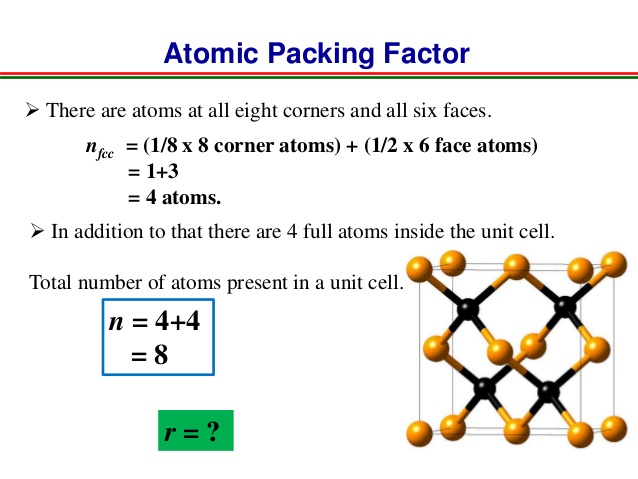
When working with crystals, it can be easy to forget that the entire volume of the structure is not occupied by its constituent particle. Because of this, it can be useful to quantify how much space is actually filled with material. After years and years of hard work and careful research, Materials Scientists have come up with a conceptual tool called an atomic packing factor. The atomic packing factor is calculated by taking the total number of particles in a crystal volume, multiplying it by their volumes and then dividing it by the total volume. This relationship can be quantitatively organized using the equation APF = (Number of atoms *Volume of atoms )/Volume of crystal. This procedure is useful for research in sustainable energy, as one would be able to analyze the properties of different types of photovoltaic crystals for solar panels.

Nuclear power generation

Nuclear power generation

Nuclear power generation

02/12/17

“How exactly is Nuclear power generated?”
We hear about nuclear power very frequently in our lives. However, how exactly does it work? Well, to start let’s look at the process. The fundamentals of nuclear power start with two elements, uranium-238 and uranium 235. U238 composes the majority of uranium in a nuclear power plant, but perhaps the most important of the two is u235. Uranium 235 is very unstable and will decompose rapidly through nuclear fission. When U235 decomposes, it’s neutrons will be thrust throughout space. When these neutrons collide with U238, the element will be shattered into a stream of different particles, which will hit other elements. This quickly sets up a chain reaction which produces a large amount of heat. This heat is then used to boil water to generate steam to move a turbine which generates electricity.

P and N-type semiconductors

P and N-type semiconductors

N-type semiconductors

02/02/17

“What are the fundamentals of the fundamentals of solar cells?”
Solar cells are one of the most magnificent devices that humanity has conjured. However, what exactly makes them tick? To find out, let’s go take a look. If one were to analyze a solar cell with a magnifying glass so powerful that it could see in the microscopic level then we would find a multitude of small, three terminal devices. These devices are known as Transistors and have very special properties. Specifically, it can work as a switch without moving parts! However, before we understand transistors, we must understand what cause them to work. Half of the composition of transistors are composed of objects known as P-type and N-type semiconductors. P-type semiconductors hold an impurity of boron[B], which holds one less electron than silicon, while N-type semiconductors are  have a small impurity of phosphorous [P], which holds an extra electron than silicon. When combined, these semiconductors will have more mobile charges and can conduct current better.

Hydrogen fuel cells

Hydrogen fuel cells

Hydrogen fuel cells

01/20/17

“Is it possible to extract the energy from fuels without an internal combustion engine?”


Fuels are tremendously useful substances for portable energy storage. However, extracting said energy from them is typically a highly pollutive process. But instead of disposing of this technology altogether, could it be possible that we could use our engineering mindsets to create a pollutive free fuel extractive technology? Well, let’s think about it. We know that fuels are typically rich in hydrogen [H2] gas, and we know that the surrounding atmosphere (at least on earth) is filled with a copious amount of oxygen [O2] gas. Furthermore, hydrogen in its ionized state has a positive charge and oxygen has a negative one, and that a current can be created if positive and negative charged states were connected together in a circuit. So what if we were to create a contraption that would separate the hydrogen gas into hydrogen ions and the oxygen gas into oxygen ions, funnel the extra electrons from the hydrogen side into the negative oxygen side, and finally combine then dispose of the surplus hydrogen and oxygen by combining them into water and flushing them out? This is the exact operating principle behind hydrogen fuel cell technology. Hydrogen fuel cells are typically implemented in automobiles and their demand growing at an exponential rate, with a 65% increases in sales from 2014-2015

However, one must be cautious when using this technology. Because all fuels will be composed of more than hydrogen gas, those chemicals will be released as well, inducing pollution. In addition, these impurities can cause short circuiting. Since we all aspire to be scientific thinkers, we must be remember to be cautious of any new breakthroughs.

Solar fuels

Solar fuels

Solar fuels

12/30/16

“How can we turn solar energy into fuel?”


If humanity wants to survive in the not too distant future, then it must become more reliant on renewable technologies such as solar energy. However, one serious drawback to solar energy when compared to traditional fuel sources is what I like to call its nature-dependent nature, or the fact we can not generate solar power at our will, we need an extraneous phenomenon (the sun being present) to do so. This has lead researchers all over the world to dedicate their careers to building new ways of storing solar energy for later use. One new method of doing so has the potential to seriously challenge traditional fuel source by imitating photosynthesis. This method works by using simple chemistry. Hydrogen gas [H2] and carbon monoxide [CO] can be combined together to create fuel sources. The sun can also be used to change water[H2O] and carbon dioxide [CO2] into hydrogen gas and carbon monoxide. Now let’s put this knowledge into practice. First, let’s build a space containing water and carbon dioxide. Then, let’s use concentrated sunlight to heat up these compounds until they lose their oxygen atoms and become hydrogen gas and carbon monoxide. We can then combine these two chemicals to create a new fuel, solar fuels. Solar fuels relieve stress from the grid and allow for simple integration and consumption any sort of machine, whether it be a small motorcycle or a titanic aircraft carrier.