Author: Isaac Gendler

Chemical precipitation

Chemical precipitation

Chemical precipitation

09/16/16

“Why does a solid sometime forms when you mix two chemicals?”


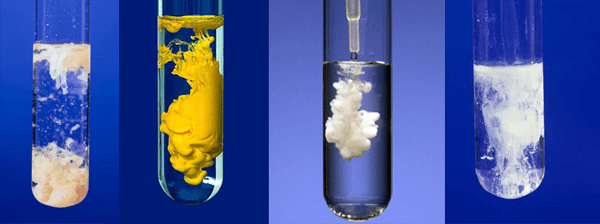
Have you ever wondered why sometimes when you mix two aqueous solutions together, a solid will sometimes form? Well, the explanation for this very simple. When two aqueous solutions mix, their atoms will dissociate and recombine into new chemicals. Sometimes one of the products might be insoluble, meaning that it will not be dispersed into the surrounding substance. As a result, a solid will form. Chemical precipitations are a very common phenomena, for example, did you know that kidney stones are actually the results of chemical precipitation, and also pipe clogging?

Clamps

Clamps

Clamps

09/15/16

“How can we use a simple tool to prevent two objects from separating?”


When doing engineering work, holding two discrete objects together might be a necessity. There are many ways to accomplish this, but how can one do it using a simple mechanical device? Well, luckily for us, engineers have already devised a tool known as a clamp. To make a clamp, simply create a solid “c” shape part, then drill a hole through the bottom curve, and then put an adjustable screw through the hole. If you put an object through the air gap of the “C” shape, and then adjust the screw to touch the object, you can apply enough pressure to entrap it in place.

Tidal locking

Tidal locking

Tidal locking

09/14/16

“How can one face of a celestial object always face the same side of the object that it is orbiting?”


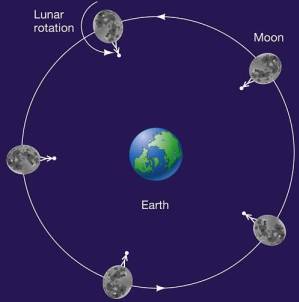
We all know that objects in space revolve around other objects. The moon revolves around the Earth, the Earth around the sun, and the sun around the center of the galaxy. These objects also usually have their own spin. For example, this spin gives rise to the days and nights on Earth. But what if an object’s rotation was in sync with it’s orbit, so that one side always faced the object it was orbiting? Well, not only is this phenomena possible, but it is also happening in our very own backyard, with our very own moon exhibiting this! When the moon revolves around the Earth, the gravity from our planet will cause the moon’s shape to be slightly from solid tides making the moon distorted to give it an almost (American) football shape to it. This distortion means that there will alway be a portion of the moon closer to the Earth then the rest, which results in that side experiencing a greater force being “hooked” to the Earth, causing it to stay on one side. Astronomers and Astrophysicists have termed this phenomena tidal locking as a result of the solid-tide induced locking on the moon.


Equivalent forces

Equivalent forces

Equivalent forces

09/13/16

“How can we simplify force diagrams?”


When working in physics or engineering, we all have to work with forces. Sometimes, we will have a multitude of forces, all going in different direction. However, how could we simplify all of these different elements of a problem to get the big picture and streamline our solution process? Well, let’s think about it. First we should think of our objective, and that is to see what happens when all of these forces are combined. So how about we take the components of each of the separate forces and moments, add them together, and find the equivalent force for all of these values? For example, let’s suppose that we had a bar of length 6 meters, with one force of 20 acting on the far left from the top and another one of 20 newtons acting at the far right coming in from the bottom. When we do all of the calculations, the equivalent force in the x direction will be 0 Newtons (Since none of the forces have an x component), The net force in the y direction will be 0 Newtons (since both forces are going in opposite directions, they will subtract each other) and the net moment will be 135 N-m (Since they are both in the same moment direction, 3m*20N+3m*25N=135N-m). With the use of equivalent forces, we can analyze an unlimited amount of problems, ranging from structural engineering to electrodynamics

Strong and weak acids and bases

Strong and weak acids and bases

Strong and weak acids and bases

09/12/16

“How do different types of acids and bases dissolve in water?”


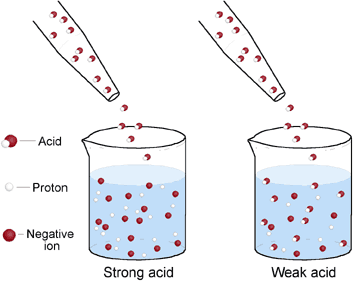
Acids and bases are like two sides of the same coin, the former have too much hydrogen anions, while the former have too much oxalate cations. When some of these substances are poured into water, the acids will ionize (decompose) and the base will disassociate (decompose). However, these compounds do not always dissolve in the same way. Some of them completely dissolve, while some of them will only partially dissolve. When an acid/base fully decomposes, it is called a strong acid. Strong acids and bases produce a lot of electrolytes, which makes the resulting solution especially conductive. The 6 strong acids include Hydrochloric acid [HCl], Hydrobromic acid [Hbr], Hydroiodic acid [HI], Nitrous acid [HNO3], Chloric acid [HClO3], Perchloric acid [HClO4], and Sulfuric acid [H2SO4]. By contrast, acids that only partially dissolve are called weak acids/bases. Since only part of the weak acids and bases decompose, the solutions are not especially conductive. Therefore, the difference between the two types are just about how much they dissolve.

Circumstellar habitable zone

Circumstellar habitable zone

Circumstellar habitable zone

Isaac Gendler


“What is the area around a sun in which a planet can sustain life?”

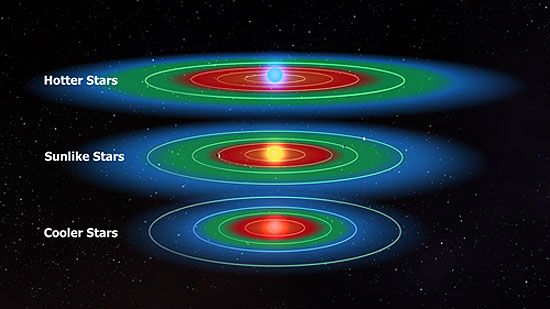
Ever since humanity first looked to the stars, we have dreamed about inhabiting other worlds. But to our dismay, ever since the beginning of surface readings of the other planets inhabiting our solar system, we have found that the sufficient conditions for complex life are truly rare indeed. However, with the recent and exponential discovery of exoplanets, this dream might become a possibility again. And one of the first steps we must take is to find at what range around a star can a planet support life. To solve this question, we must think about what is the primary source of complex life. After much debate, scientists have decided that liquid water is such as source. So for a planet to be habitable, it must be far enough from the sun to not have it’s water boil up, but not far enough to have it’s reservoirs freeze up either. The range is represented as a torus around the sun, and the size is contingent on how much energy a sun gives off, so if a sun gives off only a small amount of energy, it’s radius will be smaller, and if it gives off a lot, it’s radius will be higher. Astronomers and astrophysicists have termed this phenomena the circumstellar habitable zone. Given the right amount of atmospheric pressure and range from the sun, liquid water is possible for life on another plant.

Proxima B

Proxima B

Proxima B

09/10/16

“Is one of our nearest rocky planet habitable?”


A discovery has been made that is possibly so great that it can change the course of humanity forever. Or not. A new planet has been discovered in Proxima centauri (the nearest solar system to ours) only 4.2 light years away from us called Proxima B. We already know a few things about Proxima B, specifically has a mass that is just over a third greater than the Earth’s, it is only slightly more than seven million kilometers away from the star that it orbits, and is tidally locked (meaning one face of the planet will always be facing the star). But more importantly, this planet falls within the habitable zone of it’s star, which means that this planet has temperatures in the range  that is “just right” to host liquid water.

However, there are many factors of this planet that might just burst our bubble. First of all, we have no idea what the atmosphere of proxima B is composed of. In fact, for all we know, it could be completely toxic! Also, since the host star of Proxima B is a red dwarf, the habitable zone for the distance for the habitable zone of this planet is merely 5% of our own. This means that Proxima B is extremely close to it’s orbiting sun. So close in fact that the time for a single year to go by is merely 11 Earth days, and since red dwarfs can be very volatile, there is a strong possibility of unpredictable flairs from the planet.

Proxima B is a perfect example of why as a scientific thinker one must express excitement yet restraint when hearing possibly paradigm shifting news, since we must not bee to short-sighted to observe that such news could be false, yet not too cynical to take joy in the wonder and mystery of the universe.
Hydrothermal vents

Hydrothermal vents

Hydrothermal vents

9/09/16

“What are some geographic anomalies near underwater volcanoes?”
Underwater volcanoes are quite fascinating structures, but does the presence of these mechanisms cause the creation of other alien-like structures? Well, it turns out to be true. If you were to look at underwater volcanoes near spreading ridges and convergent plate boundaries, then you will find a very interesting series of structures known as hydrothermal vents. Hydrothermal vents are fissures in a planet’s surface that are produced when hot magma from the underwater volcanoes meet the near freezing seawater and reemerges from the surface. The seawater produced by hydrothermal vents can reach temperatures of over 700 degrees Fahrenheit! These unique conditions of hydrothermal vents are actually the living space for many communities of extremophiles. Hydrothermal vents are actually a unique discovery, being found only less than 40 years ago.

Underwater volcanoes

Underwater volcanoes

Underwater volcanoes

09/08/16

“Are there such things as underwater volcanoes?”

Volcanoes are some of the most bewildering natural structures of the earth. They’re big, they’re ominous, and most importantly they spout lava. But is there an underwater equivalent to them? Well, not only do these structures exist, but the vast majority of volcanoes are actually beneath the ocean! The reason for this is that volcanoes form near tectonic plate boundaries, and since most of these plate boundaries are in the ocean, the plurality of volcanoes end up being underwater volcanoes. In fact, underwater volcanoes make up such a high proportion that around 75 percent of all magma deposited is done by underwater volcanoes!  Most of these structures occur in a belt that wraps around the pacific ocean known as the “Ring of fire”.