Month: September 2016

Strong and weak acids and bases

Strong and weak acids and bases

Strong and weak acids and bases

09/12/16

“How do different types of acids and bases dissolve in water?”


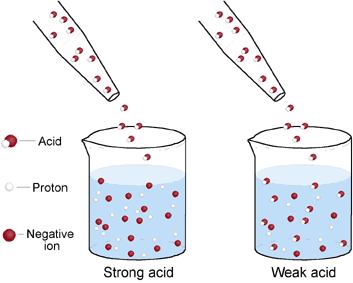
Acids and bases are like two sides of the same coin, the former have too much hydrogen anions, while the former have too much oxalate cations. When some of these substances are poured into water, the acids will ionize (decompose) and the base will disassociate (decompose). However, these compounds do not always dissolve in the same way. Some of them completely dissolve, while some of them will only partially dissolve. When an acid/base fully decomposes, it is called a strong acid. Strong acids and bases produce a lot of electrolytes, which makes the resulting solution especially conductive. The 6 strong acids include Hydrochloric acid [HCl], Hydrobromic acid [Hbr], Hydroiodic acid [HI], Nitrous acid [HNO3], Chloric acid [HClO3], Perchloric acid [HClO4], and Sulfuric acid [H2SO4]. By contrast, acids that only partially dissolve are called weak acids/bases. Since only part of the weak acids and bases decompose, the solutions are not especially conductive. Therefore, the difference between the two types are just about how much they dissolve.

Circumstellar habitable zone

Circumstellar habitable zone

Circumstellar habitable zone

Isaac Gendler


“What is the area around a sun in which a planet can sustain life?”

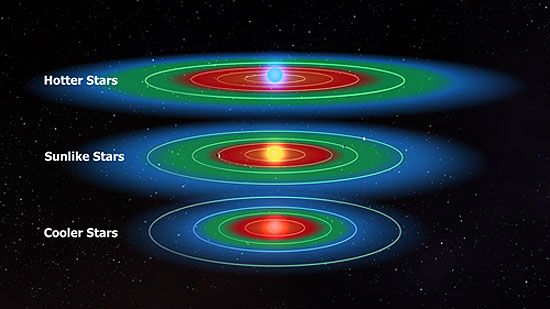
Ever since humanity first looked to the stars, we have dreamed about inhabiting other worlds. But to our dismay, ever since the beginning of surface readings of the other planets inhabiting our solar system, we have found that the sufficient conditions for complex life are truly rare indeed. However, with the recent and exponential discovery of exoplanets, this dream might become a possibility again. And one of the first steps we must take is to find at what range around a star can a planet support life. To solve this question, we must think about what is the primary source of complex life. After much debate, scientists have decided that liquid water is such as source. So for a planet to be habitable, it must be far enough from the sun to not have it’s water boil up, but not far enough to have it’s reservoirs freeze up either. The range is represented as a torus around the sun, and the size is contingent on how much energy a sun gives off, so if a sun gives off only a small amount of energy, it’s radius will be smaller, and if it gives off a lot, it’s radius will be higher. Astronomers and astrophysicists have termed this phenomena the circumstellar habitable zone. Given the right amount of atmospheric pressure and range from the sun, liquid water is possible for life on another plant.

Proxima B

Proxima B

Proxima B

09/10/16

“Is one of our nearest rocky planet habitable?”


A discovery has been made that is possibly so great that it can change the course of humanity forever. Or not. A new planet has been discovered in Proxima centauri (the nearest solar system to ours) only 4.2 light years away from us called Proxima B. We already know a few things about Proxima B, specifically has a mass that is just over a third greater than the Earth’s, it is only slightly more than seven million kilometers away from the star that it orbits, and is tidally locked (meaning one face of the planet will always be facing the star). But more importantly, this planet falls within the habitable zone of it’s star, which means that this planet has temperatures in the range  that is “just right” to host liquid water.

However, there are many factors of this planet that might just burst our bubble. First of all, we have no idea what the atmosphere of proxima B is composed of. In fact, for all we know, it could be completely toxic! Also, since the host star of Proxima B is a red dwarf, the habitable zone for the distance for the habitable zone of this planet is merely 5% of our own. This means that Proxima B is extremely close to it’s orbiting sun. So close in fact that the time for a single year to go by is merely 11 Earth days, and since red dwarfs can be very volatile, there is a strong possibility of unpredictable flairs from the planet.

Proxima B is a perfect example of why as a scientific thinker one must express excitement yet restraint when hearing possibly paradigm shifting news, since we must not bee to short-sighted to observe that such news could be false, yet not too cynical to take joy in the wonder and mystery of the universe.

Hydrothermal vents

Hydrothermal vents

Hydrothermal vents

9/09/16

“What are some geographic anomalies near underwater volcanoes?”
Underwater volcanoes are quite fascinating structures, but does the presence of these mechanisms cause the creation of other alien-like structures? Well, it turns out to be true. If you were to look at underwater volcanoes near spreading ridges and convergent plate boundaries, then you will find a very interesting series of structures known as hydrothermal vents. Hydrothermal vents are fissures in a planet’s surface that are produced when hot magma from the underwater volcanoes meet the near freezing seawater and reemerges from the surface. The seawater produced by hydrothermal vents can reach temperatures of over 700 degrees Fahrenheit! These unique conditions of hydrothermal vents are actually the living space for many communities of extremophiles. Hydrothermal vents are actually a unique discovery, being found only less than 40 years ago.

Underwater volcanoes

Underwater volcanoes

Underwater volcanoes

09/08/16

“Are there such things as underwater volcanoes?”

Volcanoes are some of the most bewildering natural structures of the earth. They’re big, they’re ominous, and most importantly they spout lava. But is there an underwater equivalent to them? Well, not only do these structures exist, but the vast majority of volcanoes are actually beneath the ocean! The reason for this is that volcanoes form near tectonic plate boundaries, and since most of these plate boundaries are in the ocean, the plurality of volcanoes end up being underwater volcanoes. In fact, underwater volcanoes make up such a high proportion that around 75 percent of all magma deposited is done by underwater volcanoes!  Most of these structures occur in a belt that wraps around the pacific ocean known as the “Ring of fire”.

Extremophiles

Extremophiles

Extremophiles

09/07/16

“Are there organisms that can thrive in the most hazardous of environments?”


The extreme has always fascinated humankind. Whether it be extreme sports or extreme beliefs, our brains are wired to love it when the  pre-conceived safety boundaries are pushed beyond recognition. Extreme environments are no exception, with many captivated by the almost alien-like structure of locations such as the bottom of the ocean. Now, in these most extraordinary of places, is it possible for something such as life to exist? Believe it or not, there in fact are. Extremophiles are life-forms that are adapted to exist within the most dangerous of environments, such as hydrothermal vents. In fact, these organisms can even survive in locations with no oxygen! Extremophiles are able to accomplish these feats with the use of a special enzyme called extremozymes. Examples of extremophiles include giant tube worms, which live on the bottom of the pacific ocean floor and withstand high levels of hydrogen sulfide, and water bears, half a millimeter creatures which can survive for 120 years with no food or water and withstand pressure 6 times what is found in the oceans, as well survive in temperatures just above absolute zero.  


Now, to take this idea a step further, if there are numerous creatures out there that can survive in alien-like conditions, could there be creatures that survive on alien worlds? Just think about it


Pulleys and mechanical advantage

Pulleys and mechanical advantage

Pulleys and mechanical advantage

09/06/16

“Is it possible to lift an object with a force that’s less than it’s weight?”


If you ever had to design a system focused on lifting objects, you probably bemoan the fact that if you want to lift a heavy object, you have to use a force that is greater or equal to it’s weight.

Or do you have to?

What if there was some way if we could manipulate the laws of physics, so we could lift an object with a force that is less than it’s weight? Well, let’s think about how we could do this using mechanical advantage.

Let us start with a very simple machine called a pulley. More specifically, we will be starting with a single, fixed pulley. A fixed pulley is a dimply a disk hinged onto an axis in which it is free to revolve around but may not move transitionally. If we were to take a rope and move throw it over the circumference of a pulley, it would reverse the direction of the rope, so we could lift an object while using a downward force instead of an upward force. We still have to use the same force as the weight, but it allows us to change directions.

Now let’s go a step further. What if we were to take that same rope, and make it go under a new pulley, this time a moveable pulley, attach the end of the rope to a ceiling like structure above the pulley, and attach the weight to the moveable pulley. Now the rope will be supporting the pulley on both sides of the object, it can effectively double it’s force value! This means we can now use a force value that is less than the weight of our object to lift it up! You can even create more complex pulley systems to create a greater mechanical advantage. However, there is one major downside to using this setup. Since energy must be conserved, and you are using a smaller force, you must increase the distance you pull your object proportionally to the strength of the force you are using. For example, if you have use a force that is half of the weight, then you will have to pull the rope twice as far, three times as far for a force a third of the weight, and so on. In addition, when we perform these calculations, we assume a massless pulley with no moment of inertia or friction, so there are bound to be some inefficiencies that will require us to use even greater distances

All in all, pulley systems are a testaments of human ingenuity, and are a classical representation of simple yet effective engineering.  
Blood pressure

Blood pressure

Blood pressure

09/05/16

“What is blood pressure?”

When you go for a medical checkup, you will often hear a lot of talk about your “blood pressure”. But what exactly is this phenomena? Well, believe it or not, blood pressure is  actually a very simple concept. Your body is able to maintain it’s operations because the heart pumps blood (which carries oxygen) to all of it’s vital systems. This pumping motion causes blood to be pushed against the walls of your blood vessels, and we can quantify this force as blood pressure. Your blood pressure is usually measured in “millimeters of mercury” (or mmHg), and is given two values (for example, a stable blood pressure is considered to be 120/80 mmHg). But why on Earth will your blood pressure be given two values? Well, let’s think about it. When your heart pumps blood, it does not do so in a constant fashion. Instead, it acts like a piston, with a force changing in a beating nature. So your blood pressure will be the highest at the peak force (termed the systolic blood pressure), and lowest at the bottom (termed the diastolic blood pressure). The higher your blood pressure is, the higher you will have a risk of developing heart heart problems. For example, someone with a blood pressure reading of 135/85 mmHg is twice as likely to receive a heart attack as someone with a blood pressure of 115/75

Reverse osmosis

Reverse osmosis

Reverse osmosis

09/04/16

“How can we use pressure to purify seawater?”

Already humanity is facing a major water problem. As the water reservoirs start to dry up, there will be entire areas with no hydration to speak of. So what is one way we could solve this? Well, how about we look to the most plentiful form of water, the ocean, to solve our problems. Ocean water is normally unusable for humanistic concerns due to it’s salty nature, but what if we were to desalinate it to make it usable?

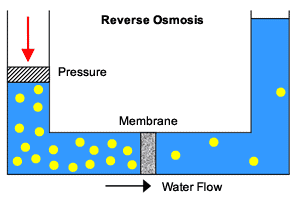
Now that we have the idea, let’s think about how we could make this a reality. Well, first of all, we should notice that salt water probably has other elements in it that are a result from exposure to the rest of the environment, such as seaweed and dead animals parts. These items are usually larger than the molecules of water and salt, so they can be filtered away easily through the use of a permeable layer. We can accomplish this by extracting sea water, and then using pressure to force it through a permeable layer. However, the leftover water will still have a high concentration of salt. But to our luck, it is still possible to separate the salt if we notice one factor, that both water and salt have different evaporation points, and more specifically, water has a lower point of evaporation. So what we can do with this leftover salt water is boil it until the point of evaporation for water, and then pass this steam off into another area, and then cool it until it solidifies again. After all of this, we will finally have ourselves some freshwater! This process is known as reverse osmosis, and plants are currently being used in arid regions such as California, Israel, and Saudi Arabia to create a usable water supply.