Tag: Transportation

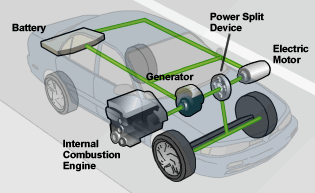
Series/parallel hybrid car drivetrain

Series/parallel hybrid car drivetrain

Series/parallel hybrid car drivetrain

01/11/17

“Can we combine both the series and parallel hybrid car drivetrains?”


Both series and parallel hybrid car drivetrains offer their distinct advantages and disadvantages. The exclusionary principle of the series drivetrain allow for greater efficiency at lower speeds, while the combined efforts model of the parallel drivetrain allow for a smaller battery. However, would it be possible to combine both types in an attempt to have our cake and eat it too? Well, it turns out such a wild idea is indeed possible through the use of a series/parallel hybrid car drivetrain. These drivetrains are set up so that the electric motor and internal combustion engine can operate independently of the condition of the other. This allows for much greater efficiency than either component acting completely discrete or in union. However, these systems will come at a higher cost, making it prohibitive for many individuals to purchases such systems. Perhaps one day, the cost of the systems will plummet to the point that they will threaten to encapsulate the entire market.

Series hybrid car drivetrains

Series hybrid car drivetrains

Series hybrid car drivetrains

01/10/17

“How can we create a more hybrid car drivetrain more efficient for busy traffic?”


Parallel hybrid car drivetrains are wonderful contraptions, but they come with one downside. Much of the efficiency benefits gained from electric vehicle technology are lost during busy “stop and go” traffic, where the internal combustion engine will impinge upon the other components. So how could we get around this problem? Well, let’s use our engineering mindsets to solve this problem. We know that the inefficiencies only come along when the ICE is in use. So what if we were to create a system in which we could control the amount of power that the motor receives from the battery and ICE? Well, it turns out that this concept has already been put into practice as a series hybrid car drivetrain. The operating principle behind these mechanisms is that an onboard computer will measure the speed and acceleration of the vehicle, and use predetermined algorithms to control the power intake of the ICE vs the battery. Due to the larger power requirements, series hybrid car drivetrain systems require a larger battery and motor.


A new way to collect transportation data

A new way to collect transportation data

A new way to collect transportation data

12/22/16

“How can we create a low-cost mobility measurement system?”
Many developing countries have a problem. Data regarding the usage of vehicles needs to be extrapolated in order to create more accurate transportation policies. The current method to obtain such measurements is to use an array of road sensors to track vehicle speeds, whose components cost an average of 10,000 USD per device and maintenance can go up to 4,000 USD per year per device. It goes without saying that this system can be insurmountably expensive for lower-income countries. So how can we use our engineering mindset to create a new, more affordable paradigm for transportation data collection? Well, a group of intrepid researchers at Lawrence Berkeley National Laboratory in California have published a paper regarding such a method. After much analysis, they realized that even though many developing countries such as India may not have the highest quality road infrastructure, they do have a fairly robust mobile communication infrastructure. And what everyday technology uses such infrastructure to transmit data? Why, smartphones of course! So what if we were to use citizen’s smartphones to collect driving data (at their own discretion of course) to create accurate information for policy makers? This is the operating idea behind the research done by the international transportation group at Berkeley lab, and it has the possibility of causing a paradigm shift in transportation analysis